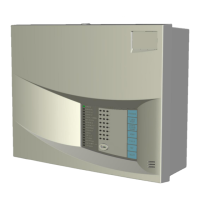
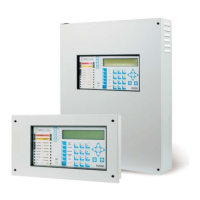
1. Lay the connection cables (refer to “Connecting
Repeaters”).
2. Remove the screws (68) (see Figure 5) and open
the Repeater FC500REP.
3. If you are flush mounting the Repeater, go to step
4. If you are wall mounting the Repeater, drill the
anchor screw holes (66).
4. Pull the wires through the wire entry (67), then,
using the anchor screws, secure the Repeater to
the wall.
5. Complete the connections to the terminal board 73
of the RS485 Interface, as described in the “Con
-
necting Repeaters” section.
- Connect the earth wire to the threaded support
69a on the cover, as illustrated in Figure 5.
P. Description
65 Knockouts for cables ducted externally
66 Holes for cabinet mounting
67 Cable entry for channeled undertrack cables
68 Screws to secure cover
69 Fixing nuts for User Interface on Cover
69
a
Repeater nuts for earth connection
70 User interface Repeater board
71 LED label slot
72 Key label slot
73 Connector for the Repeater RS485 interface
Description of the Terminals
This section describes the Control panel terminals.
n
Loop
LOOP1 Loop 1 terminals:
Ø
+LEFT: Positive signal
Ø
- LEFT: Negative signal (return).
Ø
+RIGHT: Positive signal
Ø
-RIGHT: Negative signal (return).
Ø
-SH: Cable shield terminal.
LOOP2 Loop 2 terminals (as Loop1)
LOOP3 Loop 3 terminals (as Loop1)
+
The three loops of the panel can manage up to 128
addressable devices.
+
The total length of the cables connected to the
three loops must NOT exceed 2000 m.
+
The max current load for the three loops must not
exceed 500 mA +25%.
n
Telephone line
LE Terminals for connecting the external telephone
line.
LI Terminals for connecting the internal telephone line:
connect these terminals to other telephone devices that
need to share the same phone line as the fire panel.
-
Terminal for connecting the earth wire.
n
Fire
[NC][NO][C]
Non-supervised fire output. Dry contact
relay for non-supervised devices.
It is activated, by default, at the entering of the panel in
to the alarm status (first fire event).
The de-activation of the fire output is executed during
the panel reset.
The fire output may be silenced (programmable option;
default=NOT silenceable).
The fire output may be disabled.
The fire output may be programmed to works differently
(only via FCConsole Software).
Ø
During standby status, terminal [C] closes to terminal
[NC];
In the event of fire, terminal [C] closes to terminal [NO].
+
EN54-2 certification applies ONLY when FIRE output
is not C and/or J and/or G (EN 54-1) type. Therefore
this output MUST NOT BE UTILIZED to manage Fire
Alarm devices and/or Fire/Fault transmission devices
and/or Automatic Fire alarm system.
n Fault
[NC][NO][C]
Non-supervised Fault output. Dry con-
tact relay for non-supervised devices.
It is activated at:
Ø
the entering of the panel in to the fault status (first fault
event).
Ø
in the case of Logic fault
Ø
in the case of total loose of the power.
The de-activation of the fault output is executed during
the panel reset.
The fault output may not be silenced.
The fault output may not be disabled.
The fault output may not be programmed to works diffe
-
rently.
Ø
During standby status, terminal [C] closes to terminal
[NC];
Ø
In the event of fault, terminal [C] closes to terminal
[NO].
+
EN54-2 certification applies ONLY when FAULT
output is not J (EN 54-1) type. Therefore this output
MUST NOT BE UTILIZED to manage Fault tran
-
smission devices.
SC1 (Sounder Circuit)
Supervised/Silencea
-
ble/Bypassable (Disabled) Bell output, for the Alarm
signalling devices. Terminals for the connection of devi
-
INSTALLATION 19


 To Next Page