The maximum for all 3 loops is 128 addressable analo
-
gue fire detectors and analogue devices (Input modu
-
les, Output modules).
+
Every detector and module connected to the loops
must be assigned a unique address.
You can use 2 or 4 wires for the loop connections.
NOTE: The loop connection type must be specified du
-
ring the programming phase.
Figure 6 illustrates the 2-wire connection to Loop1.
Figure 8 illustrates the 4-wire connection to Loop2.
+
Whatever the type of connection performed, make
sure that any short circuit or open circuit in the wi
-
ring does not lead to the loss of more than 32 de
-
tectors. An isolator should be fitted at least every
32 detectors.
+
If the connection is 2-wire connection type, addres
-
sable analogue fire detectors and analogue devi
-
ces (Input modules, Output modules)connect on
the left.
+
Use only shielded cable for all connections, with
one end of the shield connected to the SH terminal
of the Control panel and the other left free.
n Connecting Repeater FC500REP
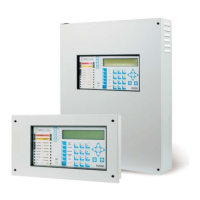
An example of how to connect two FC500REP repea-
ters in Figure 7.
The RS485 port of the FC500 (terminals [M], [+], [-]
and [24V]) accepts up to 4 FC500REP repeaters;
Terminals [+] and [-] supply the power (27.6 V) to the re-
peater panels (see figure 7).
When a mains fault occurs, the Repeaters considerably
decreases the absorbed power, switching off the LCD
display backlighting (the LCD display backlighting swit
-
ches on again, for 20 sec. when a key will be pressed).
But the absorption of the Repeaters connected to the
control panel, will contribute to run down the backup
batteries, and so the decrease of the Stand-by supply
time of the system.
As one control panel only is in the system all the Repea
-
ters must be supplied by the control panel itself, unless
a Power supply Station is in the system.
+
Use only shielded cable, with one end of the shield
connected to the earth terminal of the Control pa
-
nel and the other left free; the continuity, between
several segments of connection must be secured.
n
Connecting Output Devices
The control panel has supervised outputs, NON super
-
vised outputs and 2 Bell outputs.
+
Output devices can be connected to the loops by
means of Output modules.
n
Bell Outputs
The Bell outputs are indicated by the letter SC and their
address number.
+
The SC1, and SC2 Bell Outputs are Supervised,
Silenceable, Bypassable (Disabled) SC2 also Pro
-
grammable.
The Bell outputs can be forced to standby status by me
-
ans of the SILENCE button. Once an alarm has been
acknowledged, you can silence the audible signalling
devices and leave the visual signalling devices active
until the alarm conditions cease.
For example, a connection similar to the wiring diagram
in figure 10 will activate the Flasher, the Bell and the vi-
sual and audible signalling device of the Self-powered
Siren in the event of an alarm.
Using the SILENCE button will stop the horn but not the
flasher, which will continue to signal Alarm status until
the RESET button is pressed.
INSTALLATION 23
L
Main Board
N
Automatic
isolating
switch
+
–
Battery 12 V
Live
Neutral
Earth
230 V
50 Hz
+
–
Battery 12 V
Power Supply
RED wire
BLACK wire
Jumper
Figure 11 Wiring diagram for the power supply


 To Next Page