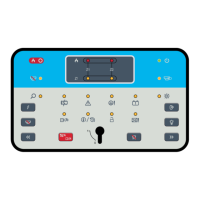
Cursor Keys
No function is related to UP Key;
No function is related to Down Key;
The Right key selects the next available Loop;
The Left key selects the previous available Loop
ESC key : ESC key deletes the procedure and returns
to the previous page;
ENTER The ENTER key accepts the selection and acti
-
vates the corresponding programming page.
Regarding the figure 43, the “selected device” field
shows the currently selected device. The “Add ” field is
used to enter the address of the selected device. The
scroll bar of available devices shows the addresses and
the class of all devices configured in the selected loop.
d087 address of the device (three digits);
class of device: d = detector, m = module.
The scroll can be viewed by using the cursor keys or en
-
tering a device address in the “Add ” field.
+
In case the address entered does not exist, the
scroll bar moves to the next available address.
n
Choose the Device
In this phase:
Alphanumeric keypad Used to enter the address of
the device that has to be selected; if the address do
-
esn’t exist the next device available will be selected.
+
If the device exists, square brackets will appear
dext to the address, but if the entered address does
not exist or is different from the one selected in the
bar below, arrows appear.
Cursor Keys
No function is related to UP or Down Key.
The Right key selects the next available Device.
The Left key selects the previous available Device.
ESC Key
The Esc key deletes the procedure and re-
turns to the previous page.
ENTER Key
The ENTER key accepts the selection
and activates the corresponding programming page.
n
Loop devices programming page
After selecting the Loop and the device, (see the Figure
43) it is possible to program various parameters rele
-
vant to the type of device, see Table 9.
Remote LED After other parameters, it is possible to
enable the activation of programmable Remote LED of
the detectors. The detectors have an output used to dri
-
ve the remote LED. This output was activated only for
detector alarm which it belonged. Now, it will be possi
-
ble to program it to activate for other events, exactly as
it happens for the other panel outputs, as well as for the
detector alarm which it belongs.
+
This option (Remote LED) will be possible to pro
-
gram also on FireClass Console, in the program
-
ming page of the detectors.
Separated programming of the Sounder and Beacon
When one of the following devices is selected:
FC410LPAV (all versions)
FC430LPASB
FC430SAB (with FC430SB),
In addition to those certified EN54-23:
FC410LPS-R/W
FC410LPBS
FC430LPBSB,
in the programming menu, it will be possible to choose
which channel (Sounder or Beacon) to be program
-
med. The User interface will ask the installer, before the
alarm conditions:
"SOUNDER = BEACON"
"yes no"
If the installer chooses "yes", the alarm conditions are
selected (and applied to both channels), otherwise the
channel selection will be displaied (and thus the alarm
conditions are valid for the selected channel).
+
See "PC PROGRAMMING" FireClass Console para-
graph "Output module parameters programming"
50 Addressable Fire Panel FC501
FC501 Panel lev.3: PROGRAM
Master Panel
Enter the SW zone number
I


 To Next Page