GENERAL INFORMATION CU800 Service Manual
19
1.8.11 Hammers
Various types of hammers are available to fit a number of applications. Use a ball-peen hammer to
strike another tool, such as a punch or chisel. Use soft-faced hammers when a metal object must be
struck without damaging it. Never use a metal-faced hammer on suspension components because
damage occurs in most cases.
Always wear eye protection when using hammers. Make sure the hammer face is in good
condition and the handle is not cracked. Select the correct hammer for the job and make sure to strike
the object squarely. Do not use the handle or the side of the hammer to strike an object.
1.9 PRECISION MEASURING TOOLS
The ability to accurately measure components is essential to perform many of the procedures
described in this manual. Equipment is manufactured to close tolerances, and obtaining consistently
accurate measurements is essential to determine which components require replacement or further
service.
Each type of measuring instrument is designed to measure a dimension with a certain degree of
accuracy and within a certain range. When selecting the measuring tool, make sure it is applicable to
the task.
As with all tools, measuring tools provide the best results if cared for properly. Improper use can
damage the tool and cause inaccurate results. If any measurement is questionable, verify the
measurement using another tool. A standard gauge is usually provided with micrometers to check
accuracy and calibrate the tool if necessary.
Precision measurements can vary according to the experience of the person performing the
procedure. Accurate results are only possible if the mechanic possesses a feel for using the tool.
Heavy-handed use of measuring tools produces less accurate results. Hold the tool gently by the
fingertips to easily feel the point at which the tool contacts the object. This feel for the equipment
produces more accurate measurements and reduces the risk of damaging the tool or component.
Refer to the following sections for specific measuring tools.
1.9.1 Dial Indicator
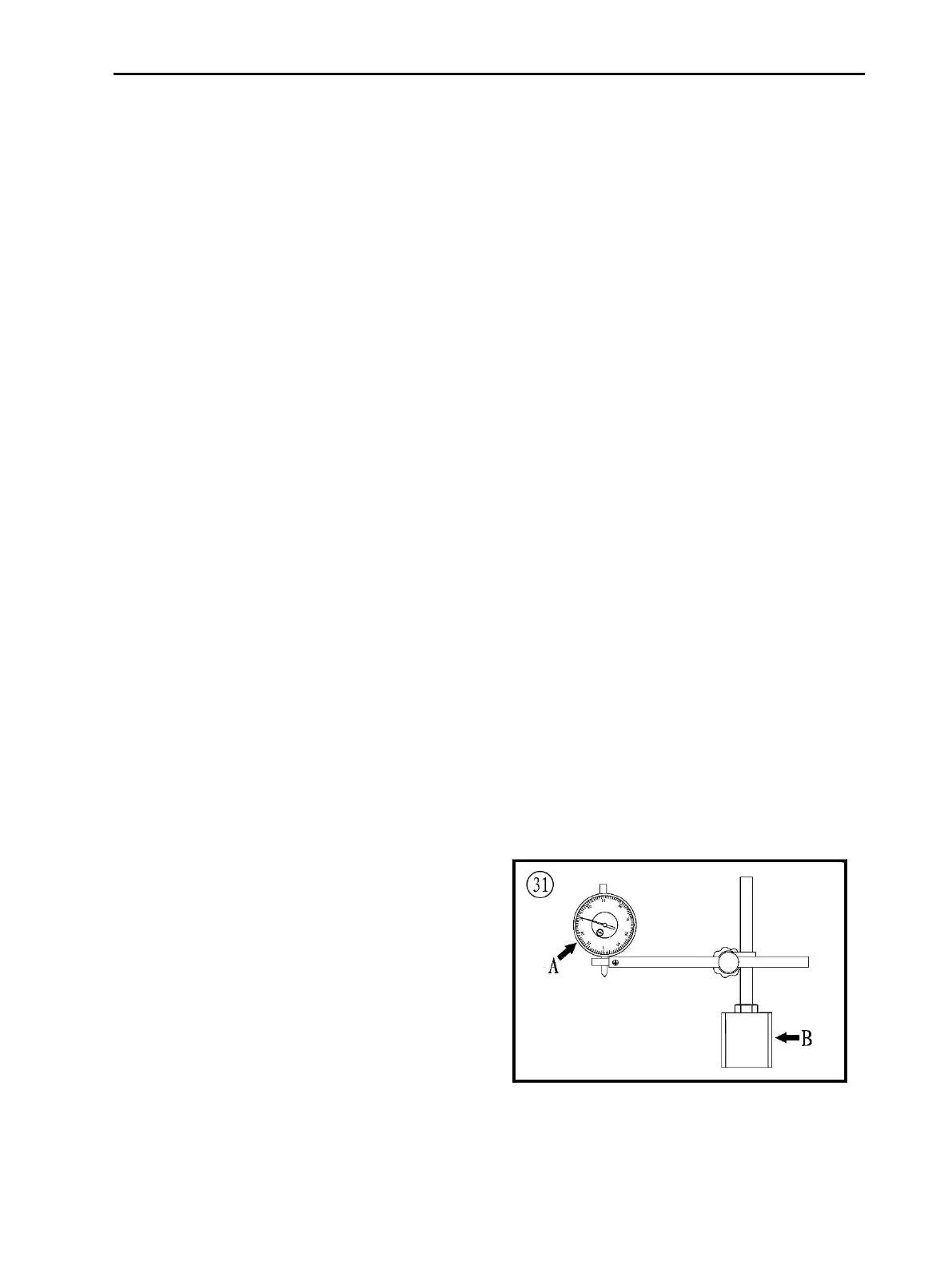
A dial indicator (Figure 31) is a gauge with a
dial face and needle used to measure variations in
dimensions and movements. Measuring brake
rotor run out is a typical use for a dial indicator.
Dial indicators are available in various ranges
and graduations and with three basic types of
mounting bases: magnetic (B. Figure 31). Clamp,
or screw-in stud. When purchasing a dial indicator,
select on with a continuous dial (A. Figure 31).
Cylinder Bore Gauge
1.9.2 Insulation Tester


 To Next Page