GSI Audera Pro User Manual
D-0129360 Rev A Page 20 of 231
INTRODUCTION
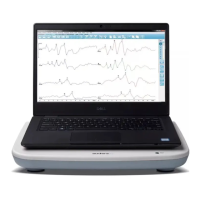
Thank you for purchasing the GSI Audera Pro™ system. GSI Audera Pro can perform all
standard auditory evoked potential tests and, depending on the configuration, auditory
steady state responses and otoacoustic emissions tests.
INDICATIONS FOR USE
The GSI Audera Pro is intended to be used for the stimulation, recording and
measurement of auditory evoked potentials, vestibular evoked myogenic potentials,
auditory steady state responses and otoacoustic emissions. The device is indicated for
use in the evaluation, identification, documentation and diagnosis of auditory and
vestibular disorders. The device is intended to be used on patients of any age.
The GSI Audera Pro is intended to be used by qualified medical personnel such as an
audiologist, physician, hearing healthcare professional, or trained technician. The GSI
Audera Pro is intended to be used in a hospital, clinic, or other healthcare facility with a
suitable quiet testing environment.
The anatomical sites of contact for auditory evoked potential (AEP) testing are the
patient’s ear canal (with the contact object being a sound delivery eartip or headphone,
or an ear probe and personal eartip) and the patient’s scalp and possibly other body
sites (with the contact object being a bone transducer or electrodes that are capable of
measuring bio-potentials). The anatomical sites of contact for vestibular evoked
myogenic potential (VEMP) testing are the patient’s ear canal (with the contact object
being a sound delivery eartip or headphone, or an ear probe and eartip) and the
patient’s head and neck and possibly other body sites (with the contact object being a
bone transducer or electrodes that are capable of measuring bio-potentials). The
anatomical sites of contact for otoacoustic emission (DPOAE, TEOAE) testing are the
patient’s ear canal (with the contact object being an ear probe and eartip).
CONTRAINDICATIONS
EP, ASSR, and OAE testing requires insertion of insert earphones or an OAE probe tip
into the ear canal. Ear canal examination with an illuminated otoscope is an essential
prerequisite to successful testing. Testing should not be performed on patients with
conditions listed below without a medical doctor’s approval.
• Impacted cerumen
• Recent stapedectomy or another middle ear surgery
• Discharging or draining ear
• Acute external auditory canal trauma
• Discomfort (e.g. severe otitis externa)
• Presence of tinnitus, hyperacusis or other sensitivity to loud sounds may
contraindicate testing when high intensity stimuli are used


 To Next Page