Wheels and TiresWheels and Tires
Check tires for excessive wear, correct tire pressure
and any damage regularly.
• Check tires and wheels for cuts, bubbles, damaged
rims or missing wheel bolts or nuts.
• Protect tires from contact with petroleum products
and chemicals.
• Check that lug nuts are tight.
It is extremely important to apply and maintain the
proper torque to prevent loose wheels, broken studs
and possible dangerous separation of wheels from the
axle. Be sure to use only fasteners matched to the cone
angle of your wheel. ALWAYS use a torque wrench.
NOTE: Wheel nuts and bolts should be torqued
before rst road use and after each wheel
removal.
The maximum torque level that can applied to the wheel
studs are shown in the following table:
Table 5-2. Maximum Torque
Stud Size Maximum Torque
1/2” - 20 UNF, Class 2A 120 ft lbs
9/16” - 18 UNF, Class 2A 170 ft lbs
5/8” - 18 UNF, Class 2A 325 ft lbs
If replacing wheels:
• Be sure to match wheel to the axle hub. Numerous
bolt circle dimensions are available.
• Ensure the wheels are strong enough with the correct
pressure rating for the maximum load-carrying
capacity of your unit.
• Match replacement wheel with the same offset wheel
as originally equipped. This is the relationship of
the center line of the tire to the hub face of the axle.
Failure to match offset can results in reducing the
load-carrying capacity of your axle.
Change TireChange Tire
Always check tire ination pressure before operating.
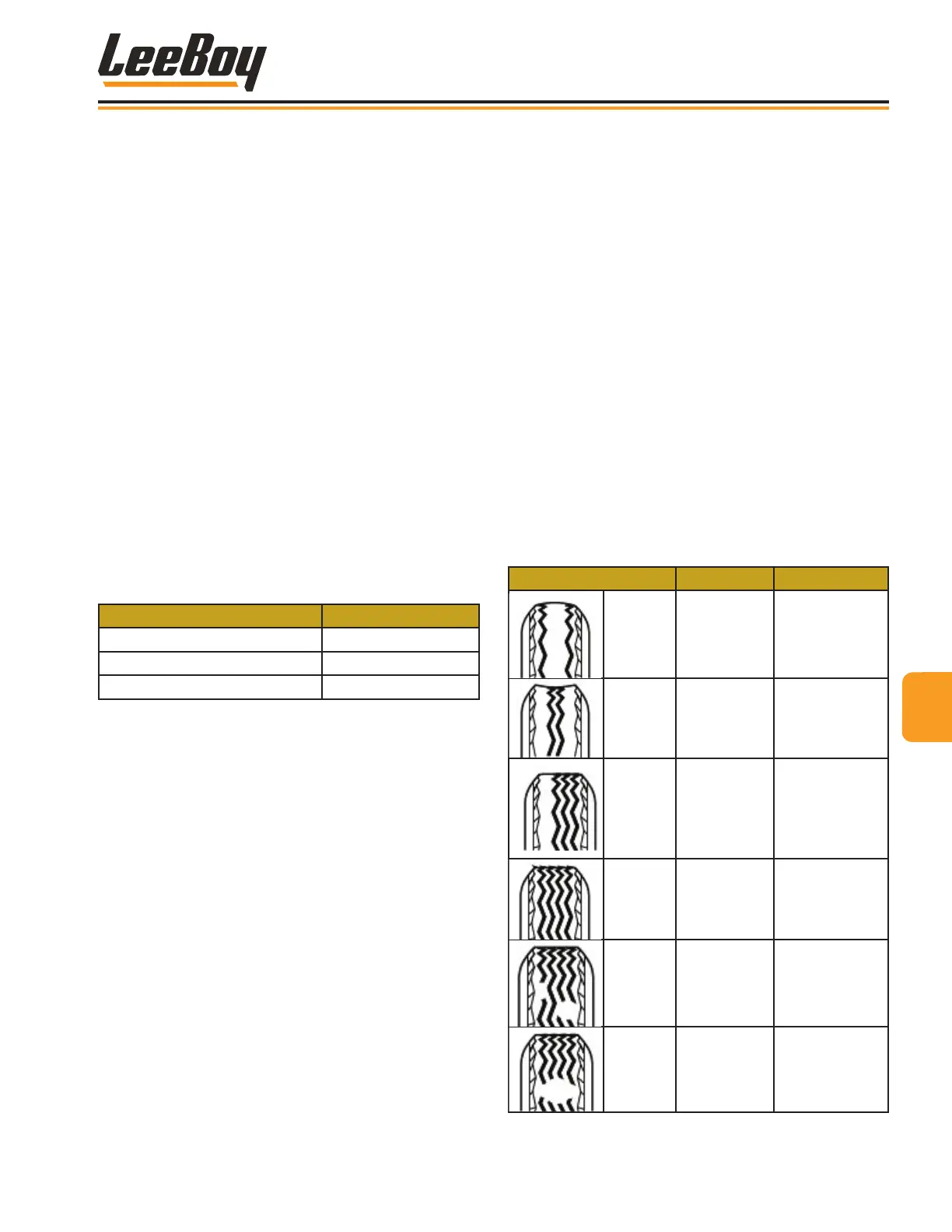
Tire wear should also be checked frequently. (Table
5-3)
To change a tire:
1. Park distributor on a at surface and place a block
or jack stand on each side of the tire not being
replaced.
2. Raise the distributor using a tire jack on the frame
near the tire being changed. DO NOT raise the
frame too high.
3. Loosen and remove lug nuts BY HAND to prevent
cross threading.
4. Carefully remove tire.
5. Install replacement tire.
6. Replace lug nuts, tightening alternately. Torque to
85 ft. lbs. (115 Nm).
Table 5-3. Tire Wear Chart
WEAR PATTERN CAUSE ACTION
Center
Wear
Over
Ination
Deate tire to
correct load
level.
Edge
Wear
Under
Ination
Inate tire to
correct load
level.
Side
Wear
Loss of
camber or
overloading.
Get alignment.
Ensure load
doesn’t
exceed axle
rating.
Toe
Wear
Incorrect
toe-in.
Get alignment
service.
Cupping
Wheels out
of balance.
Check balance
and bearing
adjustment.
Flat
Spots
Wheels
locked and
tire skidding.
Adjust brakes.
55
Maintenance
L300 and L600 Tack Distributors 5-13


 To Next Page