Light scattered by the two particles closest to the lens is collected by the lens.
Light from particle
/
is scattered beyond the lens. This shows the extent of the
working area
-
.
The minimum working range of the 300mm lens is 150mm, allowing
measurement of particles down to size 0.5mm. The working range for the 750mm
lens is 500mm, allowing for the resolution of particles down to 2mm.
The working range for each lens increases as the particle size increases. This is
because large particles scatter light at smaller angles and can therefore be resolved
at a greater distance away from the lens.
'
Note
.
The recommended solution whenever possible is to repeat the test, with
the spray closer to the Receiver module.
If measurements are made outside the working range of the lens, the system
measures incorrectly the light scattered at wide angles. This causes the light
scattering measured by the outer detectors to be "cut off", in which case the
measured intensity is less than expected. This effect is called vignetting.
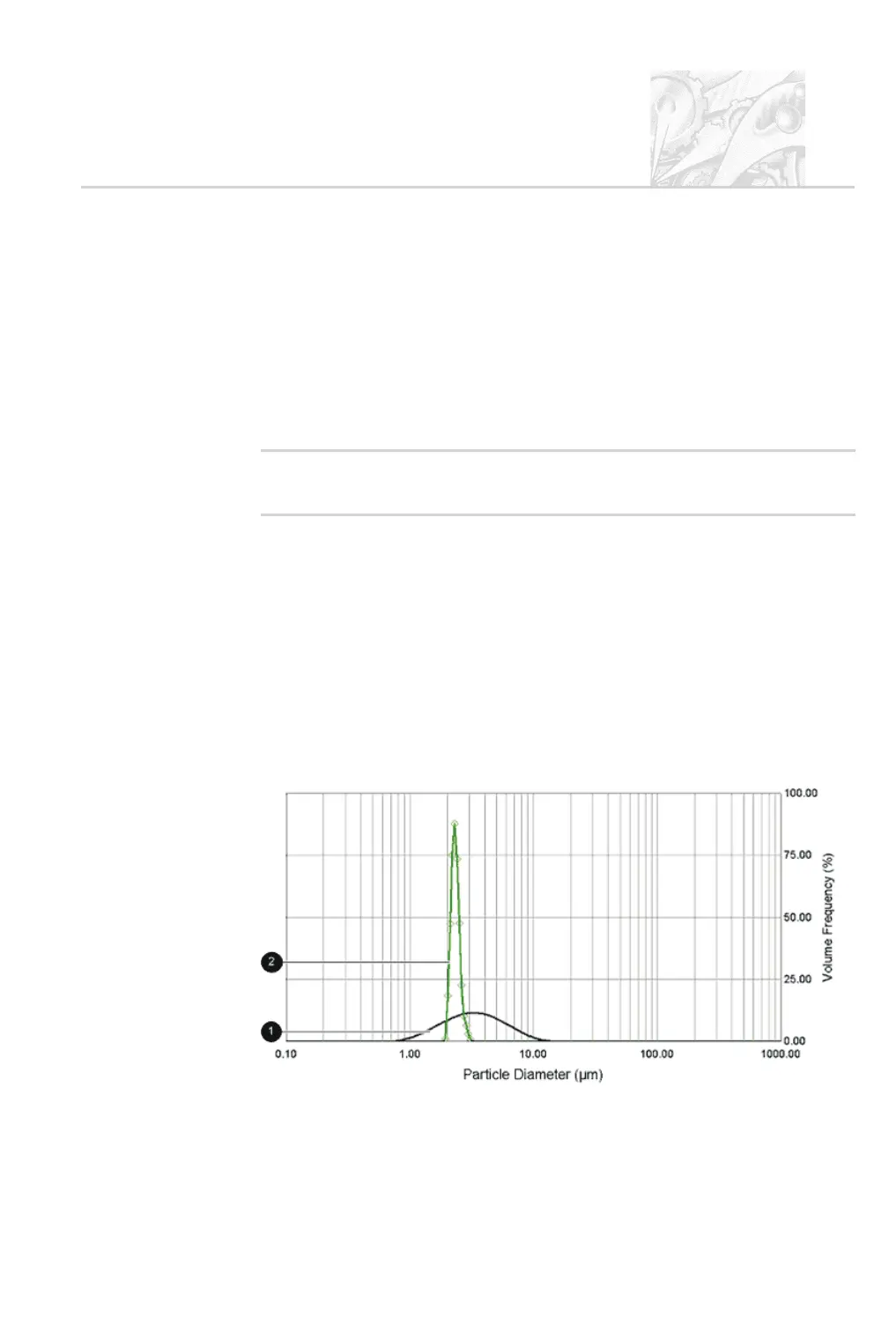
An example of vignetting is shown below for a nebuliser. The output of a
nebuliser contains a significant number of sub-micron particles.
When the nebuliser aerosol is measured within the working distance of the lens
the correct result
+
is obtained. If the nebuliser is measured outside the working
area, the scattering observed for the outer detector channels is reduced. This
causes an incorrect result
,
to be calculated.
CHAPTER 6
Spraytec Page 6.19
ILL 7456



 To Next Page