9. Navigation and control system
MiR1000 User Guide (en) 12/2020 - v.1.4 ©Copyright 2019-2020: Mobile Industrial Robots A/S. 71
• The cameras are not reliable at determining depth when viewing structures with
repetitive patterns.
• The cameras may detect phantom obstacles if they are exposed to strong direct light.
Proximity sensors
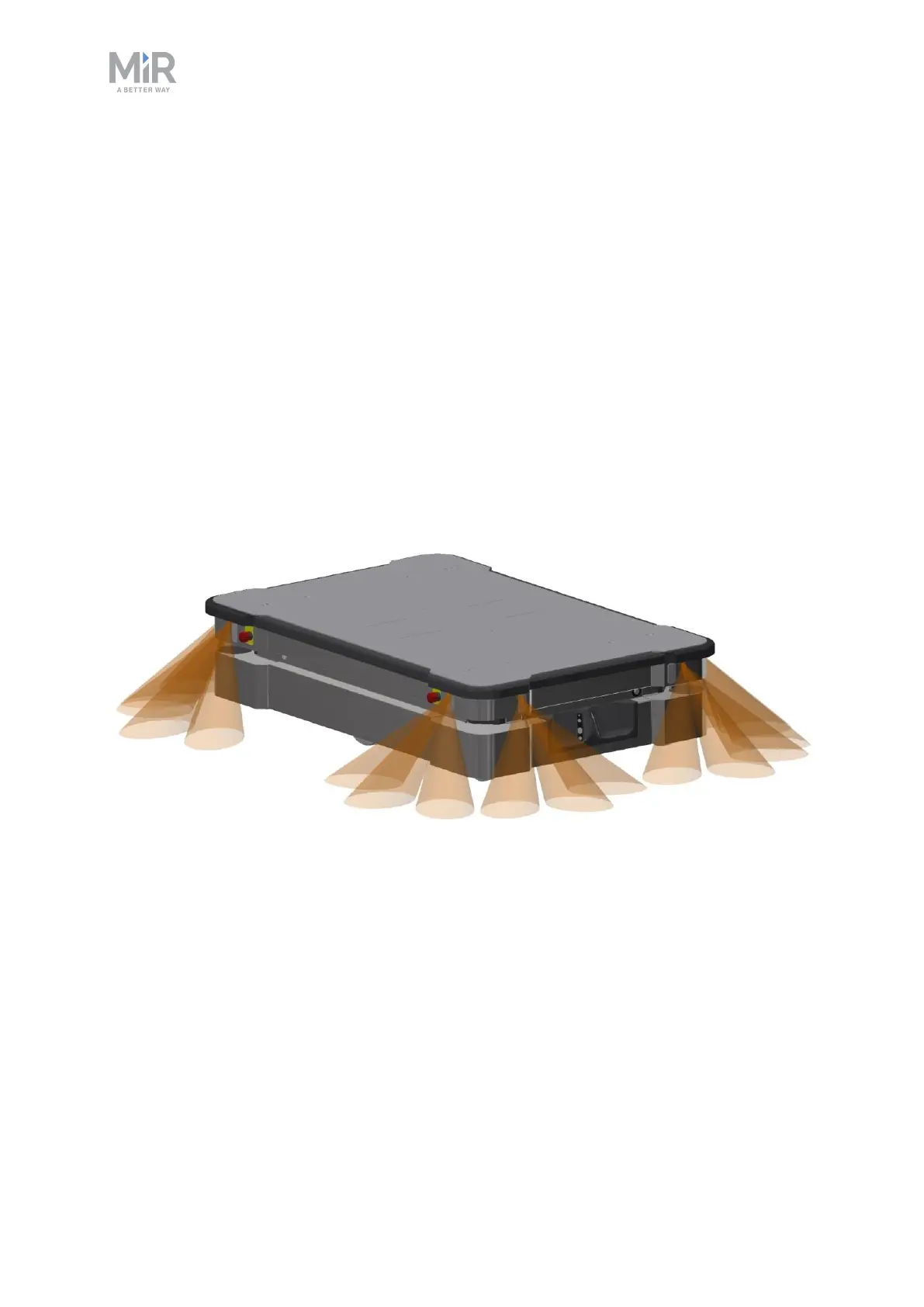
Proximity sensors placed in all four corners of the robot detect objects close to the floor that
cannot be detected by the safety laser scanners.
Using infrared light, the proximity sensors point downwards and make sure that the robot
does not run into low objects, such as pallets and forklift forks. They have a range between
5-20 cm around the robot.
Because of the proximity sensor's limited range, the data from them is only useful when the
robot is standing still or moving at reduced speeds, for example, when the robot it pivoting
or docking.
Figure 9.10. The proximity sensors in the corners of the robot detect objects below the safety laser scanners'
plane of view.
The proximity sensors have the following limitations:
• They do not have a long range and are mainly used to detect obstacles missed by the
laser scanners and cameras.
• When the robot is driving fast, obstacles detected by the proximity sensors are too close
for the robot to stop for or avoid.


 To Next Page