Chapter Six: Remote Operation Overview
61
Chapter Six: Remote Operation
Overview
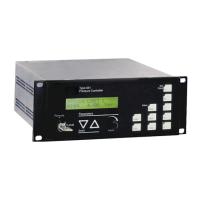
Remote operation of the 651 Pressure Controller is accomplished via the rear panel either by RS-
232 communication by means of a computer connected to the Serial Interface connector or
through analog or digital logic levels at the I/O connector. When the Key Lock switch is set to
Remote, all control commands and parameter modifications must be sent through the connectors.
The front panel becomes locked; however, it is still possible to scroll through and view current
set points (pressure and position). This chapter contains information about RS-232 and analog or
digital logic control.
Refer to
RS-232 Communications
, page 42, discusses the initial settings for the communication
parameters.
RS-232 Commands and Requests
Messages sent to the 651 controller are either
commands
that instruct the controller to change an
operating parameter, or
requests
that prompt the controller to report status information.
Responses sent by the 651 controller reply to a request message issued by means of your
computer’s RS-232 communication software.
All messages must use a carriage return-line feed (CRLF) as the end-of-line delimiter. Use your
host computer’s communications software to assign the CRLF action to the
ENTER
key.
Message Syntax
The information presented in this section applies to all RS-232 messages. The RS-232 message
syntax uses the following typographical conventions:
bold
Commands and requests that you must enter exactly as shown in
the manual.
italics
Placeholder that represents text or numeric values that you must
supply.
response
Format of messages sent from the 651 controller.
ENTER
Represents carriage return-line feed combination that you have
configured as the end-of-line delimiter.


 To Next Page