USER MANUAL
URM18PH392 Rev A. May 2020 Page 17 of 86
STYLUS 1.2.3
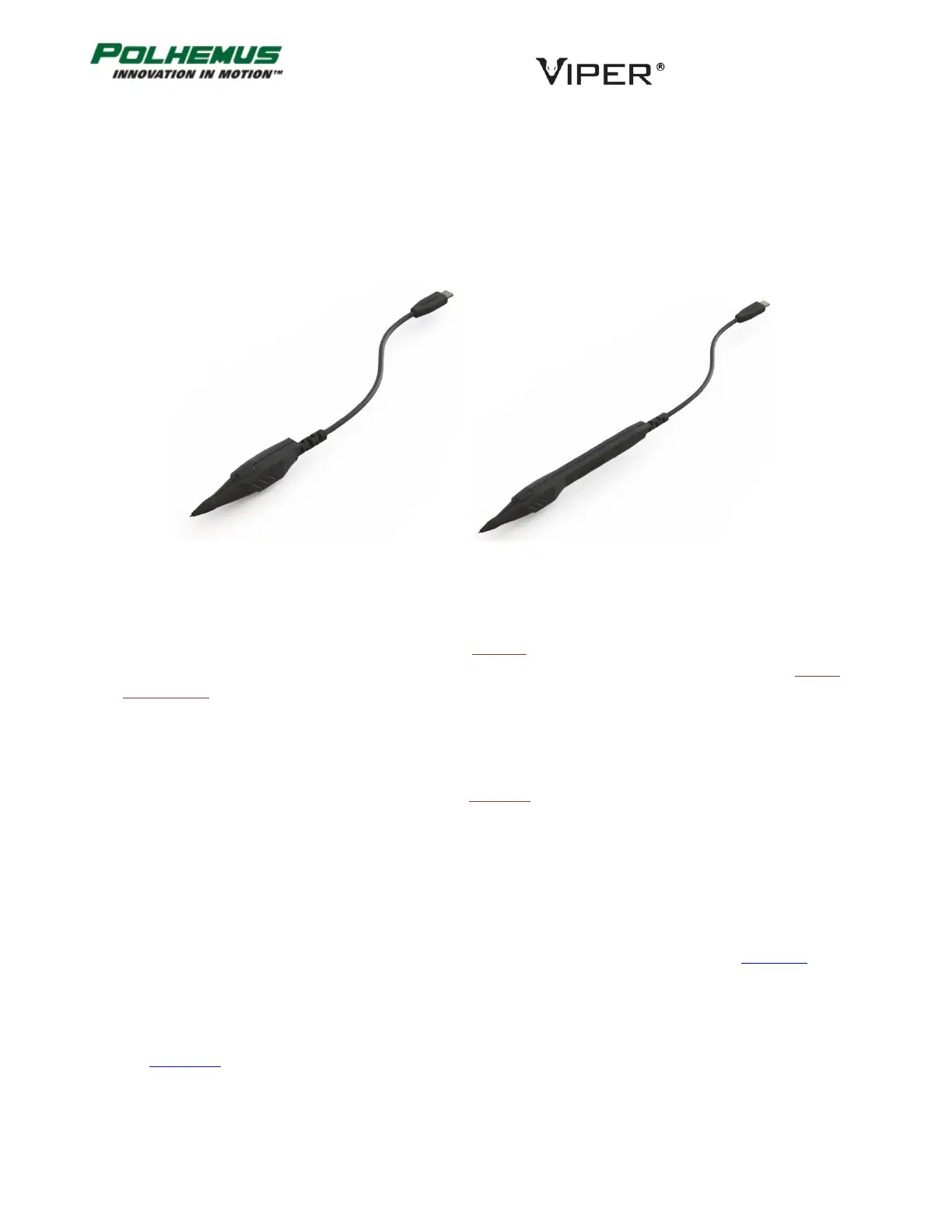
The Stylus is a pen-shaped device that is tracked positionally in three dimensions as well as angularly. A push
button switch is integrated to give the user control of the data output. Stylus position measurements are
calculated at the tip of the Stylus, using precise factory calibration. The tip is removable/replaceable and
available with a sharp point (standard) tip or a rounded tip. The Stylus is available in two sizes: 3 inches long
(FT3-Stylus) and 8 inches long (FT8-Stylus).
SOURCE 1.2.4
The VIPER™ Source emits the electromagnetic field (EM field) necessary to track the P&O of Sensors within
range. The three-dimensional space in which the EM field is detectable by the Sensors is known as the motion
tracking area. Multiple Sources may be used to define and expand this area. When more than one Source is
used, each Source must operate at a different frequency so that it can be distinguished from the others by the
Sensors. (Source frequency is not a configurable feature; Sources are manufactured to operate at specific
frequencies and may be purchased accordingly.)
In a standard installation, the Source is usually the reference for Sensor P&O measurements. The Source is
powered by the SEU and is connected at the dedicated Source connection port(s). Up to four sources can be used
in a single VIPER™ system.
The Source is usually mounted in a fixed position to a non-metallic surface or stand located in close proximity to
the Sensors.
VIPER™ Sources are available in a variety of form factors and EM frequencies. The standard TX2 Source is a 2-inch
cube. Other sizes available include TX4 (a 4-inch cube) and several smaller sizes, including the HR-Source. The
larger sized Sources emit a stronger field that can be detected from farther away by the standard Sensors. The
smaller sized Sources have a proportionally weaker field and are useful where close proximity and smaller form
factor are needed. Specifications in this manual are based on the standard 2-inch Source.
See Appendix C for approximate Source dimensions.
FIGURE 6. VIPER™ FT3-STYLUS AND FT8-STYLUS


 To Next Page