Operation and Maintenance Manual Rev M(ii) 4/03
- 27 -
Valve Selection
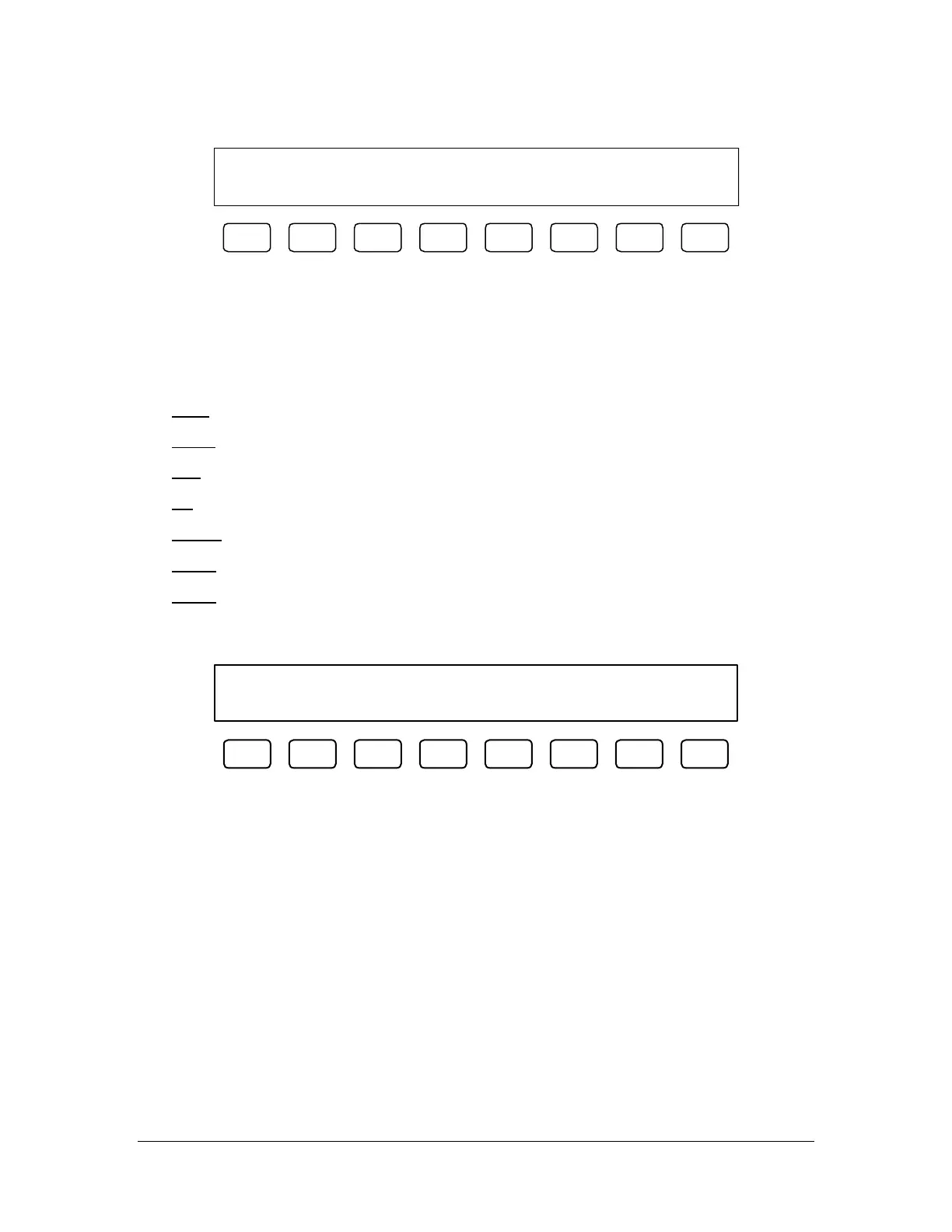
Valve Functions Head: FC100
EXIT PURG SEL UP DOWN ROTA ROTB
F1 F2 F3 F4 F5 F6 F7 F8
Units equipped with multiple valves have this mode. The active head or valve can be selected from the
Valve sublevel menu. The pneumatics Z-slide(s) and rotary(s) (if equipped) can be actuated from the Valve
submenu.
NOTE: When programming or operating the workcell, the valves should NEVER be used for moving
components or boards. Precision Valve & Automation is not responsible for damages incurred from
using the valves in an inappropriate manner.
[F1] EXIT
– Leave Valve submenu and return to the previous menu.
[F2] PURG – Actuate the current valve.
[F3] SEL – Change the active head.
[F4] UP – Raise the active head’s Z-slide.
[F5] DOWN – Lower the active head’s Z-slide.
[F6] ROTA – Put the rotary in the home position. (default)
[F7] ROTB – Put the rotary in the auxiliary position.
Automatic Mode
Auto Cycle WET Count:000000
STOP PROGRAM 1
F1 F2 F3 F4 F5 F6 F7 F8
This mode handles the automatic cycling of the machine. There are three machine setups that may be
encountered:
o Conveyor equipped.
o Stand-alone without a light curtain.
o Stand-alone with a light curtain.
For a workcell with a conveyor, the part is placed for process on the conveyor either by an operator or
mechanically via an upstream process. SMEMA signals are provided with the machine to be used in
conjunction with an upstream process. The part is recognized at the entrance to the machine and is shuttled
to the stop for cycling. Once against the stop the part is registered and dispensed / sprayed on. Once the
program finishes, the board is released and shuttled to the downstream end of the conveyor to await any
process that may follow. Once released or removed, the process is set to repeat itself.
For machines without a conveyor, all parts must be placed in the workcell manually. Part-in-place sensors
detect if a board is present or not. If a board is misplaced in the cell, the operator is alerted of the fact.
Once a machine is ready for cycling, the operator must activate the hand switches to process parts. All parts
must be removed after cycling before a new cycle may begin.


 To Next Page