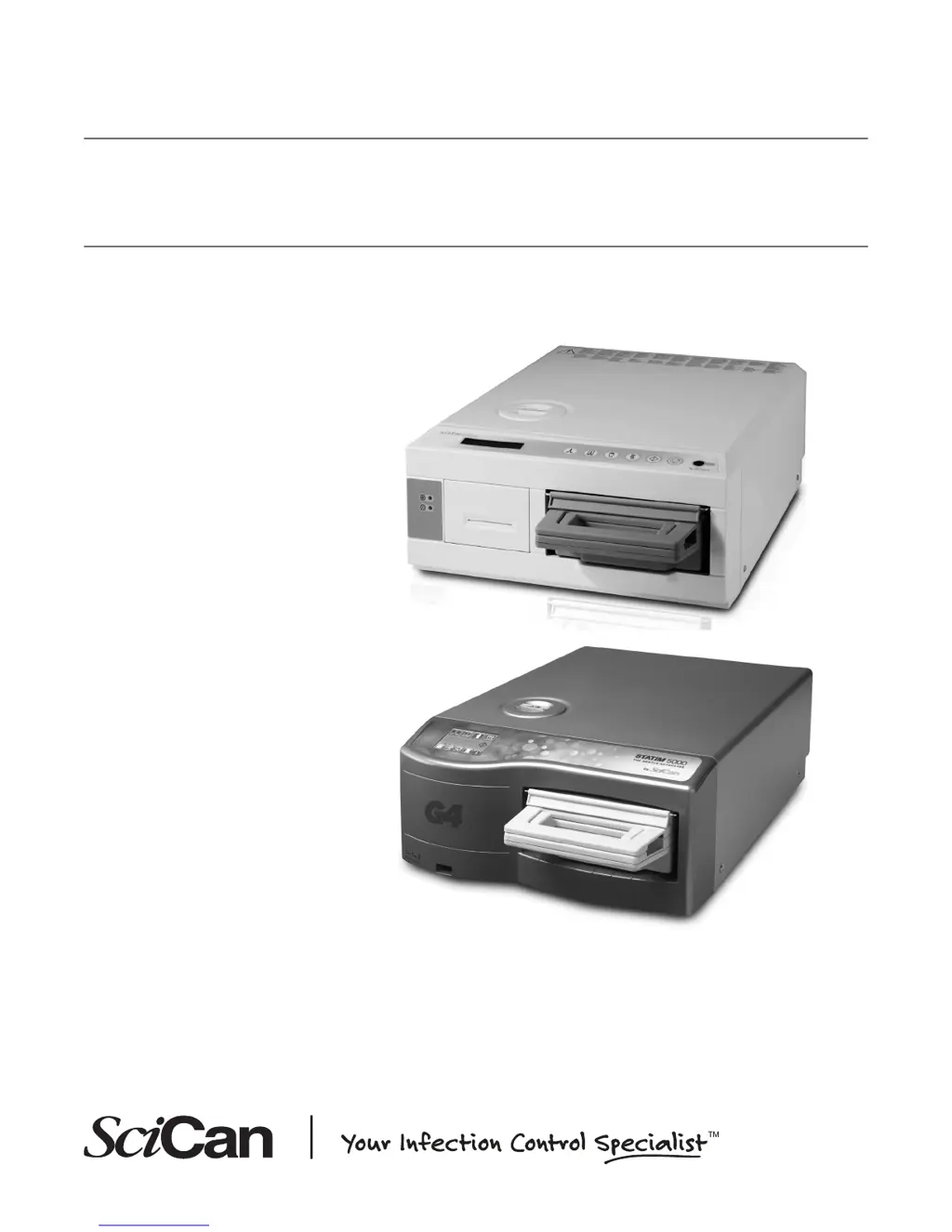
What to do when SciCan Statim 5000 Laboratory Equipment says 'MSD/FLASH FULL'?
- AAdriana PerezSep 22, 2025
If the SciCan Laboratory Equipment displays the message 'MSD/FLASH FULL REPLACE MSD', export the data from the device.
What to do when SciCan Statim 5000 Laboratory Equipment says 'MSD/FLASH FULL'?
If the SciCan Laboratory Equipment displays the message 'MSD/FLASH FULL REPLACE MSD', export the data from the device.
What to do if there is water under SciCan Statim 5000?
If you find water under your SciCan Laboratory Equipment, it's likely due to a leaking cassette. First, check the cassette seal for any misalignment or damage; if you spot any, replace the seal. If water continues to drip from the unit's underside during operation, inspect the cassette seal again for misalignment or damage and replace it if needed. Should the leak persist, turn the unit OFF, remove and unload the cassette, unplug the unit, and contact your dealer.
How to improve drying in SciCan Laboratory Equipment?
If instruments are not drying in your SciCan Laboratory Equipment, ensure the cycle completes fully. Proper loading of instruments in the cassette is important. Verify the unit is level. Inspect air filters and replace them if dirty. Clean the cassette's interior and apply Stat-Dri / Stat-Dri Plus drying agent. Also, check the exhaust tube for any kinks.
What does 'Drying interrupted – LOAD NOT STERILE' mean on my SciCan Statim 5000 Laboratory Equipment?
If you see the 'Drying interrupted – LOAD NOT STERILE' message on your SciCan Laboratory Equipment, it likely means the STOP button was pressed during the drying phase. Repackage the instruments if necessary, and rerun another sterilization cycle.
What does 'Missing lines of Data on MSD/FLASH' mean on SciCan Statim 5000?
If you see 'Missing lines of Data on MSD/FLASH' message on your SciCan Laboratory Equipment, refer to the STATIM screen to confirm successful sterilization. Additionally, reset the Data Logger by unplugging its power, disconnecting the MSD, and waiting 10 seconds.
What to do if my SciCan Statim 5000 says 'The flie or directory in the MSD is corrupted or unreadable'?
If the SciCan Laboratory Equipment displays that 'The flie or directory in the MSD is corrupted or unreadable', it's possible the MSD was unplugged during data writing. Reformat the MSD on your computer.
What to do if my SciCan Laboratory Equipment says 'REFILL RESERVOIR'?
If your SciCan Laboratory Equipment displays the message 'REFILL RESERVOIR' and won't start, it indicates that the water level in the reservoir is low. Simply refill the reservoir to resolve this issue.
What does 'PRINTER FAULT' mean on my SciCan Laboratory Equipment?
If the SciCan Laboratory Equipment printer displays 'PRINTER FAULT' on the LCD and isn't printing, check for a paper jam. If there is a jam, follow the paper removal procedures outlined in Section 7.2. Power the unit off for 10 seconds, then back on. If the message persists, follow the disassembly procedures in Section 7.2 for removing paper jams.
How to troubleshoot power issues with my SciCan Statim 5000 Laboratory Equipment?
If your SciCan Laboratory Equipment doesn't power on, check that it's plugged into a properly grounded outlet and the power cord is firmly connected at the rear. Try a different circuit. Power the unit off for 10 seconds, then back on. Also, check the condition of the line circuit breaker or fuse.
Why is there excessive steam coming from my SciCan Statim 5000?
If there is excessive steam coming from the front of the SciCan Laboratory Equipment, remove and reinsert the cassette, then try another cycle. If the leak persists, remove the cassette and inspect the cassette seal for misalignment or damage; replace the seal if needed. If the leak continues, turn the unit off, remove and unload the cassette, and contact your SciCan dealer.
Details safety criteria for servicing STATIM units according to international standards and regulations.
Explains how to identify a unit's software version by checking the LCD readout on power-up.
Details how to identify three different types of controller boards based on PCB revision.
Describes three types of steam generators encountered in STATIM 5000/5000S/5000 G4 units.
Lists STATIM specific items, generic reference devices, and electrical safety test devices required for servicing.
Provides daily, weekly, and 6-month maintenance guidelines to keep the STATIM in good order.
Instructions for draining the reservoir to prevent water damage and reduce contaminant accumulation.
Recommendations for cleaning the STATIM cassette interior for proper functioning and instrument drying.
Details procedures for changing the bacteria-retentive and compressor filters on STATIM 5000/5000S/5000 G4 units.
Procedure for changing the STATIM cassette seal every 500 cycles or six months for optimal performance.
Details dielectric strength and protective bonding impedance tests required after servicing or cover removal.
Explains how to test water conductivity using distilled water with low dissolved solids.
Guidance on understanding problems and what to do when a STATIM unit fails to function correctly.
Functional checks recommended when the immediate cause of a problem is unknown or a cycle fault is unavailable.
Describes how to gather information for diagnosis using unit software, varying by unit type and controller.
Lists cycle fault numbers, descriptions, and probable causes for specific controller board revisions.
Lists cycle fault numbers, descriptions, and probable causes for units with revision 2.x/5.x/6.x and 7.x controller boards.
Procedure for calibrating STATIM 2000/5000 non S units with revision 2.x or 5.x controller boards.
Procedure for calibrating STATIM 2000/5000 non S units with revision 6.x controller boards.
Procedure for calibrating STATIM 2000/5000 non S units with revision 7.x controller boards.
Procedure for calibrating STATIM 2000/5000 G4 non S units with revision 7.x controller boards.
Procedure for calibrating S-class STATIM 5000 units with revision 2.x or 5.x controller boards.
Procedure for calibrating S-class STATIM 5000 units with revision 6.x controller boards.
Procedure for calibrating S-class STATIM 5000 units with revision 7.x controller boards.
Procedure for calibrating S-class STATIM 5000 G4 units with revision 7.x controller boards.
Instructions for removing and reinstalling the cover for the STATIM 5000 Classic model.
Instructions for removing and reinstalling the cover for the STATIM 5000 G4 model.
Procedure for removing and replacing the armature gasket on the fascia.
Procedure for removing and replacing the fascia, including the printer module if present.
Steps to remove and replace the membrane keypad and LCD overlay from the fascia.
Procedure for removing and replacing the LCD assembly from the fascia.
Steps to remove and replace the armature gasket on the STATIM 5000 G4 fascia.
Procedure for removing and replacing the LCD overlay on the STATIM 5000 G4 fascia.
Instructions for removing and replacing the colour LCD touchscreen assembly.
Steps to remove and replace the fascia on the STATIM 5000 G4.
Information on identifying different types of controller boards, including typical features.
Steps to replace or refit the controller board assembly, including connector and wire management.
Procedures for removing and replacing the LCD controller board and associated components.
Details on processor types and their configurations on different controller boards.
Guidelines for removing the microprocessor and EEPROM devices, emphasizing ESD precautions.
Instructions for replacing or retrofitting the microprocessor and EEPROM, noting alignment.
Explains the function of the microswitch and symptoms of failure.
Procedure for replacing and refitting the microswitch, including testing and adjustment.
Covers power cords, power switch, receptacle, and line filter components.
Instructions for removing and replacing the unit's power switch.
Procedures for removing and replacing the mains input receptacle and line filter.
Steps for removing and replacing the LCD DC power source assembly.
Identifies three types of water pumps used in STATIM units and notes on interchangeability.
Procedure to test water pump flow using a pump tester and specific parameters.
Details early and later filter configurations and maintenance for STATIM pumps.
Steps for performing filter maintenance on internal pump filters, including disassembly.
Instructions for replacing the in-line filter, which should be done every 2000 cycles or two years.
Guidance on replacing pump tubes to correct water delivery issues if filters are clean.
Step-by-step instructions for removing the Fluid-O-Tech pump assembly.
Procedure for testing the pump diode using a multimeter.
Instructions for reinstalling the Fluid-O-Tech pump assembly after removal.
Procedure for removing the SciCan or Ulka pump assembly.
Steps for reinstalling the SciCan pump assembly, including electrical safety tests.
Steps to prime the STATIM pump after installation or maintenance.
Describes reservoir configurations and water sensor types found in STATIM units.
Diagnosing problems related to the water quality sensor, including conductivity issues.
Steps to modify conductivity settings in the service menu, especially for upgraded reservoirs.
Procedure for removing and replacing the float sensor in the reservoir.
Identifies two types of compressors (MEDO and THOMAS) used in STATIM units.
Detailed instructions for removing and reinstalling the MEDO compressor.
Procedures for removing and reinstalling the THOMAS (or SciCan) compressor.
Instructions for modifying the chassis to accommodate a MEDO compressor.
Describes two types of solenoid valves and procedures for inspecting and repairing Type B valves.
Steps to remove the solenoid valve assembly from the unit.
Instructions for refitting the solenoid valve assembly, including tube connections.
Information on pressure transducers, their types, and identification methods.
How to identify and check the function of the pressure transducer.
Procedure to check the output voltage of the pressure transducer against standard readings.
Steps to check the transducer's function by comparing readings and ensuring proper setup.
Procedure for removing the pressure transducer from the unit.
Instructions for reinstalling the pressure transducer, including recalibration.
Steps for removing the pressure interface board, applicable to specific controller board revisions.
Procedure for reinstalling the pressure interface board.
Steps for removing and replacing the real-time clock battery on the pressure interface board or main PCB.
Information on replacement armatures and isoplates, and how to remove them.
Step-by-step instructions for removing the armature and isoplate assembly.
Procedure for reinstalling the armature and isoplate, including bracket alignment.
Instructions for removing the isoplate from the armature.
Steps for installing a replacement isoplate into the armature.
Information on the probe bracket and chamber thermocouple subassembly, noting it's a critical component.
Procedure for removing the probe bracket and chamber thermocouple subassembly.
Critical steps for aligning the probe bracket and chamber thermocouple for correct unit function.
Describes four types of steam generators encountered during STATIM servicing.
Information on upgrading older steam generators to the Alex type with kit references.
Procedure for removing the aluminium steam generator.
Steps for removing the stainless steel steam generator.
Instructions for reinstalling the stainless steel steam generator, noting bracket configurations.
Explains the function of the check valve and recommends annual replacement.
Describes two methods for checking the check valve's functionality.
Procedure for removing and replacing the steam generator check valve.
Describes four types of thermal fuse configurations for steam generators.
Procedure for removing thermal fuses from aluminium steam generators.
Instructions for replacing thermal fuses on aluminium steam generators.
Details two types of pressure relief valves fitted to STATIM units and their specifications.
Procedure for checking the PRV's functionality under running conditions.
Steps for removing and replacing the PRV, emphasizing safety precautions.
Overview of unit variants and data recording devices, including printer and data logger compatibility.
Information on internal printers, including removal, replacement, and positioning the ferrite core.
Steps for removing and replacing the printer module assembly.
Guidance on correctly positioning the ferrite core on the printer module cable.
Procedure for removing and replacing the printer interface board.
Important notes regarding printer interface board versions and jumper settings.
How to adjust the print contrast potentiometer for optimal print quality.
Procedure for replacing the printer's real-time clock battery if it fails to save date/time.
Steps to remove the printer assembly from the printer module.
Instructions for replacing the printer assembly into the module housing.
Guide for installing thermal paper into the printer, including proper feed direction.
Steps for resolving paper jams, including partial disassembly if needed.
Information on compatible external serial printers and required cables.
Lists tested and recommended printers for STATIM 5000 units with Rev. 7 boards.
Steps for setting up the STATIM unit to recognize and use an external printer.
Information on the data logger, its capabilities, and installation for Rev. 7.x controller boards.
Steps for installing the SciCan Data Logger, including setting up the STATIM unit.
Troubleshooting common display messages and issues encountered with the Data Logger.
Procedure for transferring data from the MSD to a computer.
Lists specifications for the Data Logger, including connection types and compatible MSDs.
Factors affecting STATIM performance, including temperature, humidity, spacing, venting, work surface, and environment.
Ensures the unit is placed on a stable surface with the level indicator balanced.
Instructions for connecting the waste bottle for collecting wastewater.
Guidelines for filling the reservoir with steam-processed distilled water.
Steps to prime the STATIM pump after installation or maintenance.
Initial steps for powering up and setting up the unit after installation.
Procedures for setting the time and date on STATIM G4 and Classic models.
Steps to change the displayed language on the STATIM LCD screen.
Procedure for assigning a unique identifier number to STATIM units.
Instructions for setting or editing the unit's serial number on Rev. 7 controller boards.
Procedure for setting the air drying time on STATIM Classic and G4 models.
Steps to connect the STATIM G4 to a network via Ethernet or wireless bridge.
Instructions for setting up the STATIM's web portal, including CONTACTS and LAN pages.
Steps to configure email addresses for notifications and downloads.
How to set up email notifications for operating information and cycle faults.
Procedure for setting the time zone and enabling automatic Internet time synchronization.
Instructions for setting a new user name and password to secure configurations.
Steps to back up configurable changes and contact information to an office computer.
How to run network connectivity tests to confirm proper setup.
Final steps before first use, including running cycles and cleaning.
Instructions for draining the reservoir and preparing the unit for shipment.
A checklist to ensure all installation steps are completed correctly.
| Type | Autoclave |
|---|---|
| Model | Statim 5000 |
| Manufacturer | SciCan |
| Water Reservoir Capacity | 1.5 liters |
| Power Supply | 50/60Hz |
| Cycle Options | Unwrapped, Wrapped |