Argus Radar - SERIAL INTERFACE SPECIFICATIONS
988-10187-004 2.4
VDM – AIS VHF data-link message
Defined in ITU-R M.1371 and as received on the VHF Data Link (VDL), using the “six-bit”
field type. The structure provides for the transfer of long binary messages by using multiple
sentences.
Data messages should be transmitted in as few sentences as possible. When a data
message can be accommodated in a single sentence, then it shall not be split.
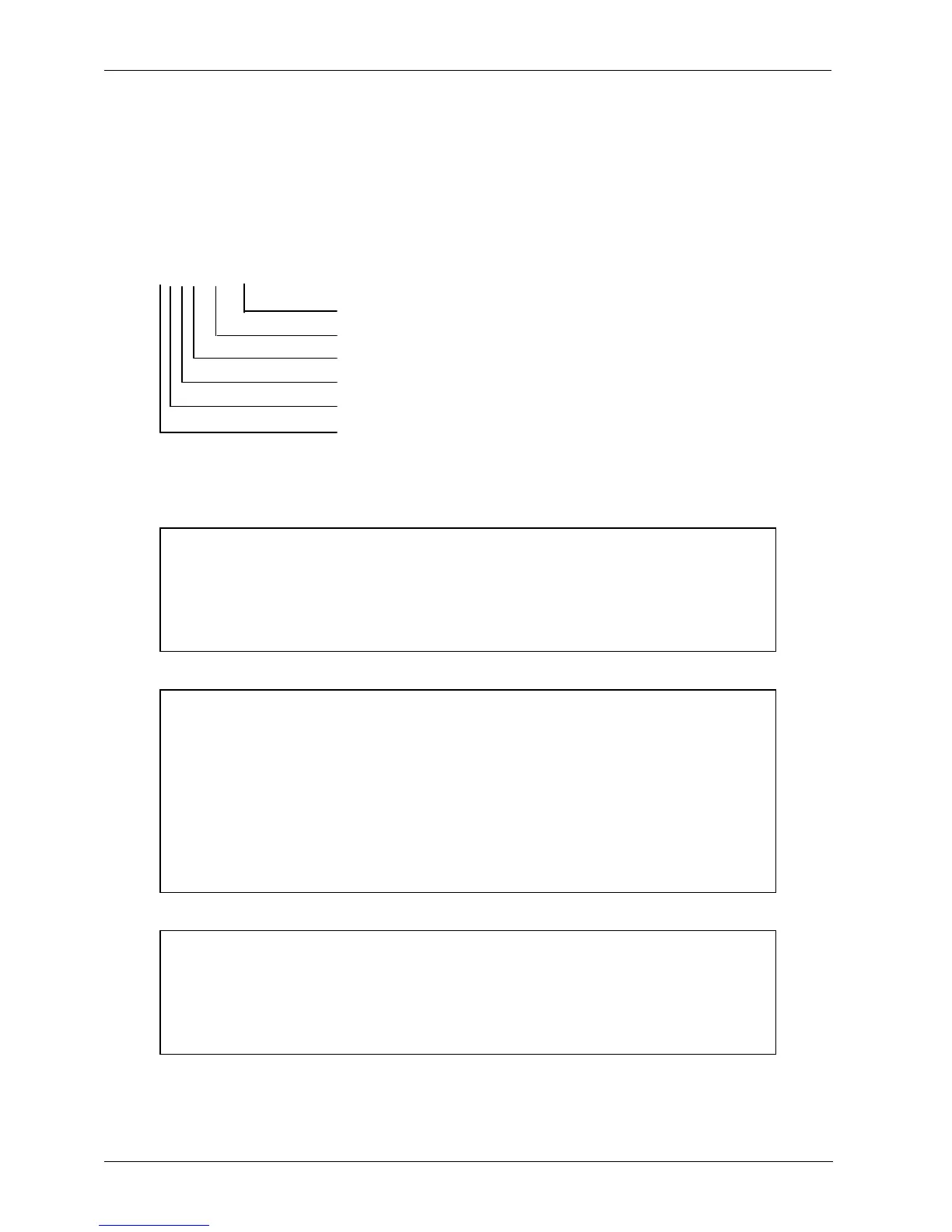
!--VDM,x,x,x,a,s—s,x*hh<CR><LF>
Number of fill-bits, 0 to 5 (see Note 5)
Encapsulated ITU-R M.1371 radio message (see Note 4)
AIS channel (see Note 3)
Sequential message identifier, 0 to 9 (see Note 2)
Sentence number, 1 to 9 (see Note 1)
Total number of sentences needed to transfer the message,
1 to 9 (see Note 1)
NOTE 1
The length of an ITU-R M.1371 message may require the transmission of
multiple sentences. The first field specifies the total number of sentences
used for a message, minimum value 1. The second field identifies the
order of this sentence in the message, minimum value 1. These cannot be
null fields.
NOTE 2
The sequential message identifier provides a message identification number
from 0 to 9 that is sequentially assigned and is incremented for each new
multi-sentence message. The count resets to 0 after 9 is used. For a
message requiring multiple sentences, each sentence of the message
contains the same sequential message identification number. It is used to
identify the sentences containing portions of the same message. This
allows for the possibility that other sentences might be interleaved with the
message sentences that, taken collectively, contain a single message. This
should be a null field for messages that fit into one sentence.
NOTE 3
The AIS channel is indicated as either “A” or “B”. This channel indication is
relative to the operating conditions of the AIS unit when the packet is
received. This should be a null field when the channel identification is not
provided. The VHF channel numbers for channels “A” and “B” are obtained
by using a “query” (see 7.3.4) of the AIS unit for an ACA sentence.


 To Next Page