3 PICOSCALE FUNDAMENTALS
3.2 Measurement principle
3.2.1 Michelson interferometer
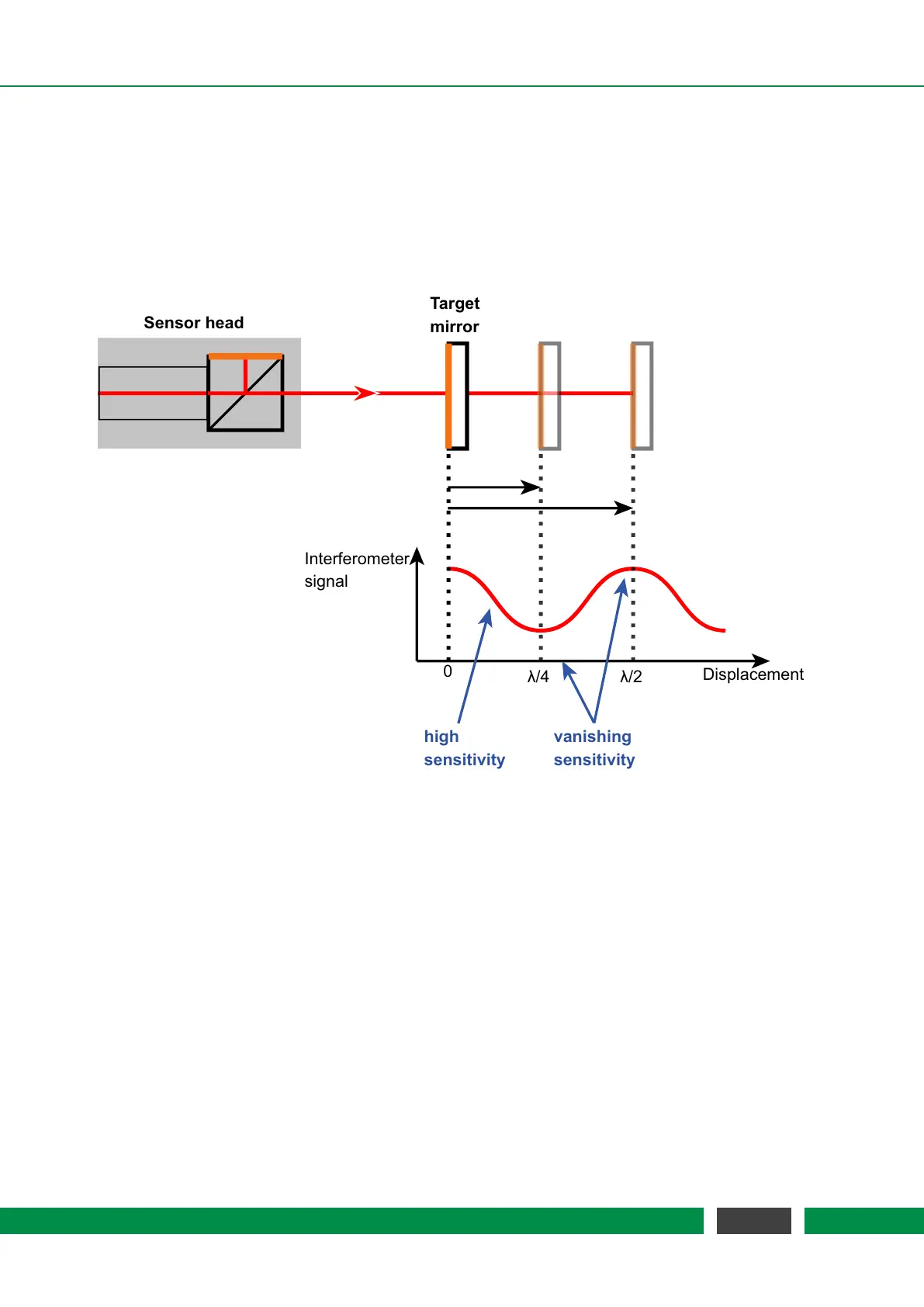
The PICOSCALE displacement sensor is based on a Michelson interferometer with an extremely
compact and stable reference arm.
.
λ/4λ/2
Interferometer
signal
Displacement
0
vanishing
sensitivity
high
sensitivity
Sensor head
Target
mirror
Figure 3.2: Measurement principle of a Michelson interferometer. Constructive and destructive
interference occur due to a displacement of the target mirror. To circumvent these
blind spots the PICOSCALE utilizes sinusoidal phase modulation, see section 3.2.2.
The interferometer is driven by a laser, which is a coherent light source, that is required if a
Michelson interferometer is operated with (very) unequal arm lengths as it is the case for the
PICOSCALE. At a beam splitter, the light is divided into two parts. One part is reflected at a fixed
reference mirror and guided back to the beam splitter. The other part of the light hits the target
mirror. This light is also reflected while picking up a relative phase with respect to the reference
beam. Inside the beam splitter, both reflected beams interfere and the coherent superposition is
recorded by a photo detector.
In the PICOSCALE system, the beam splitter is located in the sensor head, whereas the light
source, a stabilized, distributed-feedback (DFB) laser diode and the photo detector are located in
the controller housing. The wavelength of the laser is around 1550 nm. Inside the controller, a
fiber network distributes the laser light to three independent measurement channels. The output
power of each channel is around 150 µW.
17
PicoScale User Manual


 To Next Page