3 PICOSCALE FUNDAMENTALS
The integration of the miniaturized beam splitter into the sensor head ensures that changes in the
fiber length, possibly caused by temperature gradients, do not affect the measurement.
In a Michelson interferometer, two light beams interfere with each other. Due to path length
differences in the measurement and the reference arm of the interferometer, constructive and
destructive interference occur. In case of constructive interference, the recorded interferometer
signal is high, while at destructive interference the recorded signal is low. A displacement of the
target mirror causes a change in the relative optical path lengths and thus in the phase difference
of target and reference beam, compare figure 3.2. As a result, the intensity measured by the photo
diode is changed. This intensity change in turn is used to infer positions and displacements with
high accuracy.
In standard interferometry, the interference signal is sinusoidally dependent on the phase differ-
ence between the reference and probe beam. This phase difference depends on the target mirror
position. Thus, during constant movement, the resulting intensity signal is a sinusoid, similar to
the signal shown in figure 3.2. Due to the symmetry of the sinusoid, it is not possible to determine
the movement direction at every working point. Furthermore, the sensitivity (change in signal in-
tensity due to change in target position) is not constant during movement. Thus, for long range
and high-resolution position measurements, the standard Michelson interferometry is not ideally
suited.
The
PICOSCALE uses sinusoidal phase modulation of the laser beam to overcome these disadvan-
tages and provides high accuracy and resolution of position measurements as well as information
on the direction of the moving object mirror!
3.2.2 Sinusoidal phase modulation
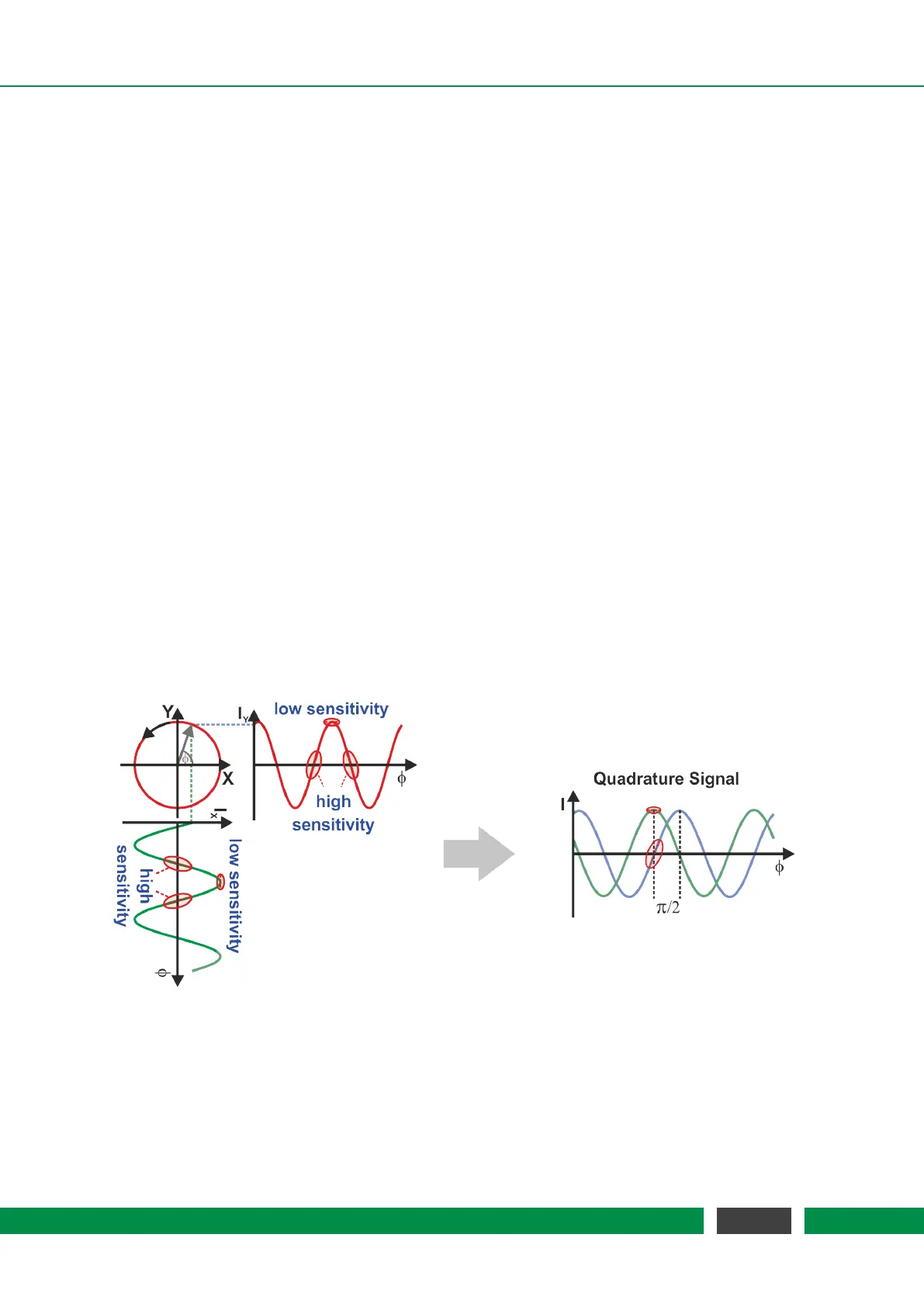
Figure 3.3: Quadrature signal detection: points of low sensitivity in one signal are compensated by
high sensitivity in the quadrature signal.
Thus, sinusoidally modulating the wavelength of the laser light can overcome the aforementioned
disadvantages. This wavelength modulation is initiated by modulating the injection current of
the used distributed feedback (DFB) laser diode. The modulation of the wavelength produces
a sinusoidally phase modulated (SPM) interference signal. Due to appropriate demodulation, it
18
PicoScale User Manual


 To Next Page