3 PICOSCALE FUNDAMENTALS
refractive index of the air can significantly influence interferometric position measurements. The
refractive index of air may change due to fluctuations in temperature, pressure and humidity
(TPH). If the refractive index increases, the optical path length of the laser light increases propor-
tionally. This effect would pretend a movement of the object mirror even if the geometrical path
did not change. To compensate a variation of the refractive index, it is necessary to measure the
atmospheric conditions such as air temperature, pressure and humidity. Based on these values,
the National Institute of Standards and Technology (NIST) suggests a formalism based on a set
of modified Edlén equations to calculate the refractive index of air
1
. The
PICOSCALE follows the
suggested formalism to calculate the refractive index and thus to correct the position data.
3.4.1 Dead path
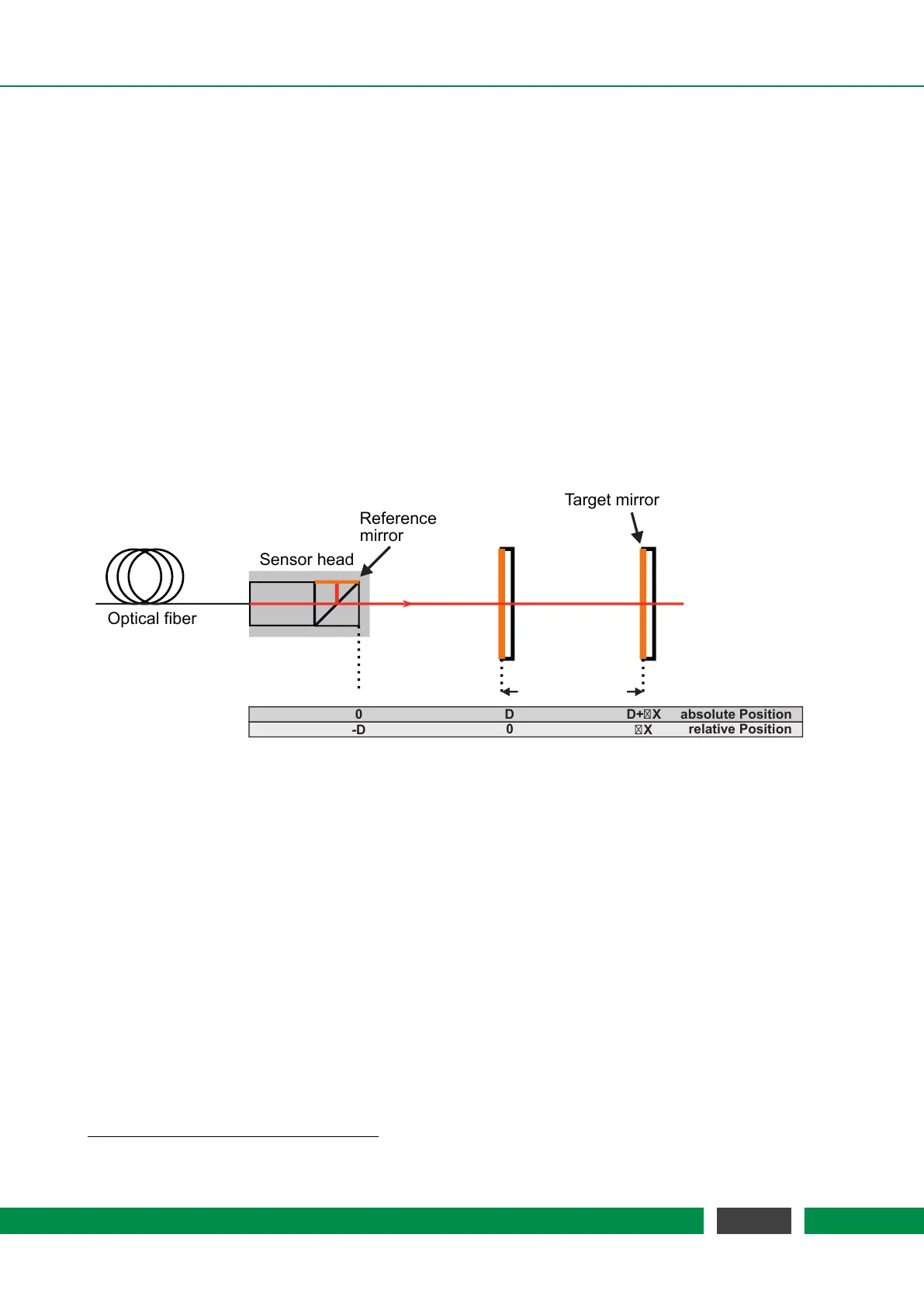
The dead path is the distance between the absolute and relative zero position of the PICOSCALE
system. As figure 3.4 highlights, the absolute zero position is at the surface of the beam splitter
cube. The relative zero position can be defined freely. The system measures any position change
Sensor head
Reference
mirror
Target mirror
Optical fiber
absolute Position
relative Position
0
-D
D
0
D+ X
X
Figure 3.4: The dead path is the distance between the absolute zero position, at the front face of
the beam splitter cube and the freely defined relative zero position.
relative to this internal zero position. When the measurement is done in ambient environment,
the changes in the refractive index cause a measurable change in the
PICOSCALE position signal.
Based on the recorded environmental parameters the system calculates a correction factor to
compensate this virtual drift. The PICOSCALE measures the absolute distance between sensor
head and target mirror during the initial adjustment phase. When the absolute measurement
is done, the controller automatically zeros the internal position value, such that the measured
absolute distance is equal to the dead path. The measured dead path is stored automatically in
the system and can be accessed with appropriate properties. Furthermore, each time the internal
position value is set, the dead path is updated automatically, if the environmental compensation
is active.
1
http://emtoolbox.nist.gov/Wavelength/Documentation.asp#EdlenorCiddor
20
PicoScale User Manual


 To Next Page