56
t
t
E
A
j = j
P
+ j
I
+ j
D
j = 3 + 5 + (- 2)
j = 6%
DT
n-1
= 0,4 K
DT
n
= 0,3 K
K
D
= 10
k
K
D
= 2
EN/06.2019/G57 © STULZ GmbH – all rights reserved
C7000 INSTRUCTIONS fOR a/C UNITS
D-factor
actual val.
Set val.
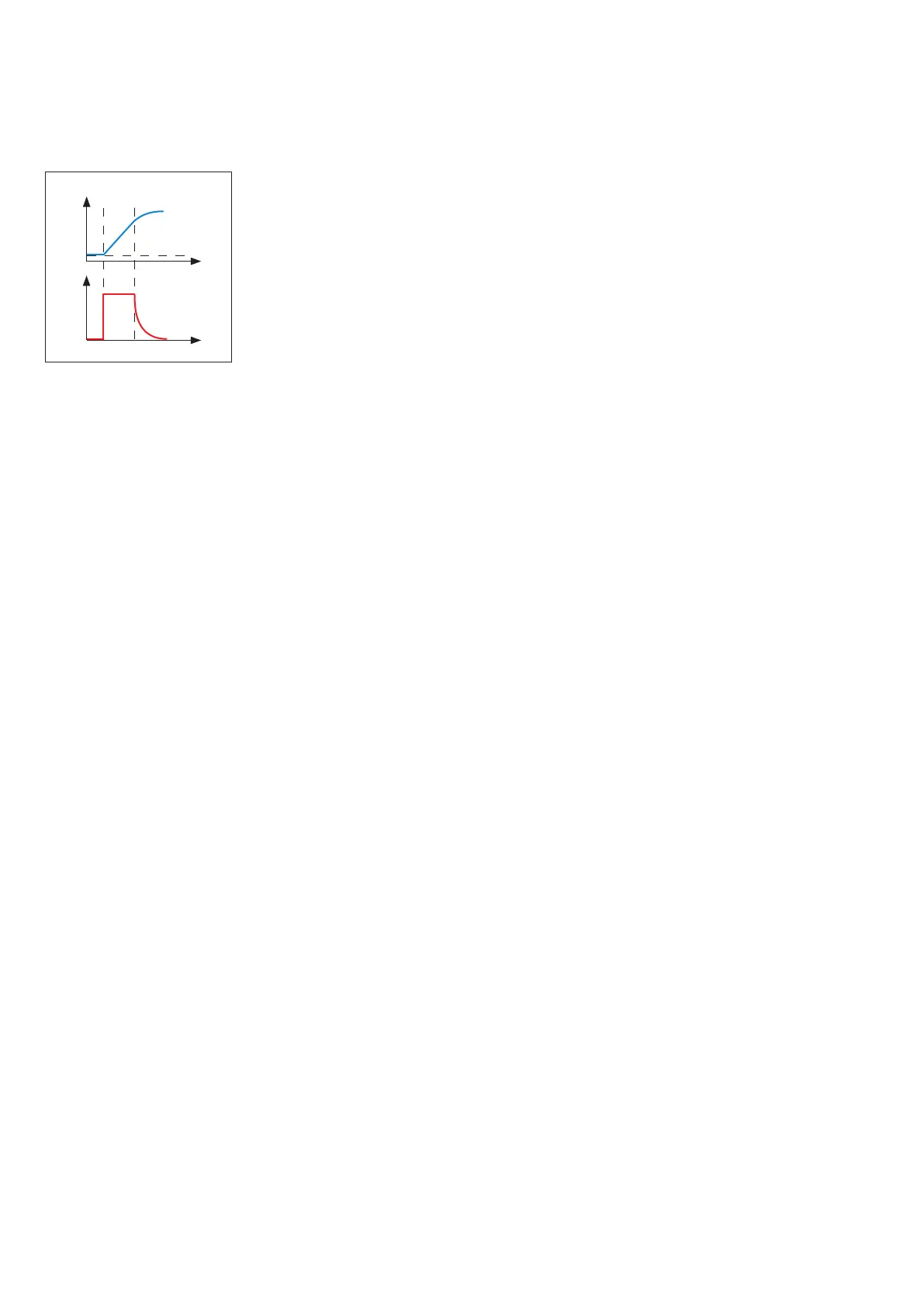
To show the principal influence of the
I-/D-factor the diagrams feature an
open control circuit.
In reality the control circuit is closed
and the alteration of the output has
an effect on the input (measured
value).
D factor:
component
depedant
constant:
Setpoint discrepancy
at the moment t
1
at the moment t
2
For calculating the output variable the single parts are added:
D factor
By the D-factor you adjust the differential part of the control. By the differential
part a change of the setpoint discrepancy is detected. This way the control can
rapidly work against an erratic change of the input value.
The size of the D factor should be set in dependance on the possibility for a sud-
den change of the input variable. If the input variable is the return air temperature,
a D factor makes hardly any sense, as there are generally no erratic changes of
the return air temperature. In contrast to this the setting of a D factor can lead to
a better control characteristic for the G valve (input variable is the condensation
pressure) or for supply air control.
Example: j
D
= K
D
DT
n
- DT
n-1
K
D
j
D
j
D
= -2 (opening degree in %)


 To Next Page