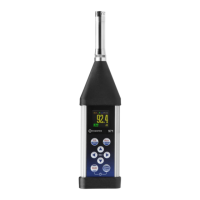
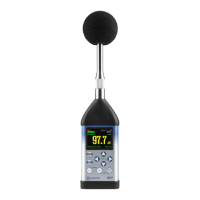
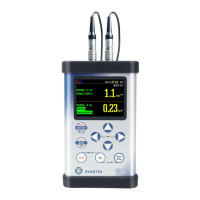
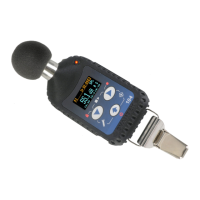
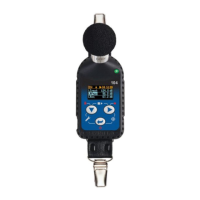
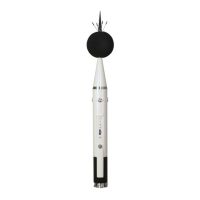
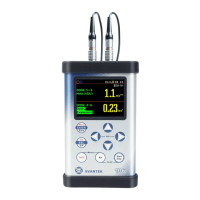
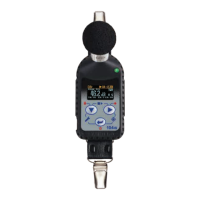
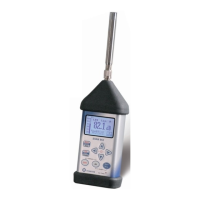
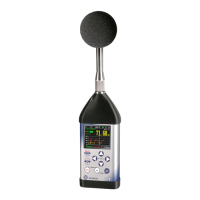
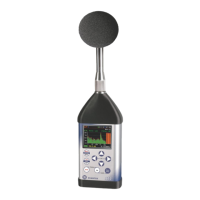
*) measured with the SL 973 microphone equivalent
Special filters
• Windscreen compensation filter improving the instrument frequency
response in the free acoustic field when windscreen SA 22
is mounted on the microphone (see Chapter C.3)
RMS detector
• Digital “True RMS“ with Peak detection,
• Resolution 0.1 dB
• Range 327.7 dB
• Crest Factor unlimited (for signals in 8 kHz band).
Overload detector
The instrument has the built-in overload detectors. Both A/D converter and input amplifier overload conditions
are detected. The overload in the measurement channel (in its analogue part) and the overload of the
analogue / digital converter are both detected. The “overload” indication appears when the input signal
amplitude is 0.5 dB above the declared “Peak measurement range”.
Underrange detector
The instrument has the built-in under-range detector. The “underrange” indication appears when the Leq
value for the elapsed time or the last second L
XY
value is below the lower linear operating range.
Time weighting characteristics (Exponential averaging)
Slow “S“ according to IEC 61672-1:2013 for Class 2, Equivalent Time Constant 1000 ms
Fast “F” according to IEC 61672-1:2013 for Class 2, Equivalent Time Constant 125 ms
Impulse “I” according to IEC 61672-1:2013 for Class 2, Equivalent Time Constant 35 ms, Hold Time 1500 s
Reference conditions as per IEC 61672-1:2013
• Class of the acoustic field Free field
• Reference acoustic pressure 114.0 dB (related to 20 Pa)
• Reference frequency 1000 Hz
• Reference temperature +23°C
• Reference relative humidity 50 %
• Reference static pressure 1013.25 hPa
• Reference incidence direction perpendicular to the microphone diaphragm.


 To Next Page