Fire Panel IRIS - Installation Manual 47
Appendix B
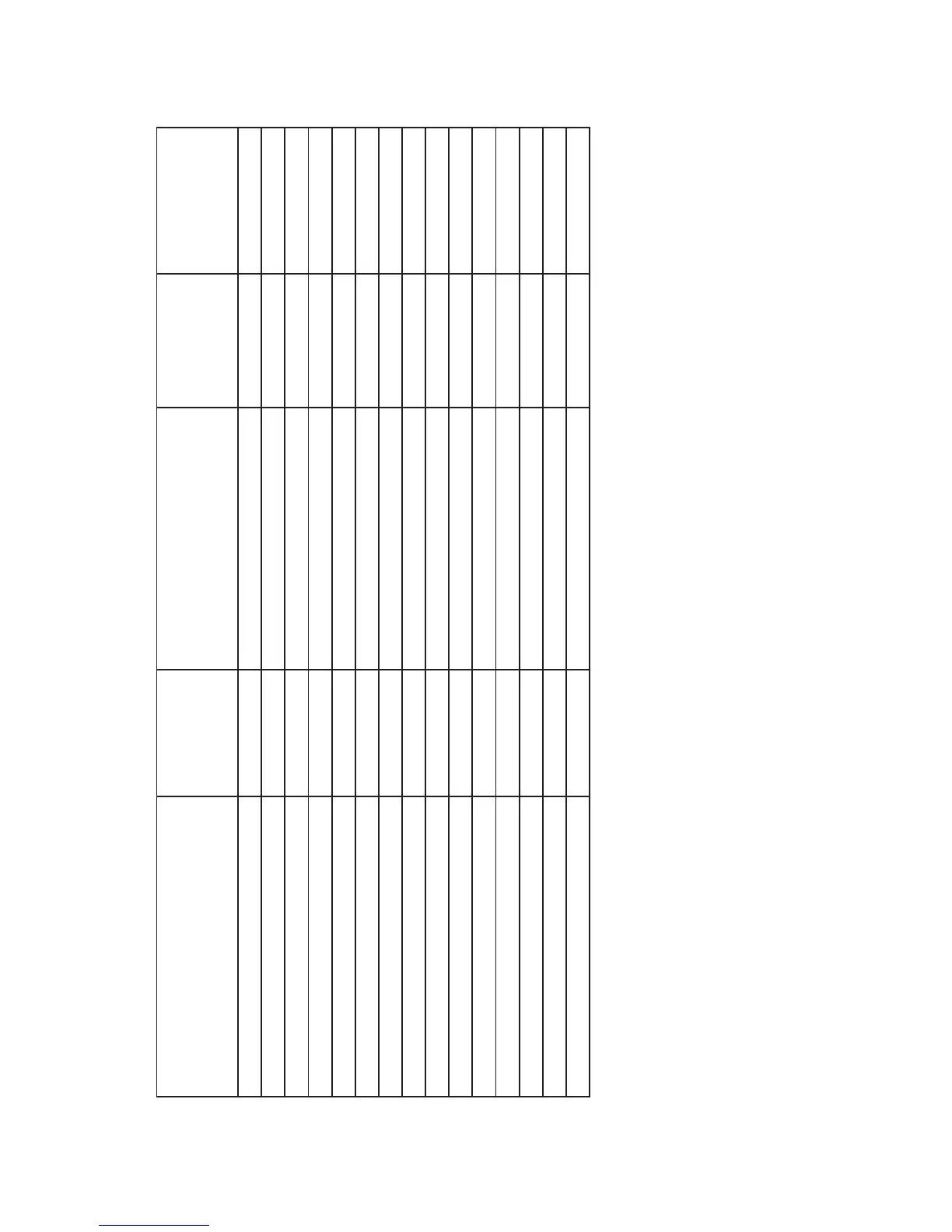
Tables for correspondence of the device types.
Devices with no need of type
readjustment.
Detection of
the panel.
LED switching on -
ON (BLINK)
2
Maintenance of
day and night
time working
modes
3
.
Day / night time
confirmation of
an alarm signal
4
.
- 2251EIS (Photoelectric smoke sensor) - 2251EM in case of a FIRE signal √ √
- 6200 (Smoke beam sensor) - 2251EM in case of a FIRE signal √ √
- FTX-P1 (Photoelectric smoke sensor) - 2251EM in case of a FIRE signal √ √
- 6500 (Linear smoke sensor)
1
- 2251EM in case of a FIRE signal √ √
- 5251REM (Temperature sensor)
- 5251EM in case of a FIRE signal √ √
- 5251HTEM (Temperature sensor)
- 5251EM in case of a FIRE signal √ √
- M220E (Dual input) - M210E in case of activation at the input - -
- M221EINPUT (Input)
- M210E in case of activation at the input - -
- M221EOUTPUT (Output)
- M201E in case of activation at the output - -
- M201E - 240 (Main switch output) - M201E in case of activation at the output - -
- M501ME (Input) - M210E in case of activation at the input - -
- M503ME (Micro monitor) - M210E in case of activation at the input - -
- M500KAC (Call point) - M210E in case of activation at the input - -
- EMA24 (Loop sounder) - M201E in case of activation at the input - -
- DBS24 (Loop sounder) - M201E in case of activation at the input - -
1
The device can be tested by covering the reflector, depending on the selected alarm level. As a result a FIRE signal is generated to the respective zone. In the case of
complete blockage of the reflector a “BEAM BLOCKAGE” message is generated. If there are any reflective objects in the path of the detector a “SIGNAL OVER RANGE”
message is generated.
2
A specific mode is assigned to the light-emitting diode of the device: BLINK and OFF. In the BLINK mode the LED blinks at every query addressed by the system. In the OFF
mode the LED does not reflect any device contact. The LED turns ON in case of a FIRE signal.
3
The device maintains day and night time working modes. Each of these are assigned different times of filtration of the FIRE signal. The night time mode must be less than
that of the daytime mode. For specific cases the times of both modes can be 0, disallowing filtration time, having the fire signal is immediately perceived.
4
The devices maintains day and night confirmation of alarm (in seconds). The alarm must remain active during the programmable period of time in order to generate an alarm
event from the panel. If the detector restores its normal state prior to time-out, the panel shall not generate the alarm.


 To Next Page