Aligna
®
4D User Manual
63 / 84
10.3.10.9 Comments on some Effects:
Some effects, which lead to a non-ideal behaviour, are described now:
10.3.10.9.1 Residual angle movement while position movement
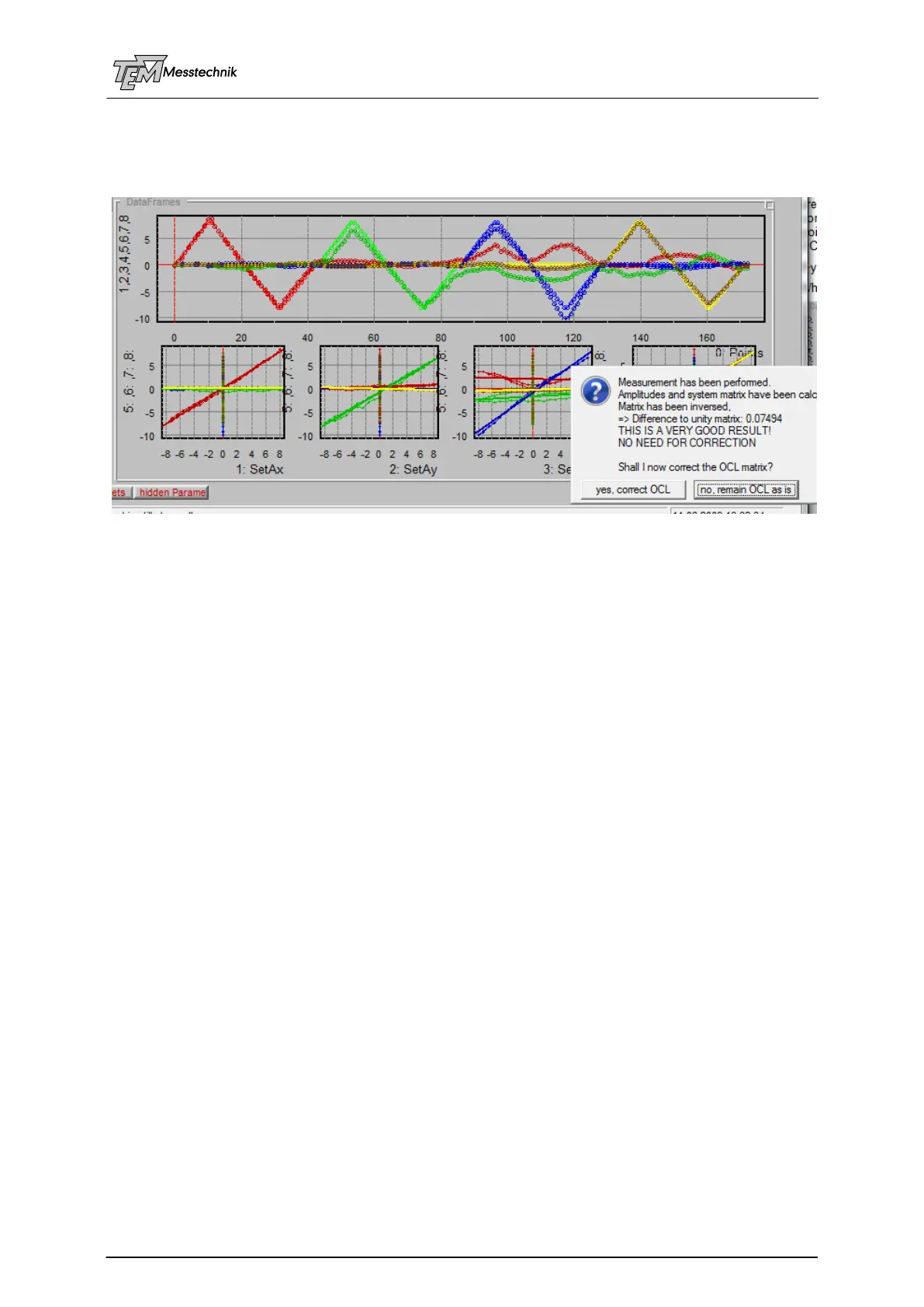
As you see in the example OCL measurements above (marked as “very good result”) you see
remaining measured angle values (red and green), even if only position is scanned (blue and
yellow).
This can be quite normal, especially with small actuators, which have a lower mechanical
resolution: A beam shift is performed by a (large) angle movement of the first actuator, and
compensated for by a (large) angle movement of the second mirror. A relatively small beam
position movement (to be corrected or scanned) is performed by the difference of two large
(angle) movements, which have effects like mechanical hysteresis, adhesion, etc. Even if
these effects are small (in the case of good mirror mounts, with polished tap surfaces, like
Aligna mirror mounts, which use extremely hard sapphire plates, special position mounting
elements,...) they are “blown up” significantly in this measurement. In the closed servo loops
they will be compensated nearly completely.
This effect is larger, if the distance between the mirrors is smaller. (More mirror movement is
necessary to reach the same position shift.)
In addition, if a motor/piezo actuator combination (MoPiA) is used, the piezo will give ex-
tremely high resolution. Therefore, even if the mechanical resolution of small motorized actua-
tors (Aligna 40) is limited, it will not limit the final resolution.
10.3.10.9.2 Offset Shifts
In the example measurement, you see a shift between the green and the dark green trace (set
and measured angle Ay). This is an effect of mechanical hysteresis. At the start of the meas-
urement, the PSD offset was automatically aligned to the actual beam pointing, to be dis-
played as 0,0,0,0.
When the Ax scan has been performed, the motors will not be exactly at the start position
because of mechanical hysteresis. Thus, the measured Ay curve is shifted against the set
curve.
However, this will be neglected, only the slope (calculated by least square fit of the measured
data against the set values), not the absolute position, is used for calculation of the matrix
elements. Because of this, these offset shifts are not important.



 To Next Page