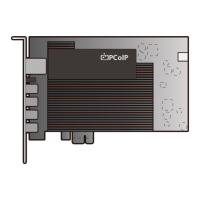
The left side of the diagram shows some of the form factors for a remote workstation in
which a host card can be installed, such as a tower workstation, a rack workstation, or a
blade workstation. The zero client on the right can connect to the remote workstation
through a direct host-client assignment, through SLP discovery, through a VMware View
Connection Server broker, or through another 3rd party connection broker. These connection
options are explained below.
Note: Other client options include PCoIP-enabled displays, phones, laptops, iPads, and other
PCoIP-enabled mobile platforms.
4.13 Prerequisites
The following conditions must be met before connecting a host card and zero client:
l The host card and zero client must have the same firmware versions. For information
how to upload firmware using the MC, see the "PCoIP Management Console User
Manual" (TER0812002). For information on how to assign a firmware file to a profile
using the MC, see MC: Firmware Management. For information on how to upload
firmware to a single host or client using the AWI, see AWI: Firmware Upload Settings.
l Your network resources must be able to meet bandwidth, QoS, latency, jitter, and packet
loss requirements. For more information about designing PCoIP network architecture,
see the "PC-over-IP Protocol Virtual Desktop Network Design Checklist"
(TER1105004).
4.13.1 Session Connection Type
Depending on the size of your PCoIP deployment, you may wish to use the Management
Console or a connection broker to manage connections between host cards and zero clients,
or you may use the AWI to configure individual hosts and clients to use a direct session
connection type.
Note: You can also use the OSD to set the client side of the session connection type
configuration.
Four connection options are available:
l Connecting hosts and clients statically
l Connecting hosts and clients using SLP host discovery
l Connecting hosts and clients using a 3rd party connection broker
l Connecting hosts and clients using the VMware View Connection Server broker
4.13.2 Connecting Hosts and Clients Statically
To statically configure a client to connect directly to a specific host card, use the Direct to
Host session connection type. You need to provide the IP address (or DNS name) of the
host for this option.
You also need to configure a Direct from Client session connection type on the host. You
have the option of allowing the host to accept a connection request from any client or from a
specific one only. If the latter, you need to provide the client's MAC address.
TER1206003 Issue 1 77
PCoIP Zero Client and Host Administrator Guide



 To Next Page