4-13
Calibration and Circuit Setup
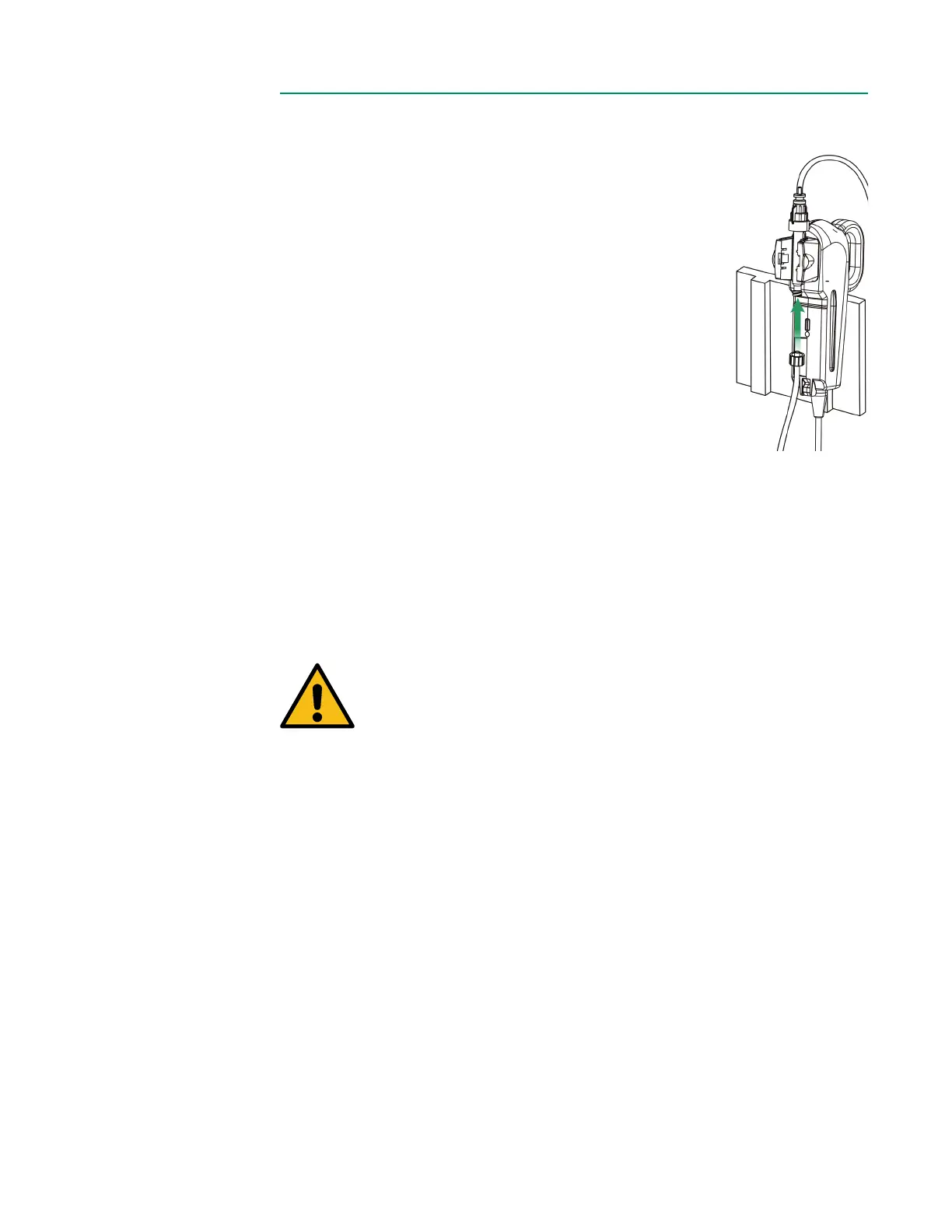
Follow these steps to install the CDI Shunt Sensor into a shunt/purge line:
1. Ensure the positioning of the BPM and CDI Shunt Sensor
is convenient for connection into the shunt/purge line.
2. Using sterile technique, remove the top Luer cap
(white) from the CDI Shunt Sensor and attach one end
of the “shunt/purge” line to the top of the CDI Shunt
Sensor. Make sure the large blue top venting luer is
completely tightened.
Note: The sensor remains attached to the BPM while being
installed in the circuit.
3. Remove the sensor lter/sparger assembly from the
bottom of the sensor. Attach the other end of the
shunt or purge line to the sensor.
Note: Air bubbles may clear more easily from the CDI Shunt Sensor when it is in an
upright position. Intermittent bubbles, once removed from the CDI Shunt Sensor, will
not affect its long-term accuracy.
4. Prime and debubble the shunt/purge line, inspecting the line and CDI Shunt
Sensor for bubbles.
5. Clear excess cabling from the work area.
Warning
Prime solutions containing acetate ions such as Isolyte-S,
Normosol-R, or Plasma-Lyte A can cause damage to the pCO
2
sensor. If the pH channel reads less than 7.00 after the sensor
is placed in the circuit, you should either recirculate the prime
solution using a CO
2
-free sweep gas or add sufcient buffer
to raise the pH of the prime above 7.00. Exposure to acetate-
containing prime solutions below pH 7.00 for longer than a few
minutes can cause signicant pCO
2
inaccuracy.
Exposure of the Shunt Sensor to prime solutions and/or blood
with pH less than 7.0 or greater than 7.8 pH units can interfere in
the accurate measurement of potassium.
Exposure of the Shunt Sensor to prime solutions and/or blood
with sodium measurement less than 120 or greater than 160
mEq/L can interfere in the accurate measurement of potassium.
The presence of air bubbles in CDI Shunt Sensors can affect the
results. Intermittent bubbles, once removed from the CDI Shunt
Sensor, will not affect its long-term accuracy.
Make sure all Luer lock connections are securely tightened before
priming the shunt/purge line. Unsecured connections can result
in a leak.



 To Next Page