Instruction manual for MH & MH+M
143
22 PROGRAM MANAGEMENT
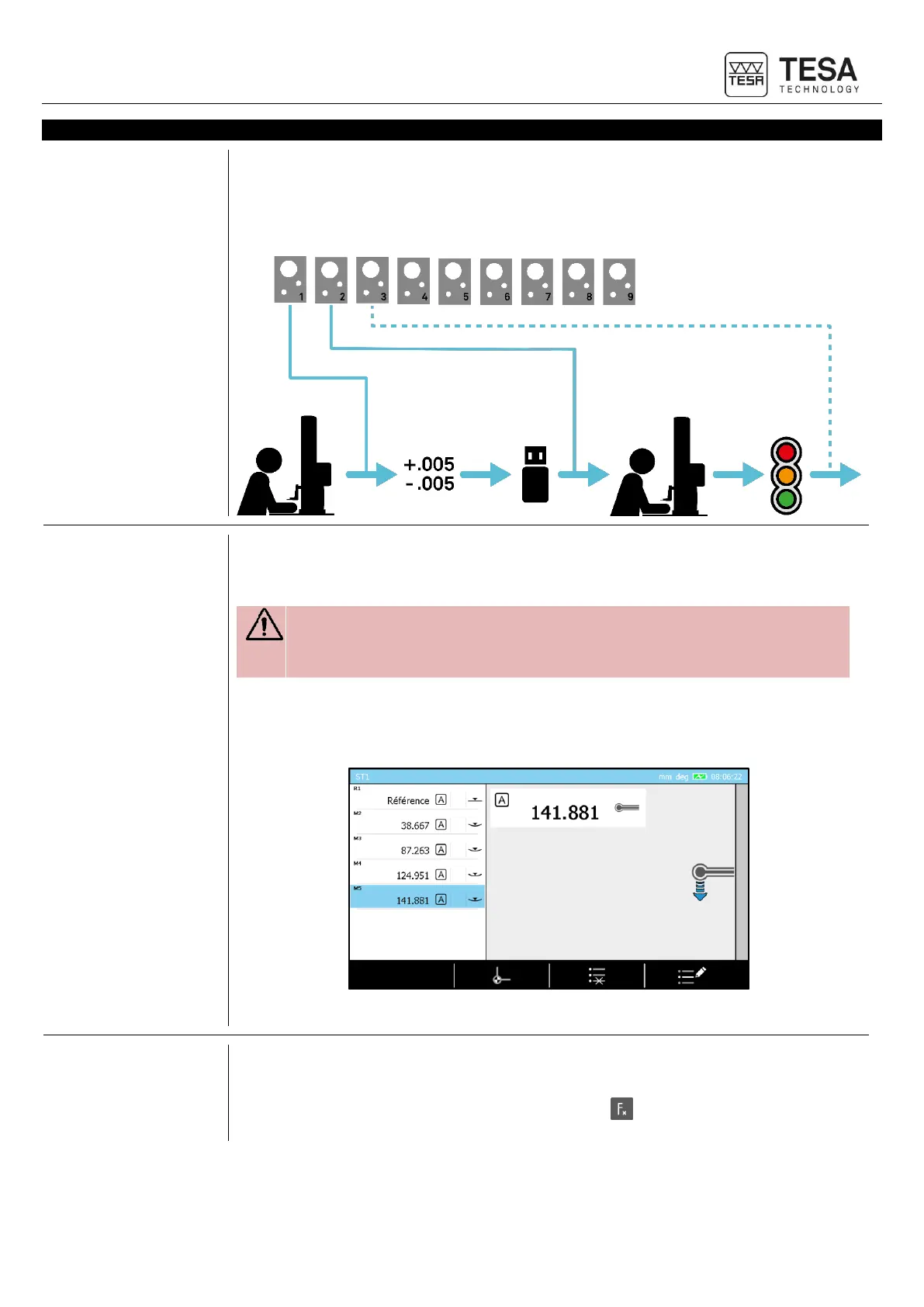
Because beyond the simple measurement of a unique part there is often the need to control
a batch of pieces that could be either small or big, TESA developed a learning mode that
gives the mean to manage in a simple way measuring sequences. Once the program has
been run, general information of the piece status is automatically displayed on the panel
screen.
The programming principle by learning means the creation of a measuring sequence on an
arbitrary piece (from a batch or not). These measuring sequences can be realised either
from ST1 or ST2 mode.
The part that is used to create the measuring sequence is not to be
considered as reference part. It is only the mean to define the steps of the
sequence by measuring feature after feature on it.
In fact, each block from the measurements’ list corresponds to a step of the measuring
sequence that can be executed later. This means that all measurements’ list corresponds to
a potential measuring sequence.
For instance, this memory of 5 blocks defines a 5 steps measuring sequence.
The tolerance management implies that measurement blocks are in memory. Without
blocks, it is not possible to insert tolerances.
Once the sequence has been done in ST1/ST2, press button from panel keyboard.





 To Next Page