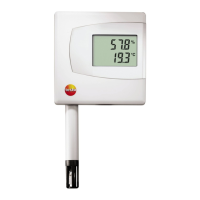
6 testo 6610 probes
71
6 testo 6610 probes
6.1. Specifications
6.1.1. Functions and use
The plug-in, adjusted probes from the testo 6610 family are used
together with the testo 6383 transmitter.
These measuring units are suitable for the following applications,
for example:
• Process instrumentation
• Clean rooms
• Test benches
• Drying processes
• Production and storage air quality
• Complex room climate applications.
6.1.1.1. Digital probes:
The probes are adjusted in the factory and transmit their
adjustment data to the internal memory of the testo 6383
transmitter. The information is only transmitted between the probes
and transmitter digitally. The probes can therefore be disconnected
from the transmitter for adjustment or servicing while the transmitter
itself can remain at the measuring point.
Hint: We recommend in this case that a probe of the same
type be inserted into the transmitter immediately in order to
be able to continue measuring with minimal interruption.
The transmitter identifies the probe and records that a probe was
connected in the history.
The testo 6383 transmitter can only be used with testo
6610 probes.
6.1.1.2. The Testo humidity sensor
With the Testo humidity sensor, which has been in successful use
and continually improved for more than ten years, the focus has
from the very beginning been on both accuracy parameters,
namely measuring uncertainty and long-term stability.
The capacitive humidity sensor is in principle a plate capacitor
consisting of two electrically conductive plates (electrodes (1) and
(2), see diagram below) opposite each other.
A humidity-sensitive polymer (5) serves as the dielectric. The
special feature lies in the perfect way the individual layers are


 To Next Page