6 testo 6610 probes
72
matched to each other. This is evident particularly in the top
electrode, which has to perform two tasks that, at first glance,
appear contradictory: it must be completely permeable to the water
vapour that is to be fed into the polymer dielectric, but at the same
time it must be impervious, smooth and repellent to condensate, oil
and dirt in order to protect the sensor.
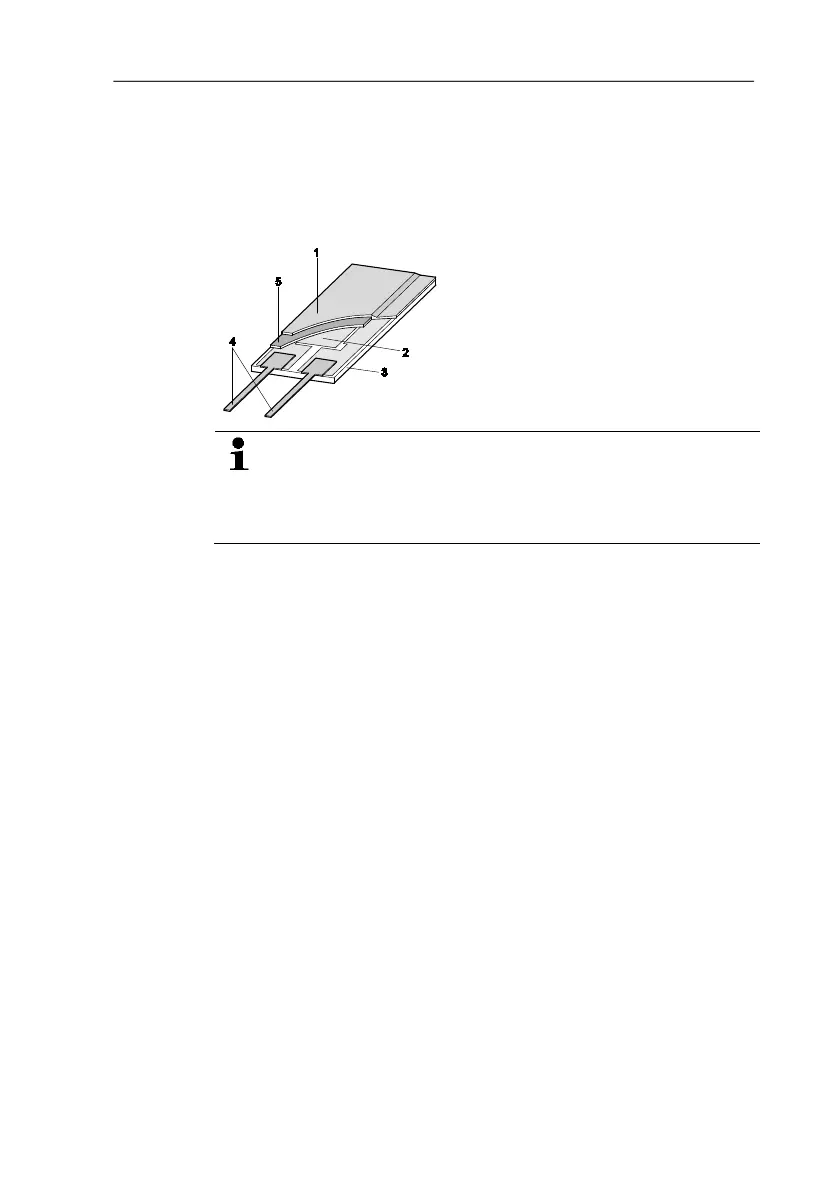
1
Cover electrode
Bottom electrode
3
Substrate (ceramic substrate for
mechanical protection)
4
Connections (protected against
corrosion)
Dielectric layer
The humidity sensor cannot be
exchanged by the customer
(except for 6611). The humidity sensor may not be
damaged or touched. Contamination and damage lead to
an impairment of the measurement and the measuring
accuracy.
6.1.1.3. Self-diagnosis
The probes in the testo 6610 range monitor their functionality
themselves and report the following faults:
• Sensor breaks
• Sensor short-circuit
• Condensation
The condensation message is issued at a reading of 100 % RH
and deactivated once the readings are within the valid range.
• Error message with drift at the adjustment points
• Value for relative humidity less than 0 % RH.
The trigger threshold is set at -2 % RH. This means that an
error message is only issued once a clear effect is discernible.
• Early warning when sensor corrosion is starting to develop
The testo 6617 probe is able to signal the first signs of
corrosion. The probe can thus be changed at an early stage
without interrupting the machine availability.
• Self-adjustment (testo 6615 only)
• Excess temperature
Error message if permissible process temperature is exceeded


 To Next Page