57
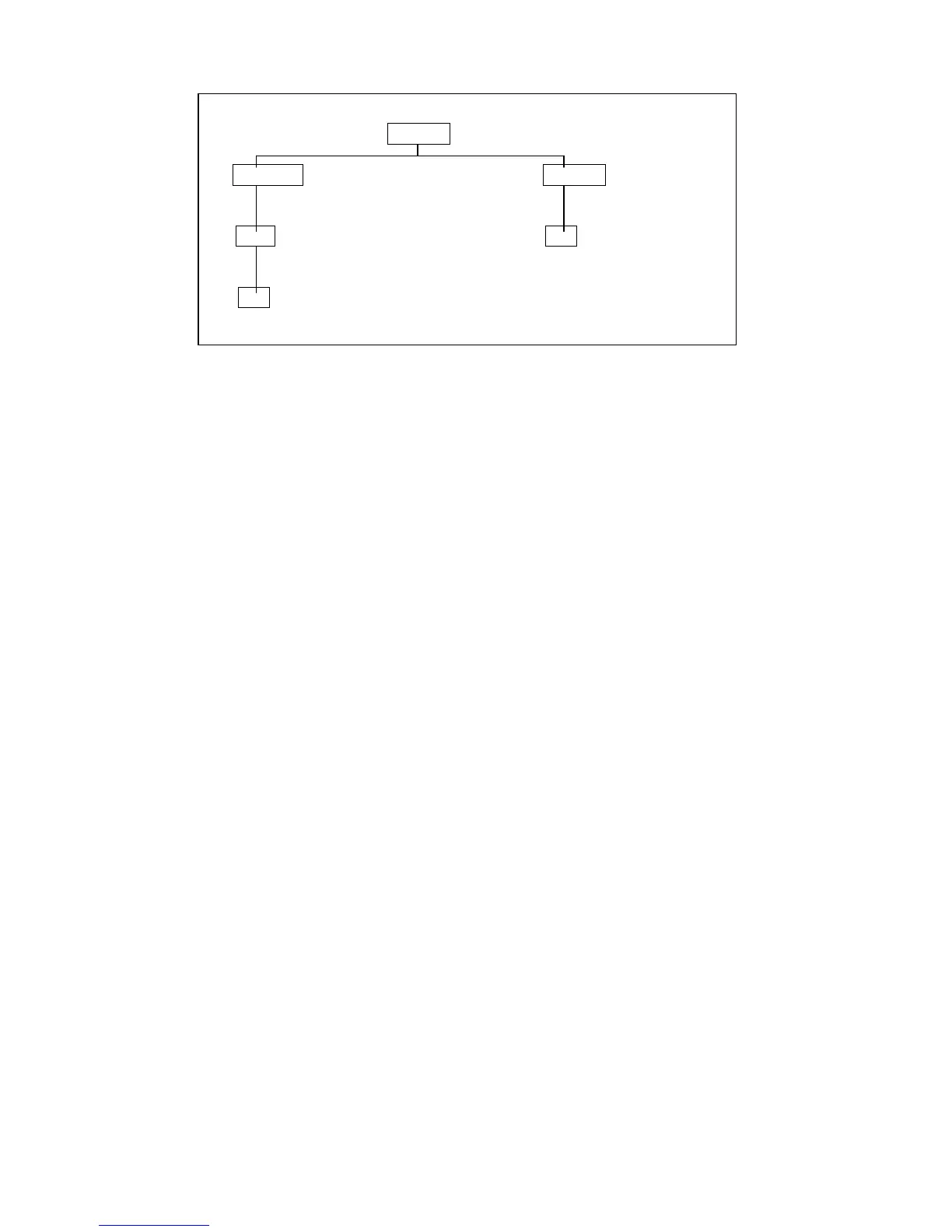
FUNCtion
IMPedence SMONitor
FUNC:IMP CPD
RANGe VIAC
FUNC:IMP:RANG 1k FUNC:SMON:STAT ON
AUTO
FUNC:IMP:RANG:AUTO ON
Figure 6-1. Command Tree Example
The basic rules of the command tree are as follows.
Letter case (upper and lower) is ignored.
For example,
FUNC:IMP CPD = func:imp cpd = Func:Imp CpD
Spaces (
︺
is used to indicate a space) must not be placed before and/or after
the colon (:).
For example,
(wrong) FUNC
︺
:
︺
IMP CPD
(right) FUNC:IMP CPD
The command can be completely spelled out or in abbreviated type.
(The rules for command abbreviation are described later in this section)
For example,
FUNCTION:IMPEDANCE CPD = FUNC:IMP CPD
The command header should be followed by a question mark (?) to generate a
query for that command.
For example,
FUNC:IMP?
The semicolon (;) can be used as a separator to execute multiple commands on a
single line. The multiple command rules are as follows.
Commands at the same level and in the same subsystem command group can
be separated by a semicolon (;) on a multiple command line.
For example,
CORR:SPOT1:STAT ON;FREQ 1KHZ
To restart commands from the highest level, a semicolon (;) must be used as the
separator, and then a leading colon (:), which shows that the restarted command
is a command at the top of the command tree, must follow.
For example,
FUNC:IMP CPD;:FUNC:SMON:STAT ON
The GPIB common commands can restart only after a semicolon on a multiple
command line.
For example,
FUNC:IMP CPD;*trg;SMON ON
The GPIB common commands keeps the previous commands level in a multiple
command line.
For example,
FUNC:IMP CPD;*SRE 32;SMON:VAC ON;IAC ON


 To Next Page