Cooling System
Maintenance
Cooling System Safety
• Swallowing engine coolant can cause poisoning;
keep out of reach from children and pets.
• Discharge of hot, pressurized coolant or touching
a hot radiator and surrounding parts can cause
severe burns.
– Always allow the engine to cool at least 15
minutes before removing the radiator cap.
– Use a rag when opening the radiator cap, and
open the cap slowly to allow steam to escape.
• Do not operate the machine without the covers
in place.
• Keep your ngers, hands, and clothing clear of the
rotating fan and drive belt.
Coolant Specication
The coolant reservoir is lled at the factory with a
50/50 solution of water and ethylene glycol base
extended-life coolant.
Important: Use only commercially available
coolants that meet the specications listed in the
Extended Life Coolant Standards T able.
Do not use conventional (green) inorganic-acid
technology (IA T) coolant in your machine. Do
not mix conventional coolant with extended-life
coolant.
Coolant T ype T able
Ethylene-Glycol Coolant
T ype
Corrosion Inhibitor T ype
Extended-life antifreeze Organic-acid technology
(OA T)
Important: Do not rely on the color of the coolant
to identify the difference between conventional (green)
inorganic-acid technology (IA T) coolant and extended-life
coolant.
Coolant manufacturers may dye extended-life coolant in
one of the following colors: red, pink, orange, yellow ,
blue, teal, violet, and green. Use coolant that meets the
specications in the Extended Life Coolant Standards
T able.
Extended Life Coolant Standards
A TSM International SAE International
D3306 and D4985 J1034, J814, and 1941
Important: Coolant concentration should be a
50/50 mixture of coolant to water .
• Preferred: When mixing coolant from a
concentrate, mix it with distilled water .
• Preferred option: If distilled water is not available,
use a pre-mix coolant instead of a concentrate.
• Minimum requirement: If distilled water and
pre-mix coolant are not available, mix concentrated
coolant with clean drinkable water .
Checking the Cooling
System and Coolant Level
Service Interval : Before each use or daily —Check
the cooling system and the coolant
level.
Before each use or daily —Remove debris from
the engine area, oil cooler , fuel cooler , and
radiator (clean them more frequently in dirty or
dusty conditions).
Every 1,500 hours —Change the engine coolant
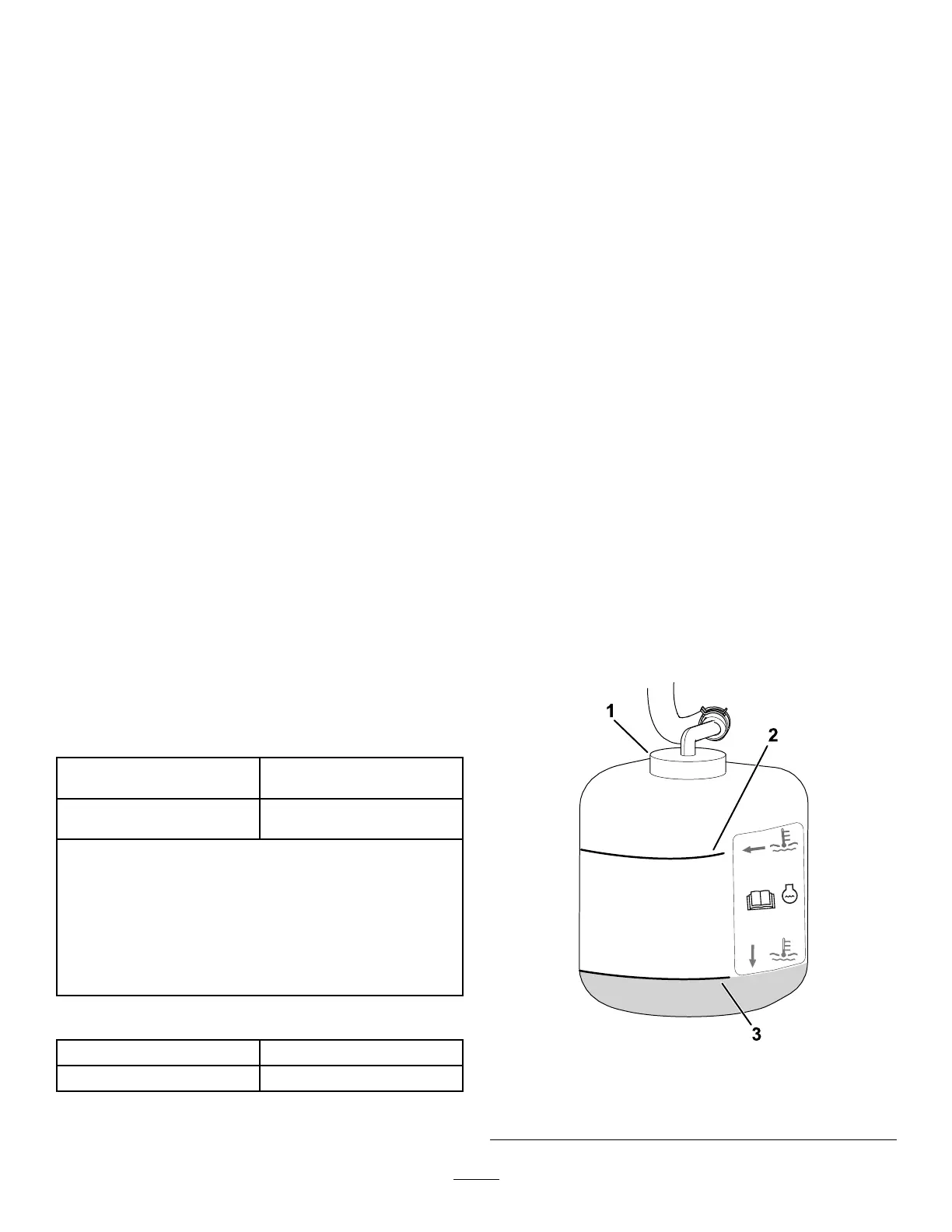
When the engine is cold, the coolant level should
be no higher than the C OLD mark on the side of the
expansion tank ( Figure 72 ). When the engine is
warm, the coolant level should be no higher than the
F ULL (H OT ) mark.
If the coolant is above the C OLD mark when the engine
is cold, it may leak out of the tank when the engine
gets hot during operation.
1. When the engine is cold, check the level of the
coolant in the expansion tank.
g325684
Figure 72
1. Cap 3. C OLD mark
2. F ULL (H OT ) mark
63


 To Next Page