If the hydraulic uid becomes contaminated, contact
your authorized T oro distributor; the system must be
ushed. Contaminated uid looks milky or black when
compared to clean uid.
Important: Use T oro replacement lters; refer to
the machine Parts Catalog . Using any other lter
may void the warranty on some components.
1. Park the machine on a level surface, lower the
cutting unit, engage the parking brake, shut of f
the engine, and remove the key .
2. Place a large drain pan under the hydraulic-uid
tank.
3. Remove the hydraulic-tank cap and dipstick.
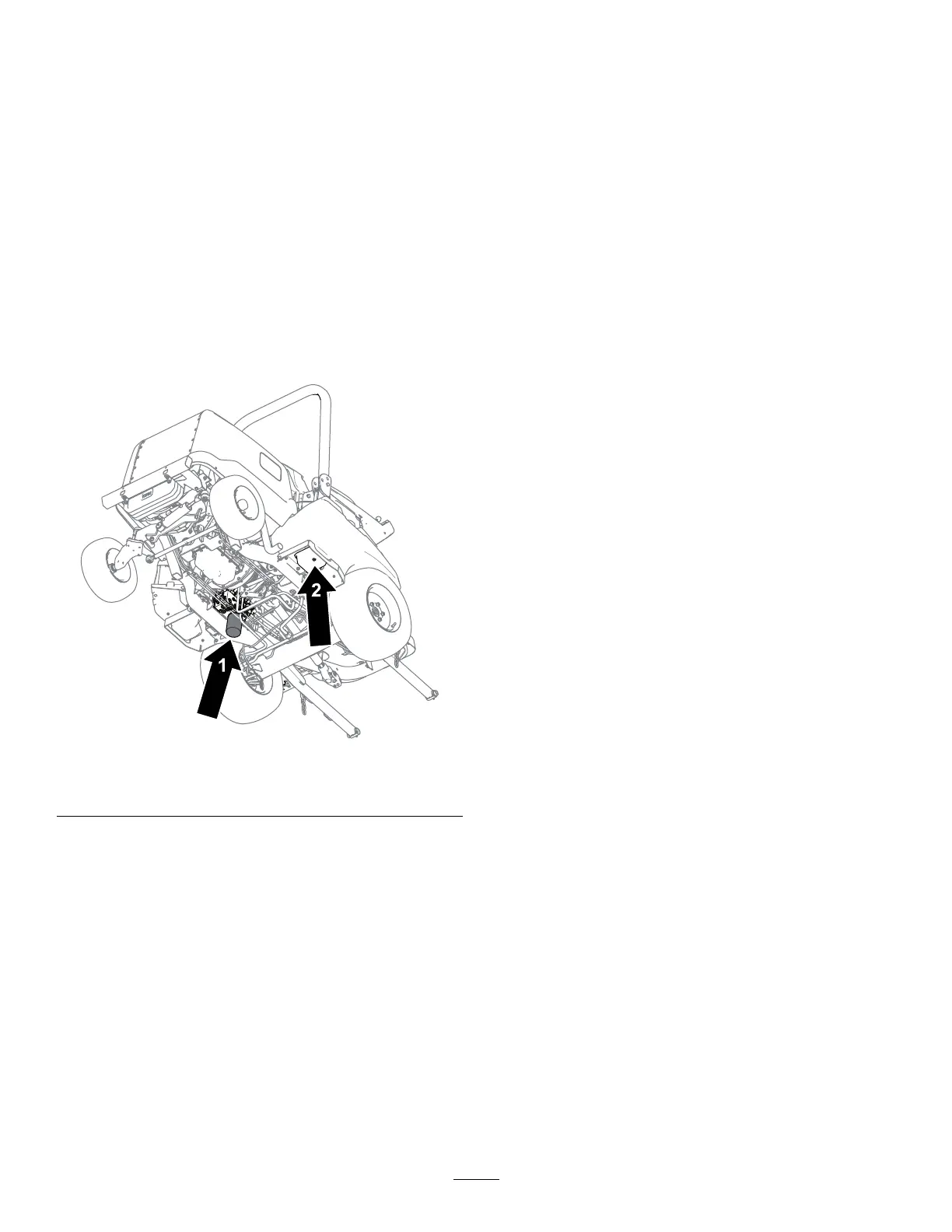
4. Remove the drain plug ( Figure 85 ) from the
bottom of the tank and let the hydraulic uid ow
into the pan.
g286315
Figure 85
1. Hydraulic lter
2. Drain plug
5. Clean the area around the lter-mounting area.
6. Place a drain pan under the lter ( Figure 85 ),
remove the lter , and let any remaining oil drain
into the pan.
7. Lubricate the new lter gasket and ll the lter
with hydraulic uid.
8. Ensure that the lter-mounting area is clean
and screw the lter on until the gasket contacts
the mounting plate; then tighten the lter an
additional 1/2 turn.
9. Fill the hydraulic tank with hydraulic uid; refer
to Checking the Hydraulic-Fluid Level ( page 69 ) .
Important: Use only the hydraulic uids
specied. Other uids could cause system
damage.
10. Install the drain plug when the hydraulic uid
stops draining.
1 1. Install the reservoir dipstick and cap.
12. Start the engine and use all of the hydraulic
controls in the following order to distribute
hydraulic uid throughout the system:
A. Use the traction pedal to move the machine
forward and backward.
B. Use the steering wheel to move the tires all
the way to the right and left.
C. Use the lift switch to raise and lower the
attachment (e.g., cutting unit).
13. Check for leaks and shut of f the engine.
14. Check the hydraulic uid level in the tank; refer
to Checking the Hydraulic-Fluid Level ( page 69 ) .
Checking the Hydraulic
Lines and Hoses
Service Interval : Every 2 years
Inspect the hydraulic lines and hoses daily for
leaks, kinked lines, loose mounting supports, wear ,
loose ttings, weather deterioration, and chemical
deterioration. Make all necessary repairs before
operating the machine.
71


 To Next Page