E6582233
K-2
11
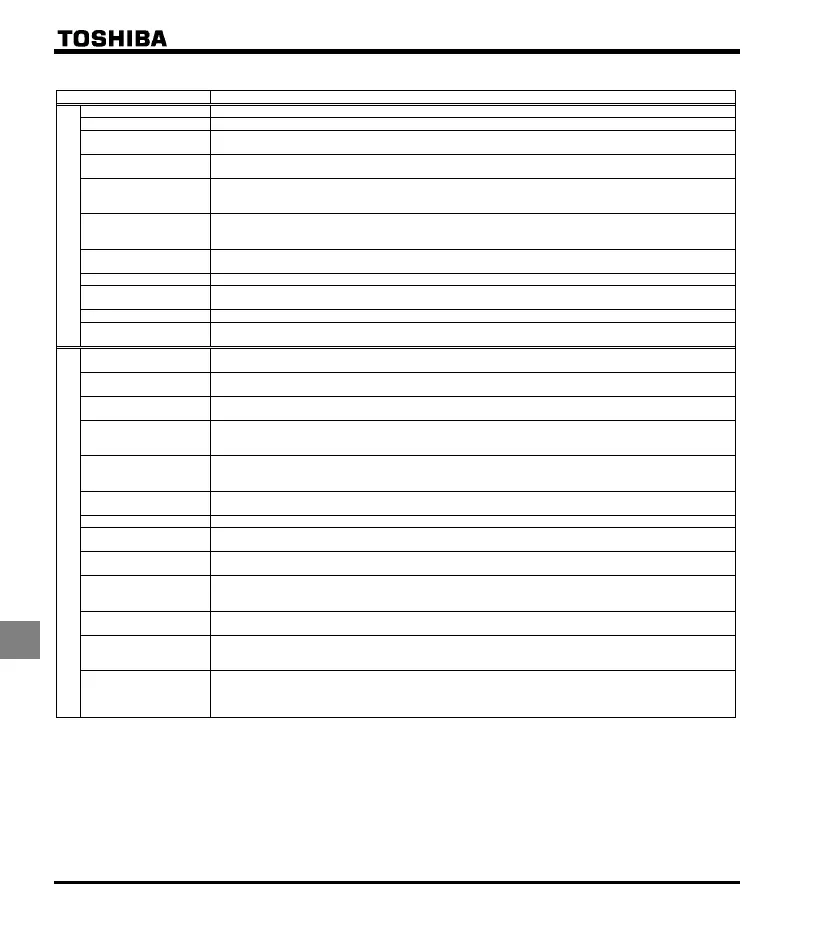
Common specification
Item Specification
Principal control functions
Control system Sinusoidal PWM control
Output frequency range 0.1 to 400.0Hz, default setting: 0.5 to 50Hz, maximum frequency: 30 to 400Hz
Minimum setting steps of
frequency
0.1Hz: analog input (when the max. frequency is 100Hz), 0.01Hz: Operation panel setting and communication
setting.
Frequency accuracy Digital setting: within ±0.1% of the max. frequency (-10 to +60°C)
Analog setting: within ±1.0% of the max. frequency (25°C ±10°C)
Voltage/frequency
characteristics
V/f constant, variable torque, automatic torque boost, vector control, automatic energy-saving, V/F 5-point setting,
Auto-tuning. Base frequency (20-400Hz) adjusting to 1 & 2, torque boost (0-30%) adjusting to 1 & 2, adjusting
frequency at start (0.1-10Hz)
Frequency setting signal Setting dial on the front panel, external frequency potentiometer (connectable to a potentiometer with a rated
impedance of 1k-10kΩ), 0-10Vdc / 0-5Vdc (input impedance: VI=40kΩ), 4-20mAdc (Input impedance: 250Ω).
Note 1)
Terminal board base
frequency
The characteristic can be set arbitrarily by two-point setting. Possible to set: analog input (VI).
Frequency jump Setting of the jump frequency and the range.
Upper- and lower-limit
frequencies
Upper-limit frequency: 0 to max. frequency, lower-limit frequency: 0 to upper-limit frequency
PWM carrier frequency Adjustable range of 2k to 12kHz (default: 4kHz).
PID control Setting of proportional gain, integral gain, differential gain and control waiting time. Checking whether the amount of
processing amount and the amount of feedback agree.
Operation specifications
Acceleration/deceleration
time
Selectable from among acceleration/deceleration times 1 & 2 (0.0 to 3000 sec.). Automatic
acceleration/deceleration function. S-pattern acceleration/deceleration 1 & 2. Control of forced rapid deceleration.
DC braking Braking start-up frequency: 0 to maximum frequency, braking rate: 0 to 100%, braking time: 0 to 20 seconds,
emergency DC braking.
Dynamic Braking Drive
Circuit
Control and drive circuit is built in the inverter with the braking resistor outside (optional).
VFNC3E-4004P to 4007P models cannot be used with the braking resistor.
Input terminal function
(programmable)
Possible to select from among about 60 functions, such as forward/reverse run signal input, jog run signal input,
operation base signal input and reset signal input, to assign to 5 input terminals. Logic selectable between sink and
source.
Output terminal functions
(programmable)
Possible to select from among about 40 functions, such as upper/lower limit frequency signal output, low speed
detection signal output, specified speed reach signal output and failure signal output, to assign to FL relay output,
open collector output terminals.
Forward/reverse run The RUN and STOP keys on the operation panel are used to start and stop operation, respectively.
Forward/reverse run possible through communication and logic inputs from the terminal block.
Jog run Jog mode, if selected, allows jog operation from the terminal board.
Preset speed operation Frequency references + 15-speed operation possible by changing the combination of 4 contacts on the terminal
board.
Retry operation Capable of restarting automatically after a check of the main circuit elements in case the protective function is
activated. 10 times (Max.) (selectable with a parameter)
Various prohibition settings
/ Password setting
Possible to write-protect parameters and to prohibit the change of panel frequency settings and the use of operation
panel for operation, emergency stop or resetting. Possible to write-protect parameters by setting 4 digits password
and terminal input.
Regenerative power ride-
through control
Possible to keep the motor running using its regenerative energy in case of a momentary power failure (default:
OFF).
Auto-restart operation In the event of a momentary power failure, the inverter reads the rotational speed of the coasting motor and outputs
a frequency appropriate to the rotational speed in order to restart the motor smoothly. This function can also be
used when switching to commercial power.
Failure detection signal 1c- contact output Note 2)
Maximum switching capacity : 250Vac-2A , 30Vdc-2A (At resistive load cosΦ=1),
250Vac-1A (cosΦ=0.4) , 30Vdc-1A (L/R=7ms)
Minimum permissible load : 5Vdc-100mA, 24Vdc-5mA
<Continued overleaf>


 To Next Page
 Loading...