CUTMASTER 10MM, 12MM OPERATION
Operation 4-6 Manual 0-5230
4.04 Cut Quality
NOTE
Cut quality depends heavily on setup and
parameters such as torch standoff, align
-
ment with the workpiece, cutting speed,
gas pressures, and operator ability.
Refer to Appendix pages for additional
information as related to the Power Source
used.
Cut quality requirements differ depending on applica-
tion. For instance, nitride build-up and bevel angle
may be major factors when the surface will be welded
after cutting. Dross-free cutting is important when fin-
ish cut quality is desired to avoid a secondary cleaning
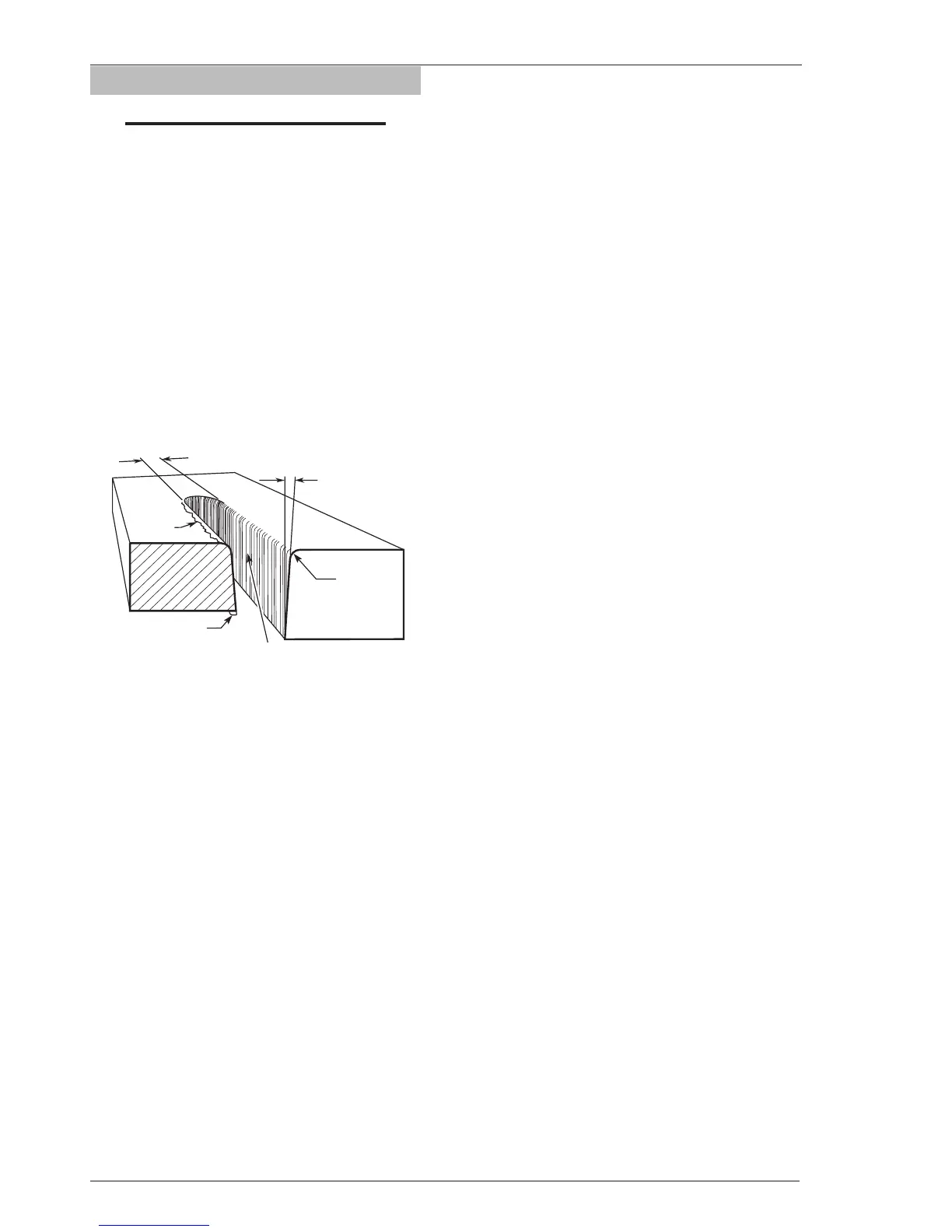
operation. The following cut quality characteristics
are illustrated in the following figure:
Kerf Width
Cut Surface
Bevel Angle
Top Edge
Rounding
Cut Surface
Drag Lines
Dross
Build-Up
Top
Spatter
A-00007
Figure 4-12 - Cut Quality Characteristics
Cut Surface
The desired or specified condition (smooth or
rough) of the face of the cut.
Nitride Build-Up
Nitride deposits can be left on the surface of the
cut when nitrogen is present in the plasma gas
stream. These buildups may create difficulties
if the material is to be welded after the cutting
process.
Bevel Angle
The angle between the surface of the cut edge
and a plane perpendicular to the surface of the
plate. A perfectly perpendicular cut would result
in a 0° bevel angle.
Top-Edge Rounding
Rounding on the top edge of a cut due to wearing
from the initial contact of the plasma arc on the
workpiece.
Bottom Dross Buildup
Molten material which is not blown out of the cut
area and resolidifies on the plate. Excessive dross
may require secondary cleanup operations after
cutting.
Kerf Width
The width of the cut (or the width of material re-
moved during the cut).
Top Spatter (Dross)
Top spatter or dross on the top of the cut caused by
slow travel speed, excess cutting height, or cutting
tip whose orifice has become elongated.












 To Next Page