Label Switching Routers
Page 30 7450 ESS MPLS Guide
If dynamic bypass creation is disabled on the node, it is recommended to configure additional
manual bypass LSPs to handle the required number of associations.
Refer to Configuring Manual Bypass Tunnels on page 181 for configuration information.
PLR Bypass LSP Selection Rules
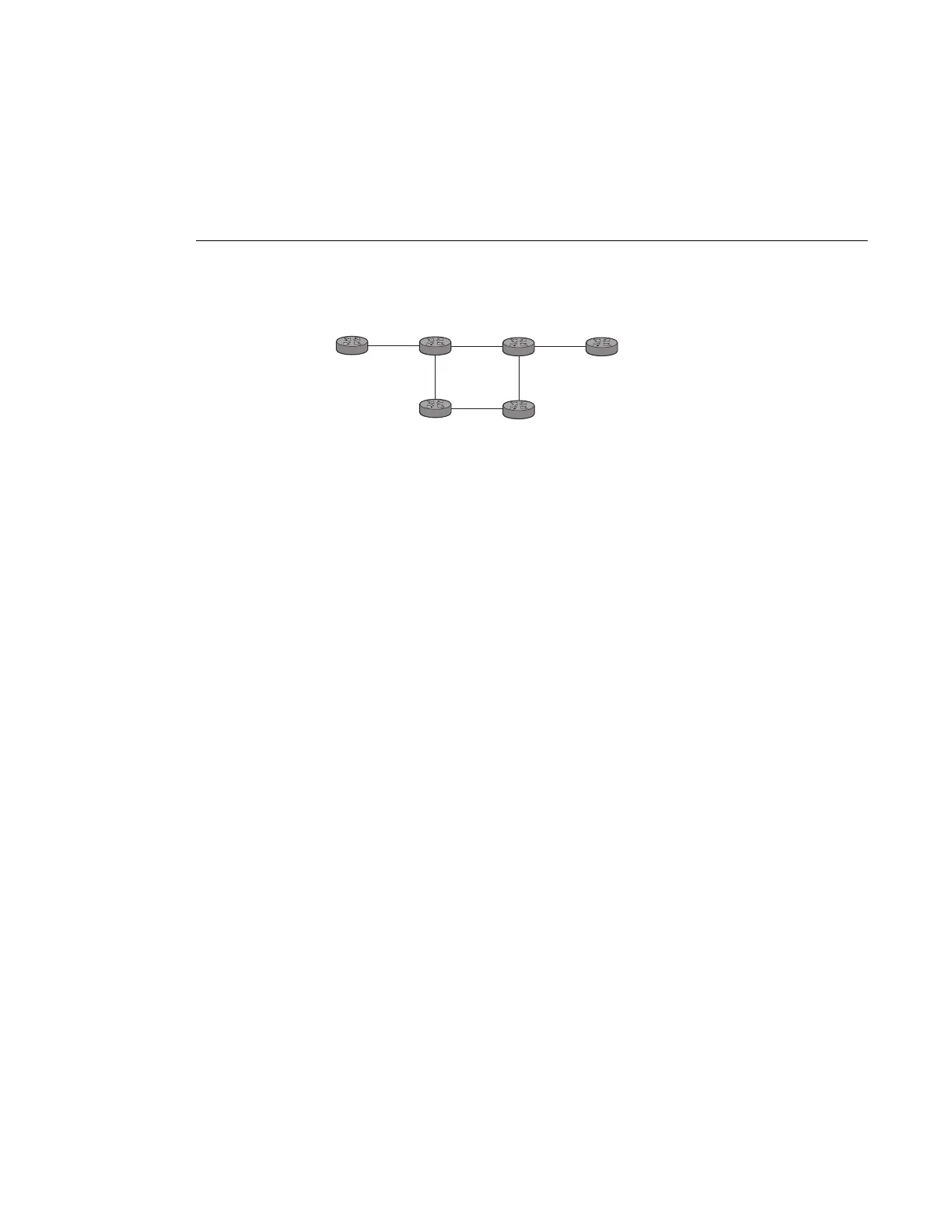
Figure 3: Bypass Tunnel Nodes
The PLR uses the following rules to select a bypass LSP among multiple manual and dynamic
bypass LSPs at the time of establishment of the primary LSP path or when searching for a bypass
for a protected LSP which does not have an association with a bypass tunnel:
1. The MPLS/RSVP task in the PLR node checks if an existing manual bypass satisfies the
constraints. If the path message for the primary LSP path indicated node protection
desired, which is the default LSP FRR setting at the head end node, MPLS/RSVP task
searches for a node-protect’ bypass LSP. If the path message for the primary LSP path
indicated link protection desired, then it searches for a link-protect bypass LSP.
2. If multiple manual bypass LSPs satisfying the path constraints exist, it will prefer a
manual-bypass terminating closer to the PLR over a manual bypass terminating further
away. If multiple manual bypass LSPs satisfying the path constraints terminate on the
same downstream node, it selects one with the lowest IGP path cost or if in a tie, picks the
first one available.
3. If none satisfies the constraints and dynamic bypass tunnels have not been disabled on
PLR node, then the MPLS/RSVP task in the PLR will check if any of the already
established dynamic bypasses of the requested type satisfies the constraints.
4. If none do, then the MPLS/RSVP task will ask CSPF to check if a new dynamic bypass of
the requested type, node-protect or link-protect, can be established.
5. If the path message for the primary LSP path indicated node protection desired, and no
manual bypass was found after Step 1, and/or no dynamic bypass LSP was found after 3
attempts of performing Step 3, the MPLS/RSVP task will repeat Steps 1-3 looking for a
suitable link-protect bypass LSP. If none are found, the primary LSP will have no
protection and the PLR node must clear the “local protection available” flag in the IPv4







 To Next Page