GMPLS
7450 ESS MPLS Guide Page 427
1830 PSS Identifiers
This section describes the various identifiers used on the 1830 PSS that are relevant to configuring
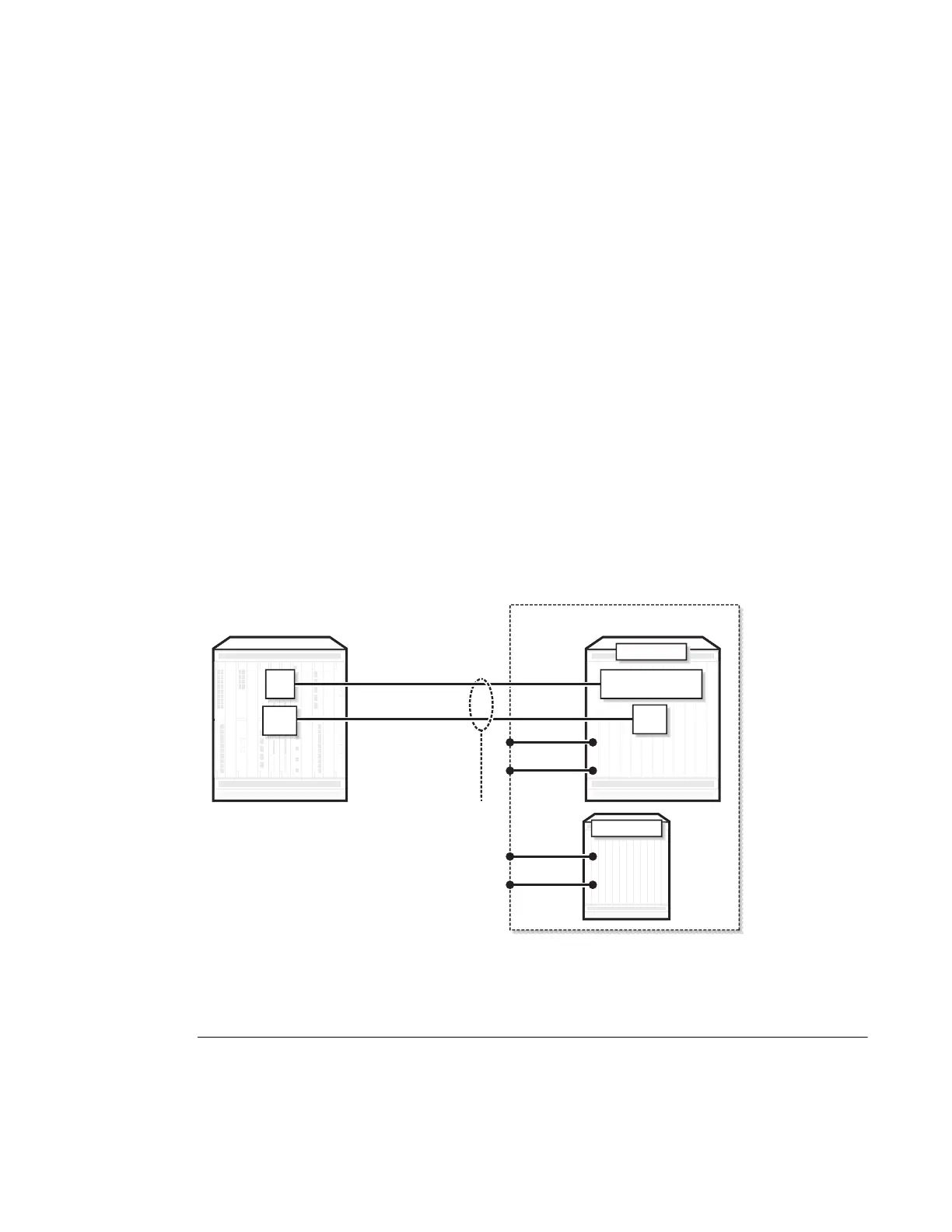
the GMPLS UNI on the 7x50 in conjunction with the 1830 PSS. The following figure illustrates
the identifier architecture of an 1830 PSS multi-shelf system. The multi-shelf system consists of a
control plane node and one or more data plane nodes. The following identifiers are used:
• IP Management loopback — This is the IP loopback address used for LMP and RSVP.
• IPCC IP address — This is the source/destination address for IPCC maintenance
messages such as LMP hellos and LMP config messages. When only one IPCC exists
between a 7x50 and 1830 PSS pair, this may be the same as the IP management loopback.
• CP Node ID — This is a non-routable identifier for the control plane node. It is used for
identifying this node in the optical domain; for example, the session/sender template. It is
also used in the RSVP ERO to identify the 1830 PSS node.
• DP Node ID — This is a non-routable identifier for a data plane node. This identifies a
particular data plane shelf in the optical domain. Visibility of this identifier is not required
by the 7750 SR; the 1830 PSS will map TE Link IDs to specified DP nodes.
• TE Link IDs — The TE Link ID is unique across a set of DP and CP nodes forming an
1830 PSS.
Figure 39: Identifier Architecture
LMP/RSVP-TE
IPCC Maintenance
CP Node ID
DP Node ID
7x50 1830PSS
Data
Plane
shelf
Multi-shelf system
24851
TE Link 1
IPCC
TE Link 2
TE Link 3
TE Link 4
NW
IP IF
IP
LB
IP Management
LB
IPCC
IP IF







 To Next Page