MPLS and RSVP
7450 ESS MPLS Guide Page 43
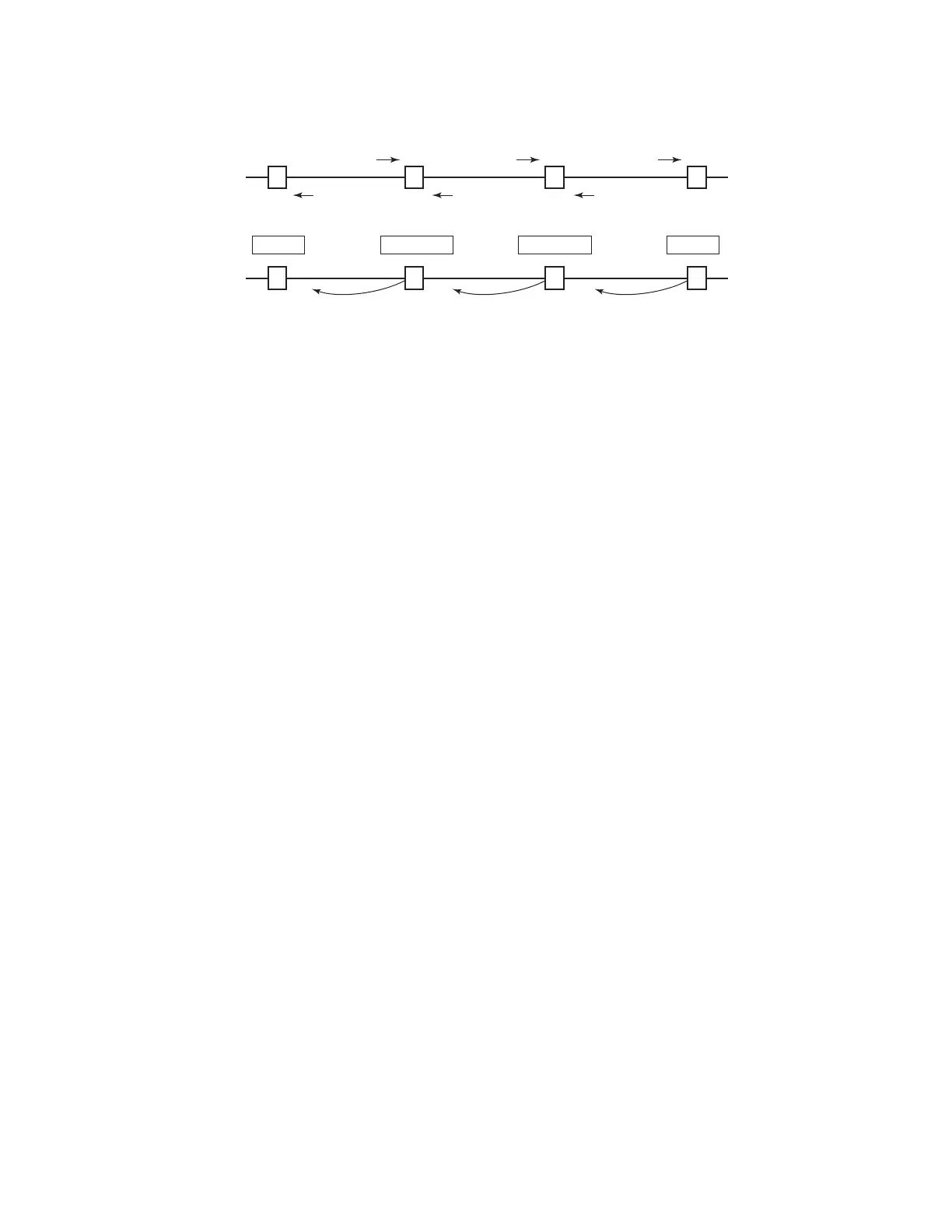
Figure 6: LSP Using RSVP Path Set Up
Figure 6 displays an example of an LSP path set up using RSVP. The ingress label edge router
(ILER 1) transmits an RSVP path message (path: 30.30.30.1) downstream to the egress label edge
router (ELER 4). The path message contains a label request object that requests intermediate LSRs
and the ELER to provide a label binding for this path.
In addition to the label request object, an RSVP PATH message can also contain a number of
optional objects:
• Explicit route object (ERO) — When the ERO is present, the RSVP path message is
forced to follow the path specified by the ERO (independent of the IGP shortest path).
• Record route object (RRO) — Allows the ILER to receive a listing of the LSRs that the
LSP tunnel actually traverses.
• A session attribute object controls the path set up priority, holding priority, and local-
rerouting features.
Upon receiving a path message containing a label request object, the ELER transmits a RESV
message that contains a label object. The label object contains the label binding that the
downstream LSR communicates to its upstream neighbor. The RESV message is sent upstream
towards the ILER, in a direction opposite to that followed by the path message. Each LSR that
processes the RESV message carrying a label object uses the received label for outgoing traffic
associated with the specific LSP. When the RESV message arrives at the ingress LSR, the LSP is
established.
1
PATH:30.30.30.1
label
100|push
100 200 300
RESV:10.10.10.1 RESV:10.10.10.1 RESV:10.10.10.1 RESV:10.10.10.1
3
PATH:30.30.30.1
42
PATH:30.30.30.1
NYC
30.30.30.1
SFO
10.10.10.1
1342
NYC
30.30.30.1
SFO
10.10.10.1
label
100|200|swap
label
200|300|swap
label
300|pop
OSSG016







 To Next Page