Label Distribution Protocol
7450 ESS MPLS Guide Page 543
one area to another. Note that only the user packets are tunneled over the RSVP LSPs. The T-LDP
control messages are still sent unlabeled using the IGP shortest path.
Note that in this application, the bi-directional RSVP LSP tunnels are not treated as IP interfaces
and are not advertised back into the IGP. A PE must always rely on the IGP to look up the next hop
for a service packet. LDP-over-RSVP introduces a new tunnel type, tunnel-in-tunnel, in addition
to the existing LDP tunnel and RSVP tunnel types. If multiple tunnels types match the destination
PE FEC lookup, LDP will prefer an LDP tunnel over an LDP-over-RSVP tunnel by default.
The design in Figure 49 allows a service provider to build and expand each area independently
without requiring a full mesh of RSVP LSPs between PEs across the three areas.
In order to provide a VLL service, PE1 and PE2 are still required to set up a targeted LDP session
directly between them. Again a 3 label stack is required, the RSVP LSP label, followed by the
LDP label for the loopback address of the destination PE, and finally the pseudowire label (VC
label).
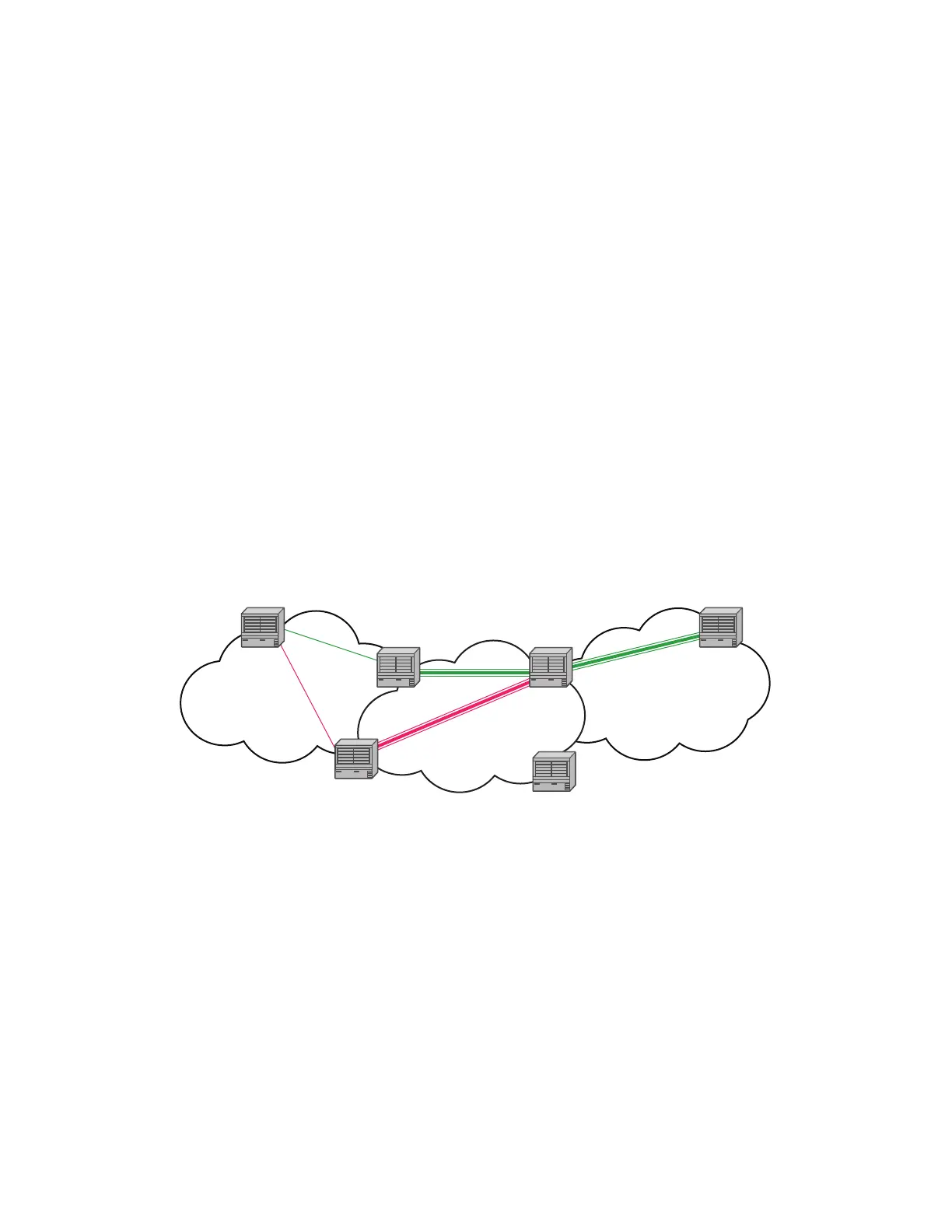
This implementation supports a variation of the application in Figure 49, in which area 1 is an
LDP area. In that case, PE1 will push a two label stack while ABR1 will swap the LDP label and
push the RSVP label as illustrated in Figure 50. LDP-over-RSVP tunnels can also be used as IGP
shortcuts.
Figure 50: LDP over RSVP Application Variant
IP/MPLS
Core Network
(RSVP Area 3)
IP/MPLS
Metro Network
(RSVP Area 2)
IP/MPLS
Metro Network
(LDP Area 1)
ABR 1 ABR 2
ABR 3
ABR 4
PE 2
LSP3
LSP2
LDP LSP1a
LSP2a
LDP
LSP1
7450 ESS
7450 ESS
7450 ESS
7450 ESS
7450 ESS
PE 1
7450 ESS
OSSG129A7450







 To Next Page