CB (E6.1) 07/2017 Page 24/145
Notes on handling carbon dioxide (CO
2
)
Carbon dioxide (CO
2
) in high concentrations is hazardous to health. It is colorless and almost odorless
and therefore practically imperceptible. Vent out any CO
2
gas that may escape via good room ventilation
or a suitable connection to an exhaust system. We recommend installing a CO
2
warning system.
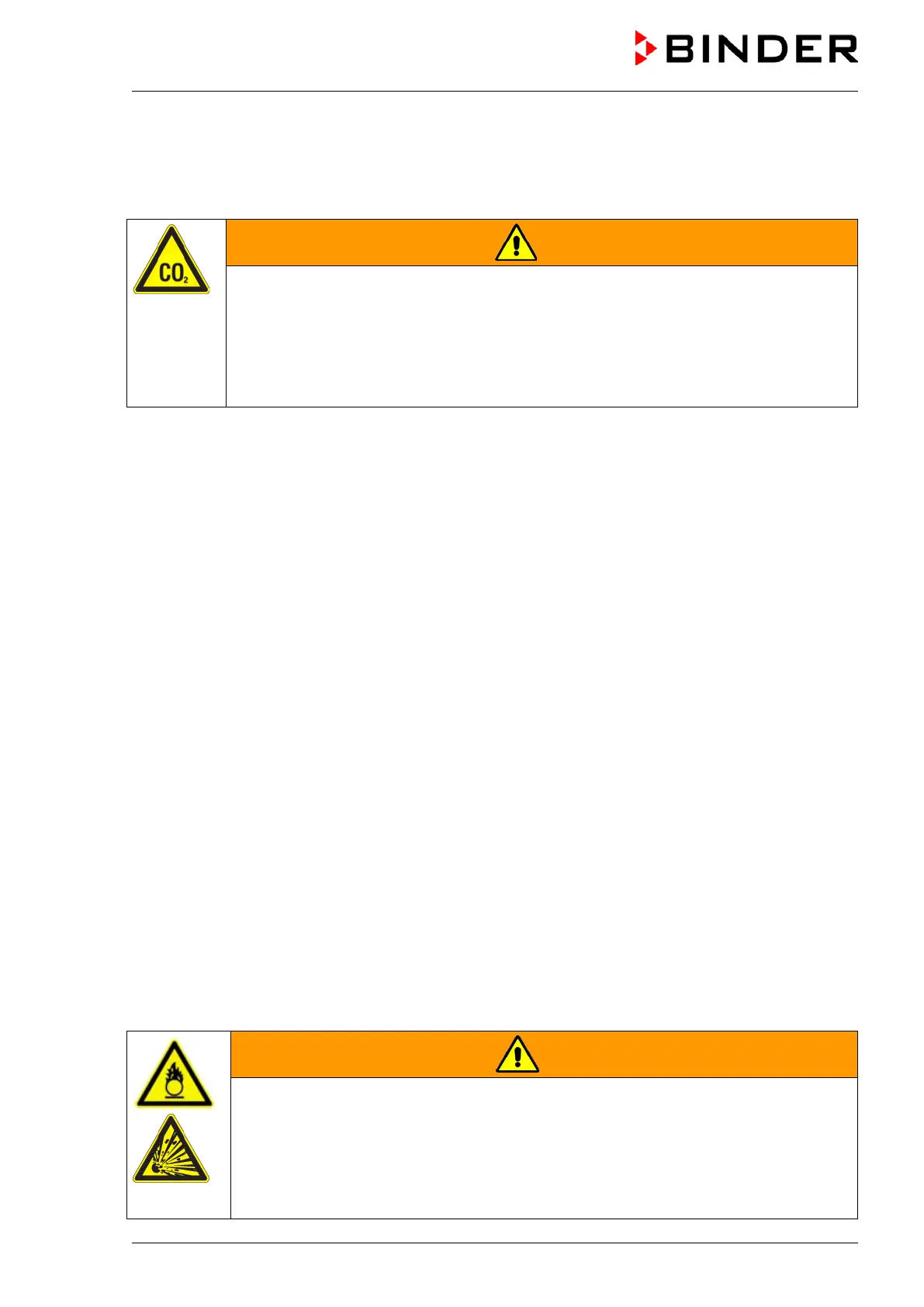
WARNING
High concentration of CO
2
(> 4 Vol.-%).
Danger of death by suffocation.
Danger of poisoning.
∅ Do NOT set up chambers in non-ventilated recesses.
Ensure technical ventilation measures.
Observe the relevant regulations for handling CO
2
.
Observe the occupational exposure limit OEL for CO
2
set by the national authorities (formerly
maximum permitted workplace concentration). Check compliance when operating all chambers located in
the room.
• OEL for Germany: 5000 ml/m
3
(ppm) = 0,5 Vol.-%
• CO
2
lost with each opening the door: about 16.4 g, i.e. 0.0084 cubic meters / 0.296 cubic feet (under
normal pressure)
• CO
2
lost during 12h at 5 vol.-% without opening the door: approx. < 2 g, i.e. 0.001 cubic meter / 0.035
cubic feet (under normal pressure 1013 mbar / 14.7 psi)
An example of how to evaluate laboratory volume and air change rate:
Question: Is an air change rate of 1/h sufficient for a lab with a volume of 100 cubic meters /
3,531.5 cubic feet with 10 incubators CB, opened 4 times per hour?
Calculation: CO
2
concentration = CO
2
lost by opening the door, multiplied by 10 chambers,
multiplied by opening the door 4 times per hour, divided by lab volume
0.0084 cubic meters x 10 x 4 div. 100 cubic meters = 0.00336, i.e. 0.336 % or 3360 ppm.
0.296 cubic feet x 10 x 4 div. 3,531.5 cubic feet = 0.00336, i.e. 0.336 % or 3360 ppm.
Result: The maximum permissible value of 5000 ppm is not exceeded under these operation
conditions.
Even when CO
2
or systems operated with CO
2
are handled carefully and appropriately, a residual risk
remains, which can lead to life-threatening situations under certain circumstances. Therefore we strongly
recommend continuous monitoring of CO
2
concentration in the ambient air of the CO
2
incubator. It must
be ensured permanently that the maximum permissible occupational exposure limit OEL for CO
2
(0.5 vol -
% CO
2
for Germany) is not exceeded.
Chamber with O
2
control: Notes on handling oxygen (O
2
)
Oxygen (O
2
) is colorless and almost odorless and therefore practically imperceptible. It promotes burns,
which can proceed explosively. There is a fire hazard for flammable oxygenated materials, e.g. clothes
and hair. O
2
is heavier than air and may accumulate in low-lying areas.
WARNING
High concentration of O
2
(> 21 % O
2
).
Fire and explosion hazard through contact of combustible materials with O
2
.
Risk of burns and other injuries.
∅ Do NOT set up chambers in non-ventilated recesses.
Ensure technical ventilation measures.
Observe the relevant regulations for handling O
2
.



 To Next Page