42 Biodex Medical Systems, Inc. © 2017
7. Testing Modes
The Biodex Balance System SD allows clinicians to assess a patient’s neuromuscular control in a
closed-chain, multi-plane test by quantifying the ability of the patient to maintain dynamic
unilateral or bilateral postural stability on either a static or unstable surface. The degree of
surface instability is controlled by the system’s microprocessor-based actuator. The clinician
selects the test duration, stability level, and protocol.
In a dynamic test, once the session begins, the patient’s ability to control the platform angle is
quantified as a variance from the locked (level) position, as well as degrees of deflection over
time. A large variance may be indicative of poor neuromuscular response. Further insight into
specific neuromuscular activation patterns is realized with the quantification of
anterior/posterior and medial/lateral platform tilt. Predictive Values and Comparative (Bilateral)
reports are available to chart the patient’s performance. Bilateral comparisons quickly
document differences between each lower extremity.
Static testing measures the angular excursion of the patient's Center of Gravity (COG). Body
height is a factor for static measures. A person's COG is approximately 55% of their height.
Based on a selected height, an appropriate static measure scaling is applied. Testing in this
mode is ideal for baseline testing for movement disorder, vestibular dysfunction, and
orthopedic patients. Good static testing scores can lead to a progression into dynamic testing
and training.
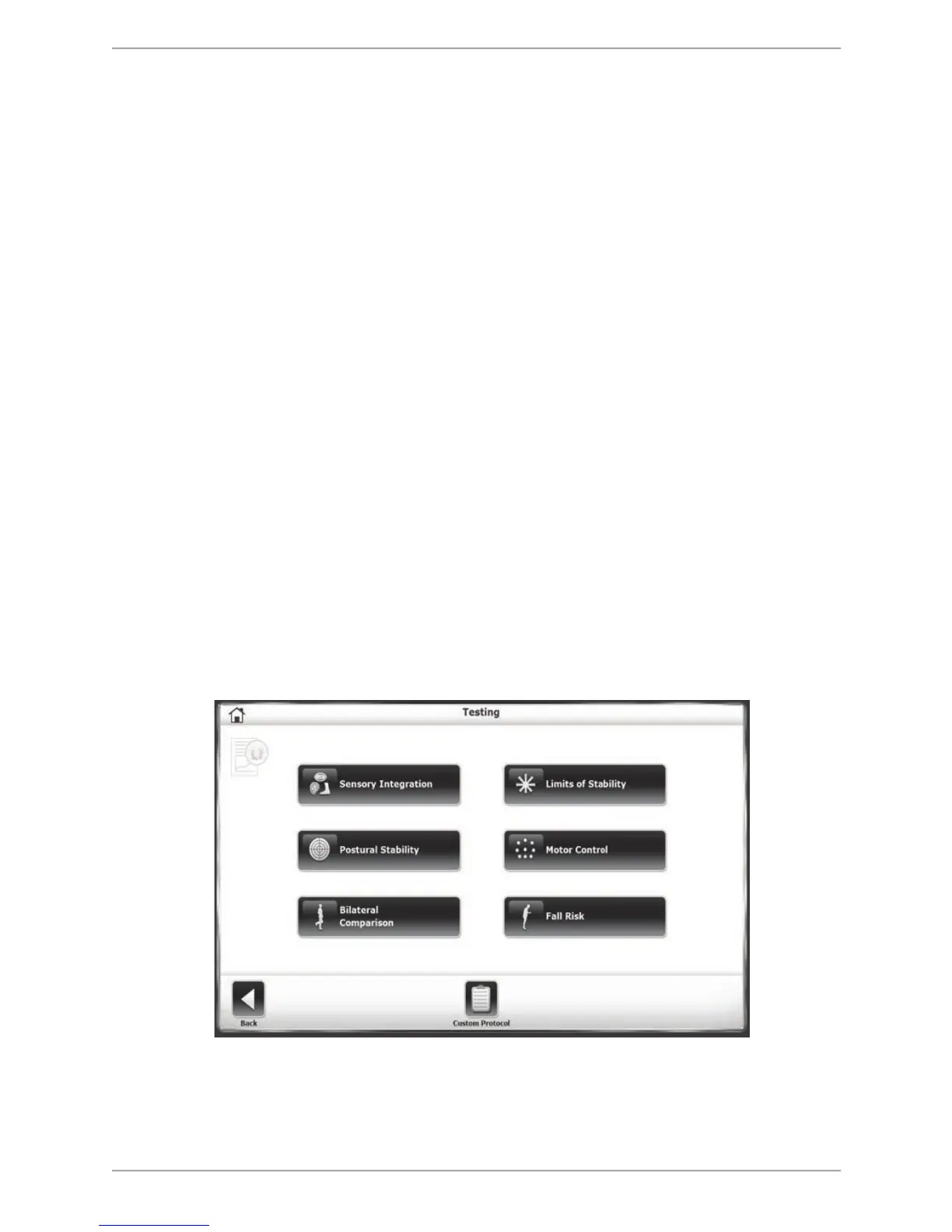
Test formats include Sensory Integration (m-CTSIB, BESS), Postural Stability, Bilateral
Comparison (i.e., comparison of postural stability performance of standing on one leg versus
standing on the other), Limits of Stability, Motor Control, and Fall Risk. There is an option for
selecting a customized protocol. The steps for customizing a protocol are listed in the System
Utilities section of this document.
Figure 7.1. The Testing Menu screen.


 To Next Page