Balance System SD (with v4.X software) 31
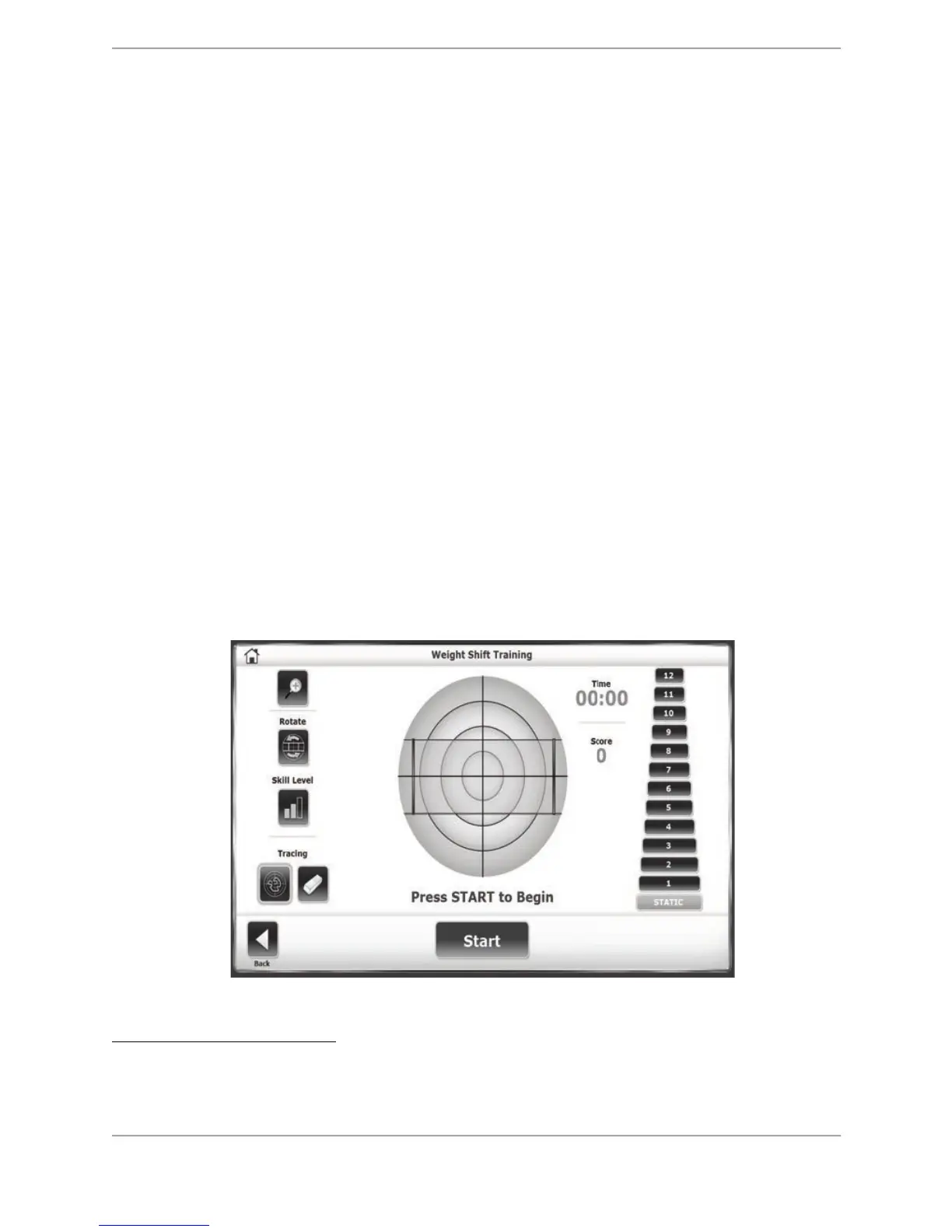
11. Explain the training protocol to the patient (i.e., that the patient should shift or maintain the
moving zone back and forth from the two blue perimeter target bars). Press <Start> to
begin the training session. The elapsed time from the start of the training session is shown
at the top right of the display and a running patient score (i.e., the percentage of time spent
on target) is provided in the upper right corner.
12. To reposition the target zone hit lines, touch the desired line (it will temporarily change
from blue to green) and re-touch the screen where the line is to be relocated.
13. Scoring is the percentage of time spent within the target range. The axis will show green
when weight bearing is within target settings.
14. To stop the training session at any time, press <Stop> on the display. The system will stop
gathering data.
15. When the training screen has been reviewed, touch <Print Results> to print the results of the
session, or <Save Results> to save the training session. If a patient identifier was not
entered at the start of the session (i.e., a name or an ID number), it must be entered now in
order to save the results of the session.
1
Weight Shift Training
This training mode allows for exercises in the most basic of activities; weight shifting. Patients
can practice shifting their weight in medial/lateral, anterior/posterior, and diagonal planes. This
can be performed with both static and dynamic settings. During this training routine, the target
zone (defined by two parallel blue lines) can be rotated to any of four orientations while the
amount of excursion within the target area can be modified to allow for varying levels of
difficulty.
Figure 6.5. The Weight Shift Training Screen.
1
* Reference: McIlroy WE, Maki BE. Preferred placement of feet during quiet stance:
development of a standardized foot placement for balance testing. Clinical Biomechanics
Vol 17, No. 1 66-70 1997.


 To Next Page