62 Biodex Medical Systems, Inc. © 2017
<Home> is touched, the system will prompt the user for confirmation because of the
possible loss of data for the test just performed.
15. Touching <Codes/Comments> allows the user to add additional information pertaining to
the test. CPT, ICD, G-Codes or comments regarding the test can be added at the conclusion
of the test or at a future time.
16. To return to the Opening Menu from the Bilateral Comparison Test Results screen, touch the
<Home> icon in the upper left corner.
Fall Risk Test
Falls are a common occurrence among older people, even for those in good health and with no
apparent balance problems
2,3
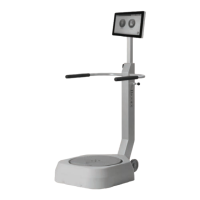
. The Balance System SD Fall Risk test allows identification of
potential fall candidates. Test results are compared to age-dependent normative data. Scores
higher than normative values suggest further assessment for lower extremity strength,
proprioception, and vestibular or visual deficiencies.
With force platform technology, an objective quantification of the patient’s postural sway
velocity can be used to predict risk.
4,5,6
Velocity can be described as the speed of an individual's
sway as balance is maintained. Higher velocities, when cues are given to specifically stand as
motionless as possible, are suggestive of postural control deficits.
The Fall Risk test protocol is based on research from the University of Dayton (Bigelow, et al
7
)
and the University of Jyväskylä in Finland (Pajala, et al
8
). Once adopted into the Biodex Balance
products as a test, a reliability study of this protocol was conducted by Bryan Riemann, PhD,
and Kelsey Piersol, MSSM, of Armstrong State University
9
. With a reliable test and protocol,
normative data was established. Please see the Normative Data section of this document for
more details on this research.
NOTE: Typically, one of the conditions of the Fall Risk test is conducted with the patient’s eyes
closed and another one is conducted with the patient in a narrow stance. Practitioners should
never leave the patient unattended during testing.
2
Kannus P, Sievanen H, Palvanen M, Parkkari J. Prevention of falls and consequent injuries in elderly
people. Lancet. 2005;366:1885-1893.
3
Hill K, Schwarz J, Flicker L, Carroll S. Falls among healthy, community-dwelling, older women: a
prospective study of frequency, circumstances, consequences and prediction accuracy. Aust N Z J Public
Health. 1999;23:41–58.
4
Thapa PB, Gideon P, Brockman KG, Fought RL, Ray WA. Clinical and biomechanical measures of balance
as fall predictors in ambulatory nursing home residents. J Gerontol Med Sci. 1996;51A:M239–M246.
5
Bergland A, Wyller TB. Risk factors for serious fall related injury in elderly women living at home. Inj Prev.
2004;10:308–313. 5 - Stel VS, Smit JH, Pluijm SM, Lips P.
6
Stel VS, Smit JH, Pluijm SM, Lips P. Balance and mobility performance as treatable risk factors for
recurrent falling in older persons. J Clin Epidemiol. 2003;56:659–668.
7
Bigelow KE, Berme N. Development of a protocol for improving the clinical utility of posturography as a
fall-risk screening tool. J Gerontol A Biol Sci Med Sci. 2011;66A: 228–233.
8
Pajala, S., Era, P., Koskenvuo, M., Kaprio, J., Törmäkangas, T., Rantanen, T. Force platform balance
measures as predictors of indoor and outdoor falls in community-dwelling women aged 63-76 years. J
Gerontol A Biol Sci Med Sci. 2008;63A:171–178.
9
Riemann, B.L., Piersol, K. Intersession reliability of self-selected and narrow stance balance testing in
older adults. Aging Clinical and Experimental Research 2016 DOI: 10.1007/s40520-016-0687-2.


 To Next Page