GasAlertMicroClip
User Manual
36
Calibration
Guidelines
When calibrating the detector, adhere to the following guidelines:
• Recommended gas mixture:
CO: 100 ppm balance N
2
H
2
S: 25 ppm balance N
2
LEL: 50% LEL or 2.5% for NA (2.2% for EU) by vol. methane
balance air
O
2
: 18% by volume, balance N
2.
• To ensure accurate calibration, use a premium-grade calibration gas.
Gases approved by the National Institute of Standards and
Technology (NIST) improve the accuracy of the calibration.
• Do not use a gas cylinder past its expiration date.
• Calibrate a new sensor before use. Install the sensor, activate the
detector, and allow the sensor to stabilize before starting calibration
(used sensor: 60 seconds / new sensor: 5 minutes, for X3 O
2
stabilization takes 60 minutes.
• Calibrate the sensors at least once every 180 days, depending on
use and sensor exposure to poisons and contaminants.
• Calibrate the detector if the gas readings varies during startup.
• Calibrate the sensor before defining the alarm setpoints.
8
• Calibrate only in a safe area that is free of hazardous gas in an
atmosphere of 20.9% oxygen.
• Do not calibrate the detector during or immediately after charging is
complete.
• The oxygen sensor can be automatically calibrated each time upon
activation (if this feature is enabled). Activate the detector in a
normal (20.9%/20.8% oxygen) atmosphere.
• Allow the detector to stabilize for 1 minute after activation before
performing a calibration or bump test.
• If a certified calibration is required, contact BW Technologies by
Honeywell.
Diagnostics Test
The detector tests the air (auto zero) and the span gas that is applied
(auto span) to ensure it meets expected values. Auto zero sets the
zero-gas level of the sensor.
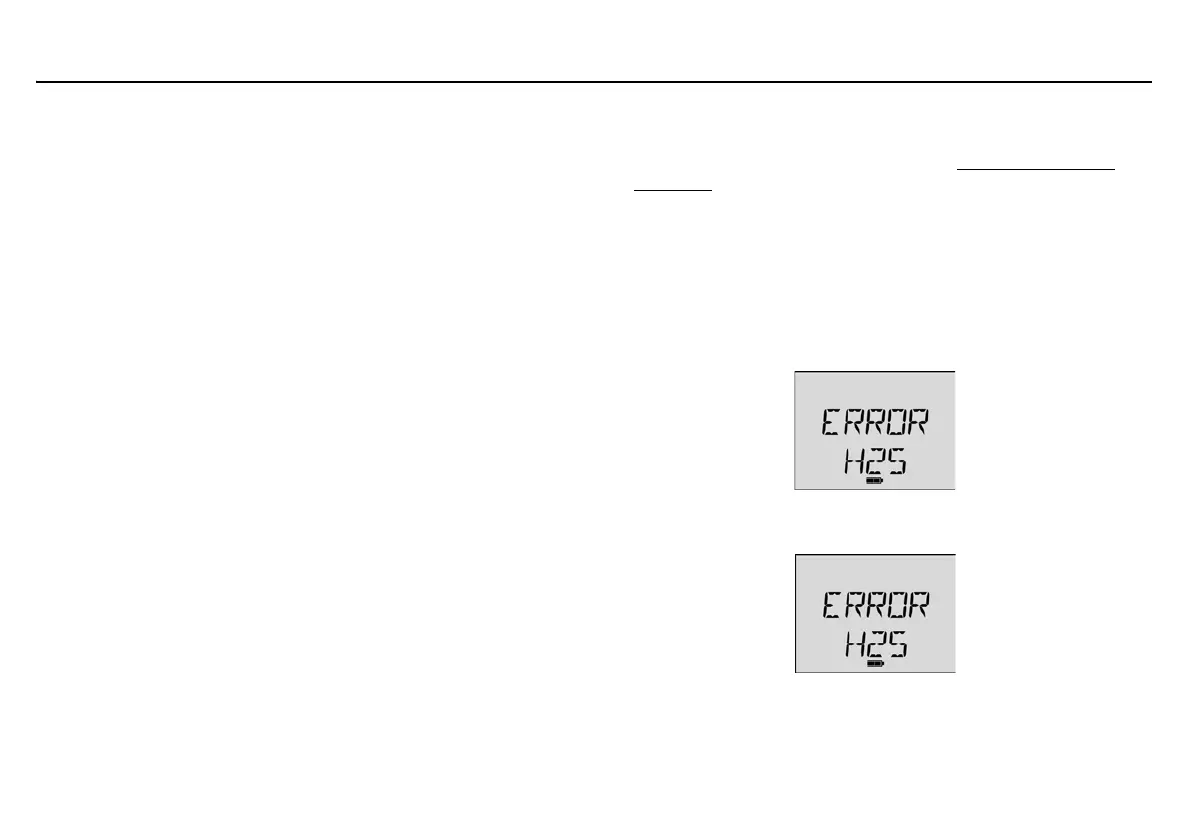
Auto Zero: If target gas is present, the zero level will be incorrect and
the sensor will fail. If a sensor fails, an error message displays.
Auto Span: If the target gas does not meet expected values, an error
message displays.
A sensors that fails to span retains the previous span value, and does
not continue with the calibration process.


 To Next Page