3
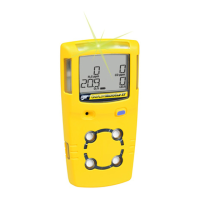
GasAlertMicroClip
Safety Information - Read First
• Calibrate the detector before first-time use and then on a regular
schedule
, depending on use and sensor exposure to poisons
and contaminants. BW recommends calibrating at least
once
every
180 days (6 months).
• BW recommends to “bump test” the sensors before each day’
s
u
se to confirm their ability to respond to gas by exposing the
detector to a gas concentration that exceeds the alarm setpoints.
Manually verify that the audible and visual alarms are activated.
Calibrate if the readings are not within the specified limits.
• BW recommends the combustible sensor be checked with a
known concentration of calibration gas after any known
exposure to catalyst contaminants/poisons (sulfur compound
s,
si
licon vapors, halogenated compounds, etc).
• The combustible sensor is factory calibrated to 50% LEL
methane. If monitoring a different combustible gas in the % LEL
range, calibrate the sensor using the appropriate gas.
• Caution: High off-scale readings may indicate an explosi
ve
concentra
tion.
• Only the combustible gas detection portion of this instrument
has been assessed for performance by CSA International.
• Protect the combustible sensor from exposure to l
ead
c
ompounds, silicones, and chlorinated hydrocarbons.
• Sensor exposure to certain organic vapors (such as leaded
gasoline and halogenated hydrocarbons) may temporarily inhibit
sensor performance. After exposure, a bump test or calibration is
recommended.
• For use only in potentially explosive atmospheres where oxygen
concentrations do not exceed 20.9% (v/v).
• Any rapid up-scaling reading followed by a declining or errati
c
re
ading may indicate a gas concentration beyond upper scal
e
lim
it, which may be hazardous.
• Only calibrate the detector in a fresh air environment and in
a
s
afe area.
• Use only BW approved batteries for the GasAlertMicroClip
detector. Refer to Specifications
.
• Charge the detector before first-time use. BW recommends th
e
detector be
charged after every workday.
• Charge the detector using the recommended charging adap
ter
on
ly. Do not use any other charging adapter. Failure to adhere to
this caution can lead to fire and/or explosion.
• Extended exposure of the detector to certain concentrations of
combustible gases and air may stress a detector ele
ment that
ca
n seriously affect its performance. If an alarm occurs due to
high concentration of combustible gases, calibrate the detector
.
I
f necessary, replace the sensor.
• Do not test the combustible sensor’s response with a butan
e
ci
garette lighter; doing so will damage the sensor.
• Do not expose the detector to electrical shock and/or se
vere
c
ontinuous mechanical shock.
• Do not attempt to disassemble, adjust, or service the detector
unless instructions for that procedure are provided in
the
t
echnical reference guide, and/or that part is listed as
a
re
placement part. Use only BW Technologies by Honeywell
replacement parts. Refer to Replacement Parts and Accessories
.
• The detector warranty will be voided if customers, personnel, or
third parties damage the detector during repair attemp
ts.
No
n-BW Technologies by Honeywell repair/service attempts voi
d
t
his warranty.


 To Next Page