5.18 MULTICAST
5.18.1 INTRODUCTION
ADVANCED SETUP > MULTICAST
In computer networking, multicast is the delivery of a message or information to a
group of destination computers simultaneously in a single transmission from the
source creating copies automatically in other network elements, such as routers,
only when the topology of the network requires it.
Multicast is most commonly implemented in IP multicast, which is often
employed in Internet Protocol (IP) applications of streaming media and Internet
television. In IP multicast the implementation of the multicast concept occurs at
the IP routing level, where routers create optimal distribution paths for datagrams
sent to a multicast destination address.
IGMP is an integral part of the IP multicast specification. It is analogous to ICMP
for unicast connections. IGMP can be used for online streaming video and gaming,
and allows more efficient use of resources when supporting these types of
applications.
There are basically 5 types of messages in the IGMP that must be implemented in
IGMP for the IGMP v3 functional properly and be compatible with previous
versions:
0x11: membership query
0x22: version 3 membership report
0x12: version 1 membership report
0x16: version 2 membership report
0x17 version 2 leave group
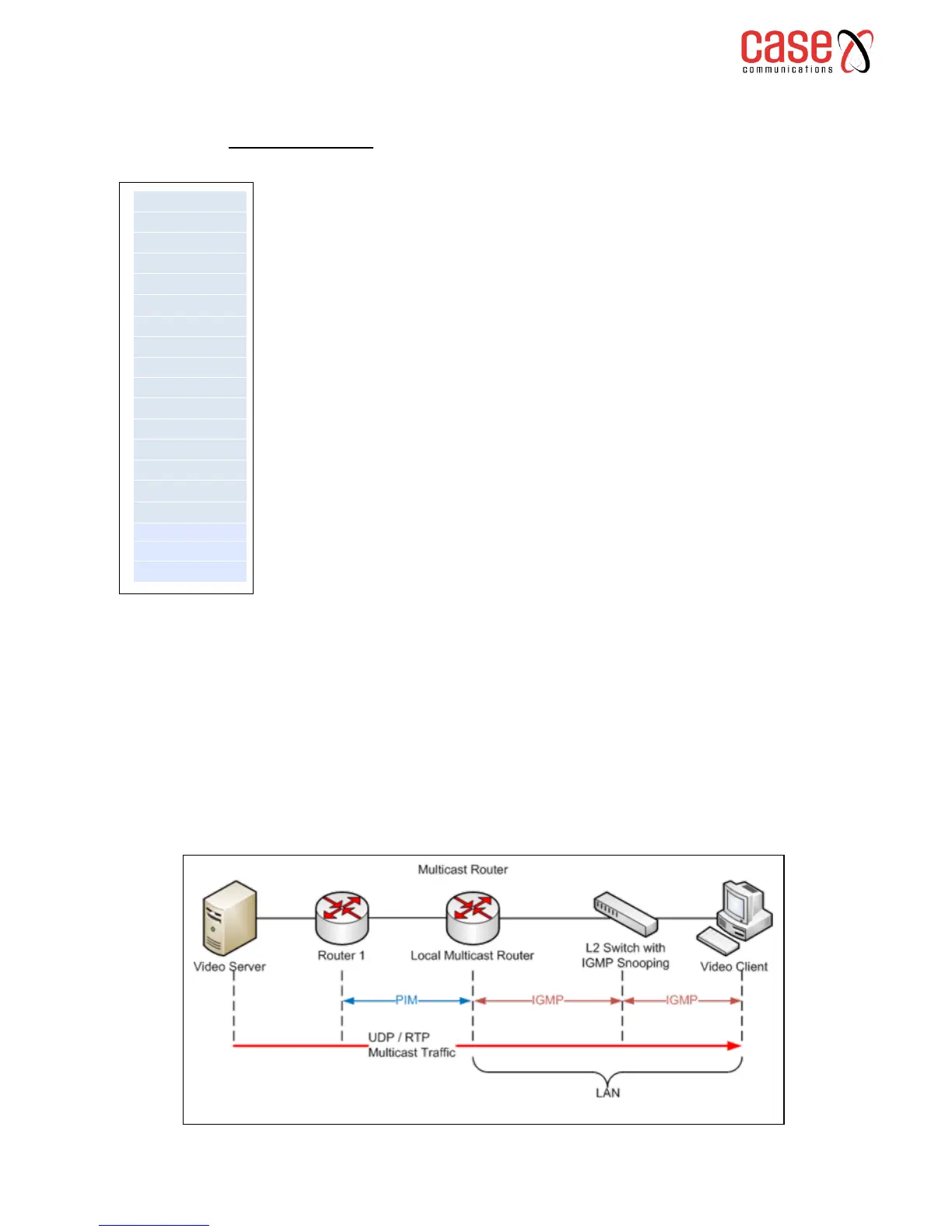
IGMP operates between the client computer and a local multicast router. Switches featuring IGMP
snooping derive useful information by observing these IGMP transactions. Protocol Independent
Multicast (PIM) is then used between the local and remote multicast routers, to direct multicast traffic
from the multicast server to many multicast clients.
A network designed to deliver a multicast service using IGMP might use this basic architecture:


 To Next Page