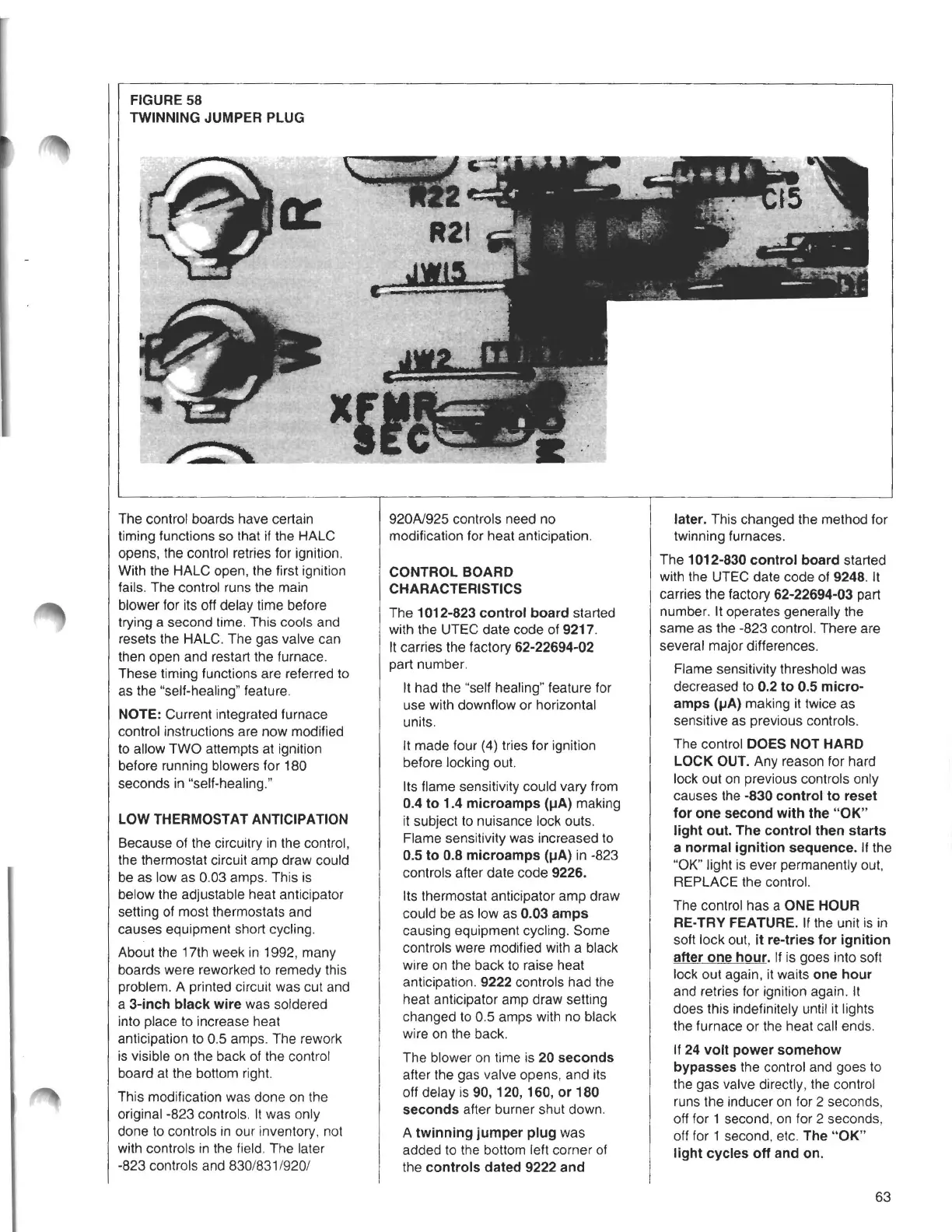
FIGURE 58
TWINNING JUMPER PLUG
The control boards have certain
timing functions so that if the HALC
opens, the control retries for ignition.
With the HALC open, the first ignition
fails. The control runs the main
blower for its off delay time before
trying a second time. This cools and
resets the HALC. The gas valve can
then open and restart the furnace.
These timing functions are referred to
as the "self-healing" feature.
NOTE: Current integrated furnace
control instructions are now modified
to allow TWO attempts at ignition
before running blowers for 180
seconds in "self-healing."
LOW THERMOSTAT ANTICIPATION
Because of the circuitry in the control,
the thermostat circuit amp draw could
be as low as 0.03 amps. This is
below the adjustable heat anticipator
setting of most thermostats and
causes equipment short cycling.
About the 17th week in 1992, many
boards were reworked to remedy this
problem. A printed circuit was cut and
a 3-inch black wire was soldered
into place to increase heat
anticipation to 0.5 amps. The rework
is visible on the back of the control
board at the bottom right.
This modification was done on the
original -823 controls. It was only
done to controls in our inventory, not
with controls in the field. The later
-823 controls and 830/831/920/
920A/925 controls need no
modification for heat anticipation.
CONTROL BOARD
CHARACTERISTICS
The 1012-823 control board started
with the UTEC date code of 9217.
It carries the factory 62-22694-02
part number.
It had the "self healing" feature for
use with downflow or horizontal
units.
II made four (4) tries for ignition
before locking out.
Its flame sensitivity could vary from
0.4 to 1.4 microamps (µA) making
it subject to nuisance lock outs.
Flame sensitivity was increased to
0.5 to 0.8 microamps (µA) in -823
controls after date code 9226.
Its thermostat anticipator amp draw
could be as low as 0.03 amps
causing equipment cycling. Some
controls were modified with a black
wire on the back to raise heat
anticipation. 9222 controls had the
heat anticipator amp draw setting
changed to 0.5 amps with no black
wire on the back.
The blower on time is 20 seconds
after the gas valve opens, and its
off delay is 90, 120, 160, or 180
seconds after burner shut down.
A twinning jumper plug was
added to the bottom left corner of
the controls dated 9222 and
later. This changed the method for
twinning furnaces.
The 1012-830 control board started
with the UTEC date code of 9248. It
carries the factory 62-22694-03 part
number. It operates generally the
same as the -823 control. There are
several major differences.
Flame sensitivity threshold was
decreased to 0.2 to 0.5 micro-
amps (µA) making it twice as
sensitive as previous controls.
The control DOES NOT HARD
LOCK OUT. Any reason for hard
lock out on previous controls only
causes the -830 control to reset
for one second with the "OK"
light out. The control then starts
a normal ignition sequence. If the
"OK" light is ever permanently out,
REPLACE the control.
The control has a ONE HOUR
RE-TRY FEATURE. If the unit is in
soft lock out, it re-tries for ignition
after one hour. If is goes into soft
lock out again, it waits one hour
and retries for ignition again. It
does this indefinitely until it lights
the furnace or the heat call ends.
If 24 volt power somehow
bypasses the control and goes to
the gas valve directly, the control
runs the inducer on for 2 seconds
off for 1 second, on for 2 seconds'
off for 1 second, etc. The "OK" '
light cycles off and on.
63


 To Next Page