EasyManua.ls Logo

Dorr EcoBell2 SL EC - User Manual

Dorr EcoBell2 SL EC
156 pages
Print Icon
To Next Page IconTo Next Page
Loading...
www.durr.com
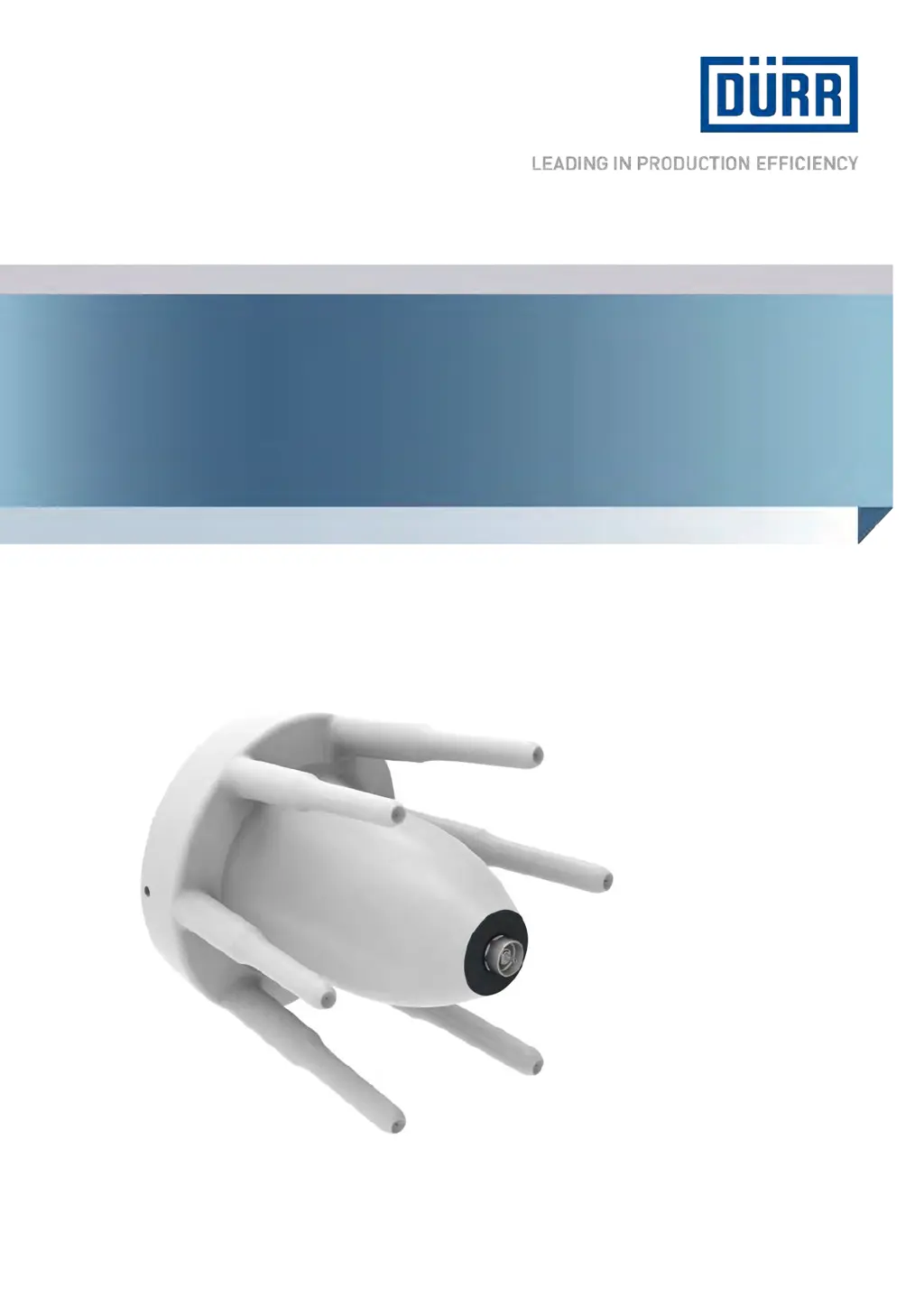
EcoBell2 SL EC
Rotating Atomizer with External
Charging
Operating Manual
Pos: 1.2 /INP/Übe rgreifende Kapitel/00 _Intro/Copyright @ 32\mo d_13941 11773169_2 0.docx @ 424 820 @ @ 1

Table of Contents

Questions and Answers

Summary

1 Introduction

1.1 Information about the document

Provides essential information for safe operation, maintenance, and repair of the product.

1.2 Symbols in the document

Explains safety symbols and signal words used to indicate potential risks in the document.

1.3 Intended use

Describes the atomizer's function in electrostatic coating and its intended application.

1.4 Avoiding foreseeable misuses

Lists prohibited actions to prevent dangerous situations and product damage.

1.5 Material numbers

Lists product material numbers for the EcoBell2 SL EC atomizer.

1.6 Device combination

Details Dürr components and available combinations for atomizer operation.

2 Safety

2.1 Danger zones

Defines safety distances required around high-voltage parts and within explosive atmospheres.

2.2 Safety requirements

Outlines requirements for rotational speed, high voltage, and fire safety during operation.

2.3 ATEX marking

Explains ATEX marking details and requirements for operation in explosive atmospheres.

2.4 Residual risks

Identifies residual risks related to parameters, operation, and maintenance activities.

2.5 Conduct in the event of a hazardous situation

Provides basic steps for behavior in hazardous situations.

2.6 Responsibility of the operator

Defines the operator's responsibilities for system integration, safety, and compliance.

2.7 Personnel Requirements

Specifies qualifications and training needed for cleaning, assembly, and electrical personnel.

2.8 Personal protective equipment

Lists essential personal protective equipment (PPE) for safe operation.

2.9 Danger of damage to property

Highlights risks of property damage due to invalid parameters or incorrect external conditions.

2.10 Environmental protection

Emphasizes observing manufacturer's instructions for paint, solvents, and cleaning agents.

2.11 Emergency shutdown

Stresses the operator's role in integrating the atomizer into their safety and emergency concept.

3 Transport and storage

3.1 Delivery

Details how the atomizer is delivered and whom to contact for defects.

3.2 Storage

Specifies environmental conditions for storage, including temperature and humidity.

4 Operating principle

4.1 Brief description

Provides a concise overview of the EcoBell2 SL as a high rotation atomizer.

4.2 Overview

Illustrates and lists the main components of the atomizer.

4.3 Functionality

Explains how the atomizer operates, including atomization and electrostatic charging.

4.4 Assemblies

Details the individual assemblies of the atomizer, such as bell disk and turbine.

4.5 Connections

Describes the interfaces and connection points of the atomizer.

4.6 Accessories and Related Parts

Lists accessories and related parts for the atomizer, including material numbers.

4.7 Tools

Details the tool kit and specific tools required for maintenance and operation.

5 Installation and assembly

5.1 Installation illustration

Presents a configuration example for atomizer installation.

5.2 Assembly

Covers general assembly by technical personnel and prerequisites for installation.

5.2.1 Requirements for the installation point

Lists requirements for the installation point and necessary system components.

5.2.2 Prerequisites for installation

Details prerequisites like power off, depressurized lines, and existing atomizer mount.

5.2.3 Flange assembly

Explains how to assemble the flange and connect it to the atomizer.

5.2.3.2 Cable and hose routing

Provides rules for routing cables and hoses inside and outside the cabin.

5.2.4 Fasten electrode ring

Details the procedure for fastening the electrode ring, including lubrication and screw tightening.

5.2.5 Attach the atomizer to the flange package

Guides the attachment of the atomizer to the flange package, including O-ring lubrication.

5.2.6 Attaching the bell disk

Explains the correct procedure for attaching the bell disk using a special tool.

5.2.7 Attach type plate

Instructs on positioning the type plate near the atomizer, typically on the cabin wall.

5.2.8 Final checks

Covers final checks on the atomizer, pneumatic supply, and media lines after installation.

6 Operation

6.1 Safety notes for operation

Lists critical safety warnings for operating the atomizer in various hazardous conditions.

6.2 General Notes on Operation

Provides general operational notes on valves, noises, vibrations, cleanliness, hoses, and grounding.

6.3 Operating Parameters

Details operating modes, speed specifications, painting data, and required air pressures.

6.4 Starting Operations

Covers commissioning notes, the commissioning process, and testing paint flow control.

6.5 Purging

Explains the purging sequence and the selection of appropriate detergents.

6.6 Checks during operation

Provides a table of procedures for checking and testing the atomizer and flange package.

7 Cleaning and maintenance

7.1 Safety Instructions

Highlights safety precautions for cleaning and maintenance, including high voltage and rotating parts.

7.2 Cleaning agents

Specifies approved cleaning agents, their properties, and precautions for use.

7.3 Cleaning and maintenance plan

Presents a schedule for maintenance activities and the personnel responsible.

7.4 Cleaning

Details cleaning procedures, protective equipment, accessories, and cleaning positions.

7.5 Maintenance work

Describes maintenance tasks like bell disk assembly, nozzle replacement, and electrode replacement.

7.6 Final work after maintenance activity

Covers final checks and procedures after cleaning and assembly work is completed.

8 Faults

8.1 Safety provisions

States that only damaged components can be replaced and where to get assistance.

8.2 Fault Indicator

Explains that faults are displayed on the control and how atomizer faults are perceived.

8.3 Behavior during faults

Provides instructions on system shutdown, air separation, and troubleshooting steps.

8.4 Troubleshooting

Lists possible faults, their causes, and fixes in a table format.

9.1 Mounting the valve block

9.1.1 Dismantling the valve block

Details the procedure for dismantling the valve block and related components.

9.1.2 Mounting the valve block

Outlines the requirements and steps for mounting the valve block.

9.2 Mounting the turbine

9.2.1 Dismantling the turbine

Explains how to dismantle the turbine by removing the screw cap.

9.2.2 Installation of the turbine

Guides the installation of the turbine, including checking sealing rings and alignment.

9.2.3 Checking the position of the nozzle

Describes how to check and correct the nozzle position after turbine installation.

9.3 Installation of the light conductor

9.3.1 Removing the light conductor

Details the process of removing the light conductor by first removing the chuck.

9.3.2 Cleaning the light conductor

Provides instructions on cleaning the light conductor with a damp cloth.

9.3.3 Testing the light conductor

Explains how to test the light conductor for proper illumination.

9.3.4 Installing the light conductor

Guides the installation of the light conductor into the valve block.

9.4 Mounting of the shaft detent

9.4.1 Dismantling of the shaft detent

Details the procedure for removing the shaft detent by unscrewing the lid.

9.4.2 Installation of the shaft detent

Explains how to install the shaft detent, including greasing and insertion.

9.5 Installing the main needle valve

9.5.1 Removing the main needle valve

Guides the removal of the main needle valve by first removing its lid.

9.5.2 Installing the main needle valve

Details the installation of the main needle valve, including lubrication and tightening.

9.6 Working on paint pipe

9.6.1 Removing paint pipe

Explains how to remove the paint pipe by loosening screws.

9.6.2 Checks on removed paint pipe

Lists checks for damage, cleanliness, and function of the removed paint pipe.

9.6.3 Disassembling the paint pipe

Describes how to unscrew the nozzle holder from the paint pipe.

9.6.4 Assembling the paint pipe

Details the assembly of the paint pipe, including parts and procedures.

9.6.5 Mounting the paint pipe

Covers prerequisites and steps for mounting the paint pipe onto the valve block.

9.7 Assemble valve

9.7.1 Removing the valve

Explains how to remove a valve from the component using a socket wrench.

9.7.2 Assembling valve

Details the procedure for assembling a valve, including checks and lubrication.

9.8 Replacing the hose at the flange assembly

9.9 Resistance test

9.10 Final work after fault removal

10 Dismantling and Disposal

10.1 Switching off the atomizer

Provides safety precautions for switching off the atomizer, including high voltage handling.

10.2 Separating the atomizer from the flange package

Details the procedure for separating the atomizer from the flange package.

10.3 Dismantling of the atomizer

Outlines the process for dismantling the atomizer into individual parts.

10.4 Disposal of the atomizer

Provides guidance on the proper disposal of the atomizer to prevent environmental damage.

11 Technical Data

11.1 Replacement parts

Lists replacement parts, including material numbers and denominations.

12 Contacts and Hotline

13 Appendix

13.1 Check list for commissioning - External charging G500

Provides a checklist for commissioning the external charging G500 system.

Dorr EcoBell2 SL EC Specifications

General IconGeneral
BrandDorr
ModelEcoBell2 SL EC
CategoryElectronic Cigarettes
LanguageEnglish