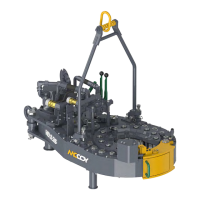
KT5500 5-
1
/
2
” Tong & CLInCHER® BaCKup
SECTIon ConTEnTS
3.28
TECHnICaL ManuaL
MaInTEnanCE
M. TUBULAR CONNECTION EQUIPMENT DE-COMMISSIONING PROCEDURE
Perform the following decommissioning procedureswhen removing tubular connectionequipment from service, with the intent of
shorttolong-termstorage.Theseproceduresareessentialforensuringproperprotectionoftheequipmentfromenvironmentalattack,
andtoaidinthequickturnaroundwhenreturningtheequipmenttoservice.
Storeallo-rings,seals,packings,gaskets,etc.instrongmoistureproof,airtightcontainers.Ensurethattheseitemsarenotcrushed,
nicked,orotherwisedamaged.
Donot perform anyfurther actions ormaintenance while thetong isconnectedto anyhydraulicpower supply. Farr recommends
thatallhydrauliclinesarefullydisconnected,andresidualhydraulicpressureisbledoff.Ensureadequatecontainmentisinplaceto
preventenvironmentalcontaminationfromresidualhydraulicfluid.
DepressurizAtion proceDure in prepArAtion for storAge:
1) Rotatethe tongsothat theopeningin therotarygearfacesthegeartrain(towards therearof thetong).Ensuretongand
backupdoors(ifequipped)areclosed.Fullyextendtheliftcylinder(ifequipped).Ifmountedinaframe,retractthefloatcylin-
ders(ifequipped).
2) De-energizethepowerunit.
3) RepeatedlyactuatethetongmotorcontrolvalveleverINBOTHDIRECTIONStodissipateanyresidualpressureinthevalve
andmotor.
4) RemovethehydraulicSUPPLYlinefromtheequipment.
5) Repeatedly actuate the remaining control valve levers IN BOTH DIRECTIONS to dissipate any residual pressure in the
remainderofthehydrauliccontrolsystem.
7) DisconnectthehydraulicRETURNlinefromtheequipment.
8) Disconnectremaininghosessuchascasedrains,orlinesconnectedtotheturnscounter.
1.
Performaninitialwashofthetoolinordertoremovethemajorityofdirtandgreasebuild-up.Ensureadequatecontain-
mentisinplacetopreventenvironmentalcontaminationfromresidualhydraulicfluidanddirtygrease.
2.
Removetheaccesspanelonthesideofthetongdirectlyadjacenttotheshiftermechanism.
3.
Cleantheinteriorofthetongthoroughly,usingeitherwater(donotuseapressurewasher),oranappropriatesolvent-
basedgrease-cuttingcleanersuchasVarsol.Ensureadequatecontainmentisinplacetopreventenvironmentalcon-
taminationfromresidualhydraulicfluid,dirtygrease,andcleaningagents.Makeanoteifanymetalshavingsormetal
piecesareflushedoutofthegeartraincavity-ifshavingsormetalpiecesareseenthetongmustbeoverhauledbefore
itisreturnedtoservice.
4.
Cleantheexteriorofthetoolthoroughly,usingeitherwater(donotuseapressurewasher),oranappropriatesolvent-
basedgrease-cuttingcleanersuchasVarsol.Ensureadequatecontainmentisinplacetopreventenvironmentalcontami-
nationfromresidualhydraulicfluid,dirtygrease,andcleaningagents.
5.
Inspectallfastenersandfastenersafetywires.Replaceanymissingfasteners-useGrade8boltsonly.Re-torqueall
externalfastenerstoSAEspecifications.
6.
Inspectbackingpin(s).Ifcracked,broken,orbentit(they)mustbereplaced.
7.
Repairorreplaceanydamagedormissingexternalbodyparts,suchastorquegaugemounts,hydraulicsupports,safety
doorprotectors,etc.
8.
Inspectallpaint-locationsinwhichthepainthasbeendamagedmustberepairedpriortostorage.Prepareareastobe
paintedtoensuretheyarefreeofgrease,dirt,orsolvent.Touchupusingasolvent-basedacrylicpaint-“McCoyGrey”is
paintnumberRAL7015.Allowsufficienttimeforpainttodrybeforeproceeding.
9.
Performaliberallubricationoftheequipment-refertoMaintenancesectionofmanualtodeterminelubricationpoints.
Generouslyfillthegeartrainhousingwithgreasethroughtheaccesspanel,andalsothroughtheopeningintherotary
gear.
10.
Connecttheequipmenttoahydraulicpowerunit.Ensurealllinesarefullymadeuptopreventequipmentdamagefrom
excessivebackpressure.Donotneglecttoconnectthemotordrain.
11.
Energizepowerunit.
12.
Rotatetongforoneminute,stop,andreversethedirectionofrotationforanotherminute,endingwiththeopeningofthe
rotarygearfacingthegeartrain.De-energizethepowerunit,andperformanothergenerouslubricationofthegeartrain,
includingthegearhousing.
HYDRAULIC PRESSURES AS HIGH AS OPERATING PRESSURE MAY REMAIN TRAPPED IN
SMALL AREAS OF THE EQUIPMENT. ENSURE ALL MAINTENANCE IS CARRIED OUT BY A
QUALIFIED SERVICE TECHNICIAN, AND THAT ADEQUATE PERSONAL PROTECTIVE EQUIP-
MENT IS USED TO GUARD AGAINST PRESSURE-INDUCED INJURIES


 To Next Page