position yourself for an optimal start you should monitor Dist opt WP to know your distance to the optimal
intercept and Dist to Cyl. or Dist StCyl to see if you are inside or outside the cylinder (positive distance is outside
and negative distance is inside). Of course you can also look at the Map page to see your position relative to
the course.
If, after achieving a valid start, you wish to take the next start time, press the " key (“next
!
pr
"
wp” must be
displayed in the bottom line in the Information Field). By pressing the " key you set the start (WP1 in the
example) as the active waypoint, and the instrument will increment the start time by the interval set in the
Competition Route. If you wish to increment to the next start time before you have achieved a valid start, press
the ! key (next wp) followed by the " key (prev wp) and the instrument will increment the start time by the
interval set in the Competition Route. If the last start time has passed and you press the " key, the instrument
will not increment the start time. Note: It is required that the first turnpoint after the start cylinder be outside the
start cylinder. Please see Section 12.6 for a detailed example of a task with an Exit start.
5.4.3.2 Entry Start
When the Competition Route is set
for an entry start, the start time
open signal will be given at the
designated start time (i.e.,
Countdown timer/Start Race=0:00)
and the “turnpoint reached” signal
will be given as soon as you
subsequently cross the start
cylinder from outside to inside. The
first turnpoint will become active
and all calculations and the
direction arrows will be made with
respect to the first turnpoint (WP2 in
the example).
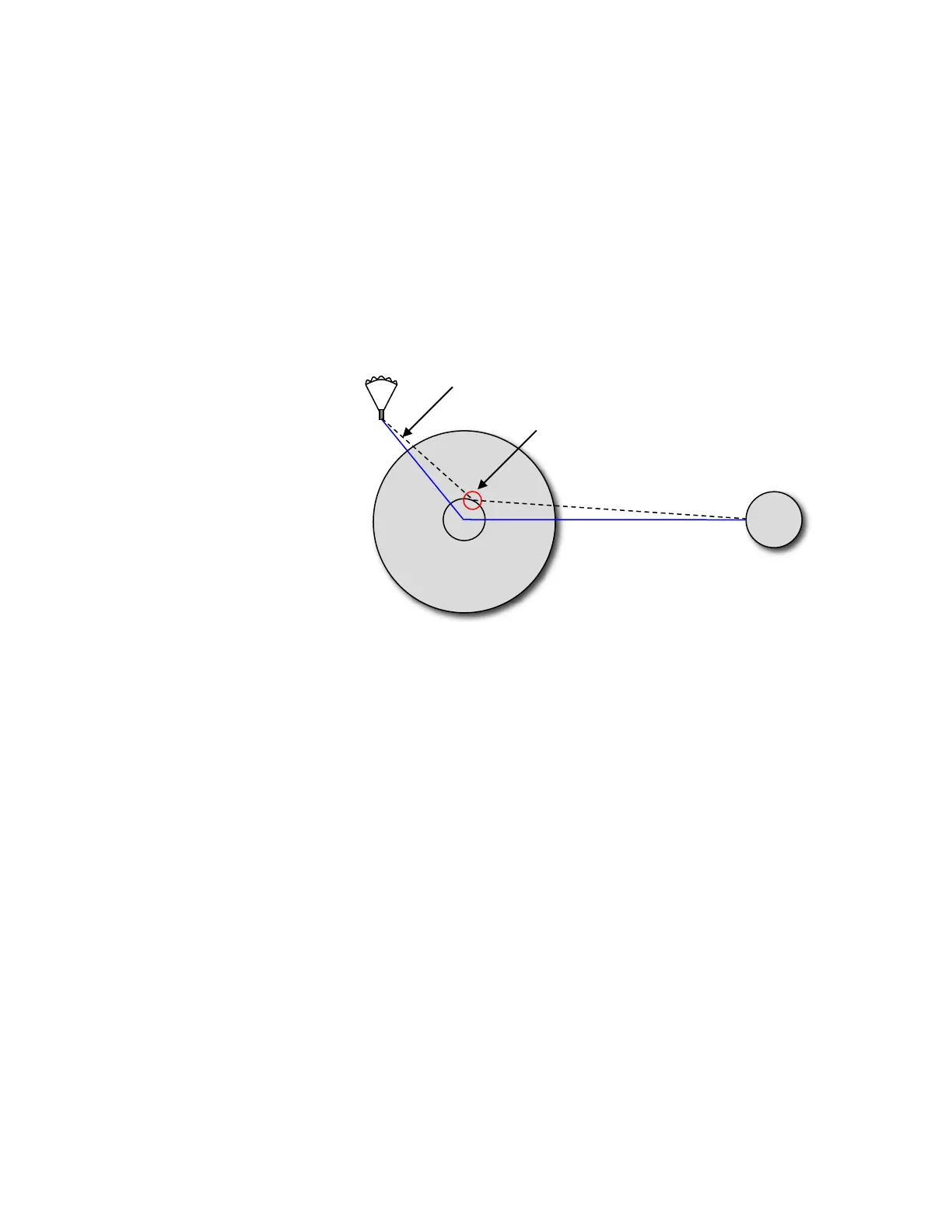
If the Optimized Competition Route is being
used, the entry start cylinder has no optimized
entry point, however, the turnpoint inside the entry cylinder has an optimized intercept (C-Wp) that is calculated
when the 6030 recognizes that the flight has begun (flight acceptance). The first leg of the route is drawn from
your position at flight acceptance to the C-Wp and is updated as needed when the your cross track error divided
by the distance to the cylinder is greater than 0.2 (~11º).
If you are trying to position yourself for an optimal start you should monitor Dist StCyl. to see if you are inside or
outside the cylinder (positive distance is outside and negative distance is inside). Before a valid start has been
achieved the direction arrow points to the C-Wp of the first turnpoint and will continue to point to the first
turnpoint’s C-Wp until the first turnpoint is achieved.
If, after achieving a valid start, you wish to take the next start, press the " key (“next
!
pr
"
wp" must be
displayed in the bottom line in the Information Field). By pressing the " key you set the start (WP1 in the
example) as the active waypoint, and the instrument will increment the start time by the interval set in the
Competition Route. If you wish to increment to the next start time before you have achieved a valid start, press
the ! key (next wp) followed by the " key (prev wp) and the instrument will increment the start time by the
interval set in the Competition Route. If the last start time has passed and you press the " key, the instrument
will not increment the start time. Please see Section 12.6 for a detailed example of a task with an Exit start.
5.4.4 Final Glide
Here, GPS data and the McCready theory go hand in hand (please also read the Section 12.5, McCready
Theory). The objective of final glide calculations is to reach goal as quickly as possible, by determining the
optimal altitude for leaving your last thermal and the best speed to fly while on final glide. To this end the 6030
will indicate when to leave the last thermal, and will assist you in determining the correct speed ring setting to fly
to goal. Because there is no way for the 6030 to know the nature of the air mass in route to goal, final glide
recommendations are just that and should not be interpreted as absolutes. However, the 6030 will provide
highly useful data to help you access your progress and make beneficial adjustments.
In order to provide final glide data, the 6030 needs to know the distance to goal, the climb rate of your last
thermal, the altitude of goal, your present altitude, and your glider’s polar. There are two other variables that will
affect your final glide: the horizontal (wind) and vertical (lift/sink) components of the air mass on final glide.



 To Next Page