31
4 SETTING UP
TRADITIONAL GUITAR POWER AMP & CAB
Global Settings: Modied (see below)
Presets: Factory or Custom
This setup uses traditional guitar speakers and a traditional guitar power amp—that is, one with a pronounced
effect on tone and feel. This amp may be the “power section” of a head or combo, accessed via an “FX RETURN”
input on the amp, or it may be a standalone power amp for guitar.
DISABLE POWER AMP MODELING
The “non-neutral” power amp in this setup contributes
considerably to the overall sound. We will therefore
disable “Power Amp Modeling” in the FM9 so as to not
apply power amp characteristics twice! The FM9 will
continue to model the preamp.
You can disable power amp modeling manually in the
Amp blocks of your presets (this parameter is on the
amp’s Power Amp Page), or you can take advantage of
an easy global setting:
Navigate to SETUP: Global Settings: Cong.
Change Power Amp Modeling to “OFF”.
(NOTE: Some power amps are in fact more subtle, and
some players like to leave Power Amp Modeling ENABLED
with this type of setup. Try it both ways and decide for
yourself.)
DISABLE SPEAKER CAB MODELING
This setup also uses traditional guitar speakers, which
apply strong tonal coloration. Using modeled speakers
at the same time would be redundant, so we must
disable or remove the FM9 cab block. You can do this
manually in every preset, or take advantage of an easy
global setting:
Navigate to SETUP: Global Settings: Cong.
Change Cabinet Modeling to “BYPASSED”.
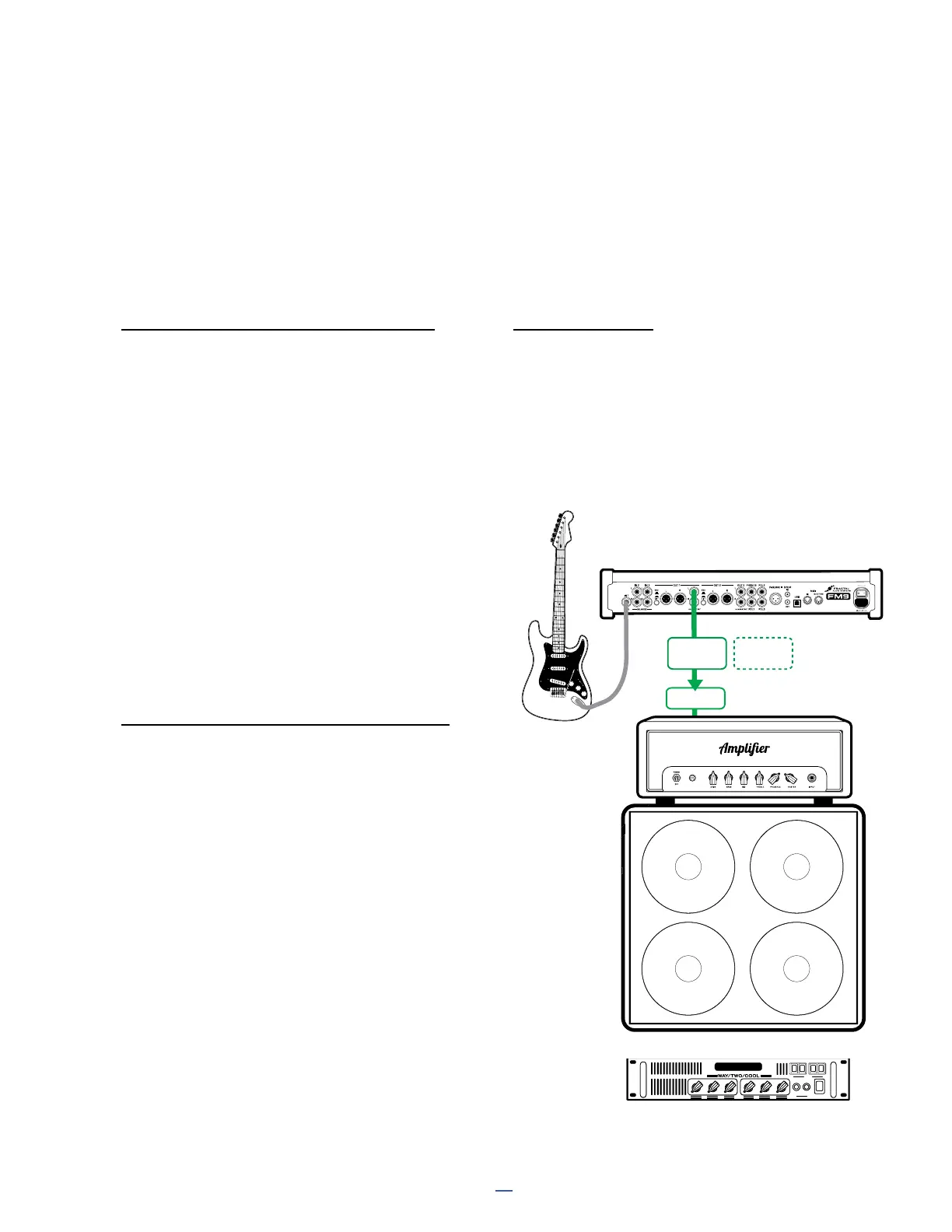
CONNECTIONS
Connect your guitar to FM9 Input 1 Instrument.
Connect the FM9 to the power amp
input using FM9 Output 1 (1/4" jack)
using a Humbuster™ cable.
Connect your power amp to a guitar speaker
cabinet as directed by the manufacturer. (If it’s
a combo, the speaker is already connected.)
NOTE: Instead of the power section of a head or cab,
you can also use tube power amp designed for guitar.
FM9
HEAD OR
COMBO
WITH
POWER AMP IN
OR
FX RETURN
OUTPUT
1R
Optional for Stereo
to a second amp
OUTPUT
1L
Amplifier
Model 50
FX RETURN


 To Next Page