CENTRAL PROCESSING UNIT MC68332
5-4 USER’S MANUAL
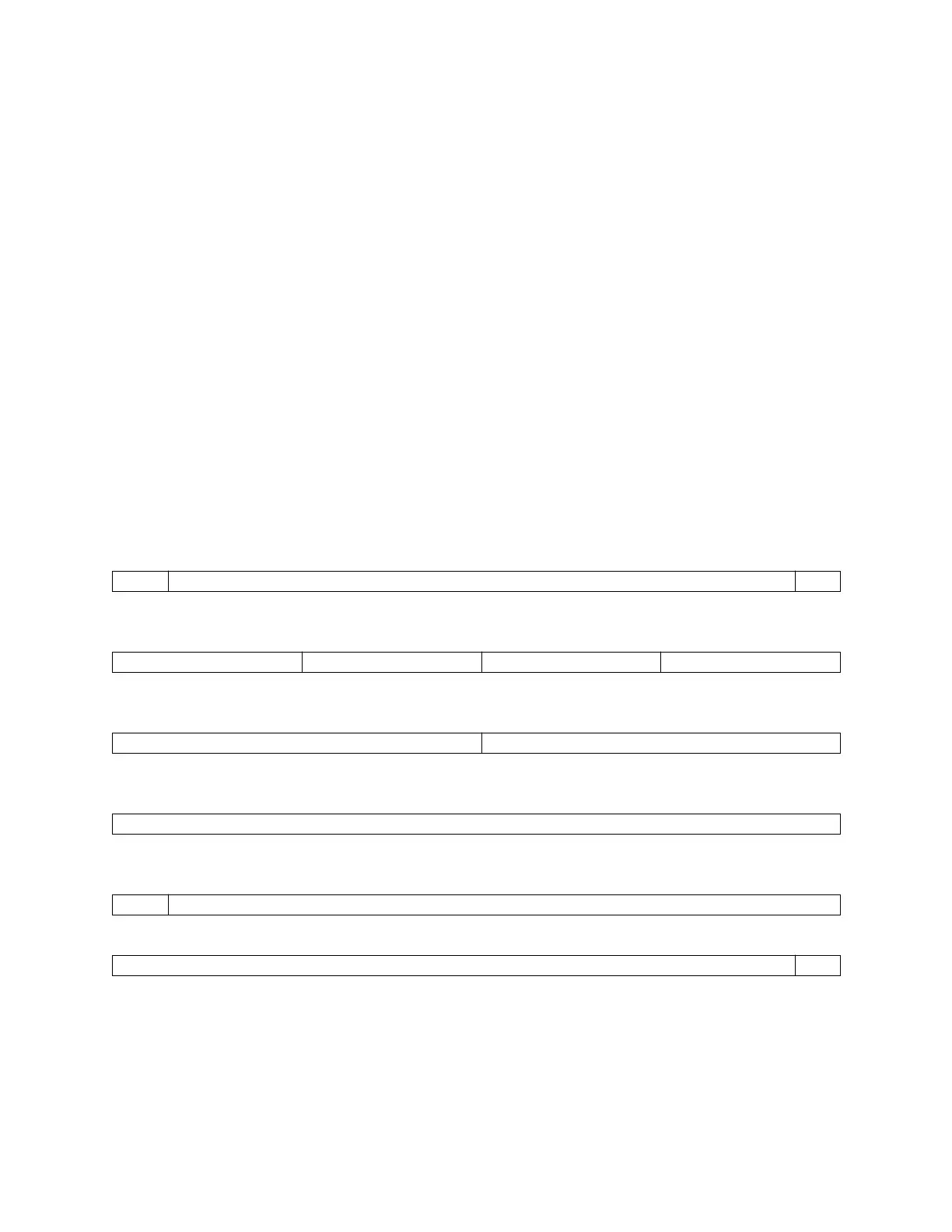
Each of data registers D7–D0 is 32 bits wide. Byte operands occupy the low-order 8
bits; word operands, the low-order 16 bits; and long-word operands, the entire 32 bits.
When a data register is used as either a source or destination operand, only the ap-
propriate low-order byte or word (in byte or word operations, respectively) is used or
changed; the remaining high-order portion is unaffected. The least significant bit (LSB)
of a long-word integer is addressed as bit zero, and the most significant bit (MSB) is
addressed as bit 31. Figure 5-4 shows the organization of various types of data in the
data registers.
Quad-word data consists of two long words and represents the product of 32-bit mul-
tiply or the dividend of 32-bit divide operations (signed and unsigned). Quad-words
may be organized in any two data registers without restrictions on order or pairing.
There are no explicit instructions for the management of this data type, although the
MOVEM instruction can be used to move a quad-word into or out of the registers.
Binary-coded decimal (BCD) data represents decimal numbers in binary form. CPU32
BCD instructions use a format in which a byte contains two digits. The four LSB con-
tain the least significant digit, and the four MSB contain the most significant digit. The
ABCD, SBCD, and NBCD instructions operate on two BCD digits packed into a single
byte.
Figure 5-4 Data Organization in Data Registers
31 30 1 0
MSB LSB
BYTE
31 24 23 16 15 8 7 0
HIGH-ORDER BYTE MIDDLE HIGH BYTE MIDDLE LOW BYTE LOW-ORDER BYTE
16-BIT WORD
31 16 15 0
HIGH-ORDER BYTE LOW-ORDER WORD
LONG-WORD
31 0
LONG-WORD
QUAD-WORD
63 62 32
MSB ANY Dy
31 1 0
ANY Dy LSB
Fr
ees
cale S
em
iconduct
or
, I
Freescale Semiconductor, Inc.
For More Information On This Product,
Go to: www.freescale.com
nc...



 To Next Page