FULLTEST3
EN - 40
6.4. DIELECTRIC TEST (DIELECTRIC)
In accordance with the requirements of the IEC/EN60204-1 guideline, the power
circuits of electrical machines must withstand a voltage test between active short-
circuit conductors and the earthing system for at least 1s. The test is performed at
twice the nominal power supply (or 1000VAC choosing the larger of the two values)
50Hz. Disconnect or dissect all machine control parts / logics that could be
damaged by the test voltage.
CAUTION
The instrument supplies high voltage of a dangerous power. According to
EN50191 guideline (see § 5.5.2) the following precautionary measures
must be taken prior to a test
x Block access to danger area
x Put up warning signs (Attention! High voltage, danger to life)
x Install warning lamps (red, green) to be easily visible (consider the
FT3R-GLP optional accessory)
x Install EMERGENCY-OFF switch into the mains installation outside
the dangerous area (consider the FT3SFTSW optional accessory)
x Electrical trained personnel may only do the tests under supervision
of specialist staff and have to be trained regularly
x Use safety probes with protection against contact or with two-
hand operation only. Always hold only one probe in one hand
x Connecting one test terminal to the UUT and working with one probe
or holding both probes in one hand is prohibited
x It is prohibited to touch the unit under test during the test. If need be,
additional measures must be taken (e.g. cover made of insulating
mats) to protect the person performing the test against inadvertent
contact with the test object
x Ensure that all switches on the UUT are closed in order to test all it’s
components. For the purpose of measurement all active conductors
(L1, L2, L3 and N) must be short-circuited
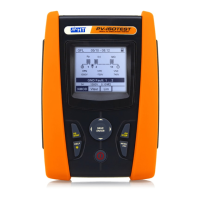
1. Press the FUNC key and select the DIELECT function. The following screen is
shown on the display
Fig. 35 : DIELECT initial screen
2. Select the test parameters on the instrument (see Table 4) and carry out the
desired setup


 To Next Page