Section 1 - General
GENERAL
7
Installation and Maintenance
1.3.2 InstallerQualication
ᘐ WARNING: The product contains the hydrocarbon
refrigerant R290 which is very ammable. The refrigerant
may mix with air to form a ammable atmosphere
increasing the risk of re and/or explosion. Work that
requires the removal of the exterior casing of the Heat
Pump must only be carried out by competent persons
who are familiar with the risks of R290 refrigerant. Work
on the refrigeration circuit must only be carried out by
a Cat I or Cat II F-gas certied engineer with a City and
Guilds 6187-21 certicate or equivalent. Work done on the
heat pump should be done in accordance with industry
standard safety procedures and practices for working with
hydrocarbons
ᘐ WARNING: Work on electrical systems must only be
carried out by competent persons.
ᘐ WARNING: The DHW Cylinder must be installed by a
competent person as dened by the relevant regulations.
Manufacturers notes must NOT be taken as over-riding
statutory obligations.
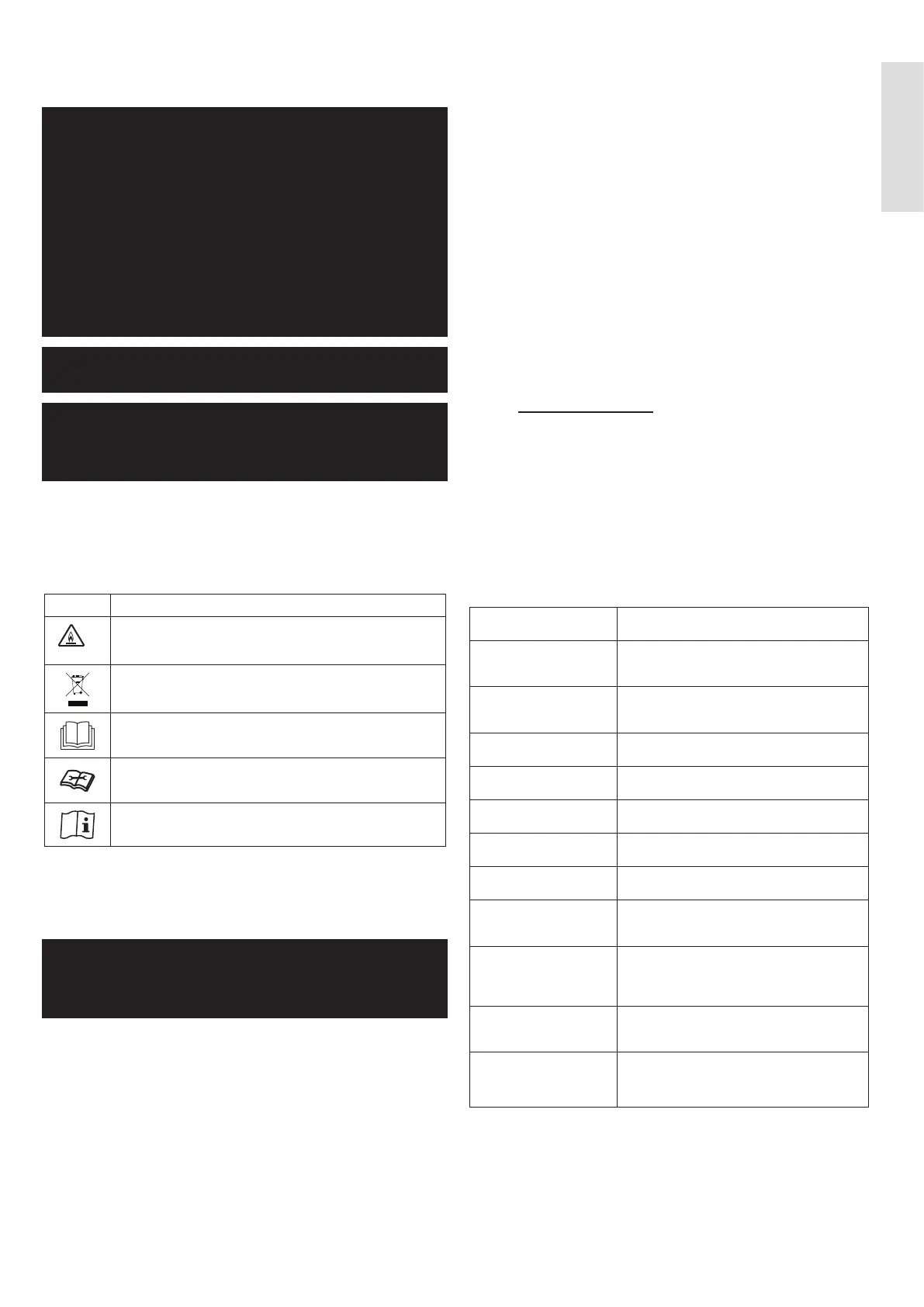
1.3.3 Appliance Symbols
These warning labels also include rules of conduct for the R290
refrigerant. The warning labels must not be removed.
Symbol Meaning
Flammable refrigerant
At the end of the product life, dispose of the packaging
and product in a corresponding recycle centre.
Read the operating manual.
Read the installation manual.
Read the installation and operating manual.
1.3.4 Intended Use
and must be obeyed.
ᘐ WARNING: Failure to comply with the requirements
stipulated within this documentation may result in
increased risk of death, serious injury and/or damage to
equipment and property.
The Heat Pump is an air-to-water monobloc heat pump to be
installed in a domestic household with a sealed heating system.
The Ideal HP290 setup parameters do not provide a cooling
function.
The Heat Pump takes heat from ambient outdoor air for transfer
into domestic hot water or a space heating system. This air is
back into the natural environment.
The DHW cylinder is used to heat a store of domestic hot
water. The DHW cylinder is to be installed within a domestic
household.
The control box / heat pump controller is to be installed
as this contains the control system and installer interfaces
needed for the initial setup and commissioning of the overall
heating system. A limited interface is provided for the end user
however it is envisaged that day to day interface will be via a
Programmable Room Thermostat (PRT) i.e.,Halo Lite RF.
If the Halo Lite RF is not installed as the Programmable Room
Thermostat (PRT) and an alternative PRT is used it must have a
maximum cycle rate of 1 per hour.
The following basic functionality is recommended:
• Setback Temperature with a maximum 3°C below comfort
temperature.
• Heating Schedule with a minimum 2.5-hour optimisation.
System schematic diagrams in this document are meant for
reference only. It is the responsibility of the installer to make
sure that all appropriate measures are implemented.
The installation must comply with all accompanying
documentation and applicable local regulations and guidelines.
1.4 REGULATIONS
Installations must conform with the regulations of the installation site:
• National building regulations.
• Local regulations and provisions of local electricity suppliers.
• IET Wiring regulations.
•
Detailed recommendations are contained in the following British
Standards Codes of Practice. Listed below are the editions of the
standards at the time of publication, it should be made sure that the
current editions at the time of installation are used for reference.
BS EN 378:2016 Refrigerating systems and heat pumps. Safety
and environmental requirements.
BS EN 1717:2000 Protection against pollution of potable water in
water installations and general requirements of
BS 7593:2019 Code of practice for the preparation,
commissioning and maintenance of domestic
central heating and cooling water systems
BS 7671:2018 +A2:2022 Requirements for Electrical Installations. IET
Wiring Regulations
BS EN 14336:2004 Heating systems in buildings. Installation and
commissioning of water-based heating systems.
BS EN 15450:2007 Heating systems in buildings. Design of heat
pump heating systems.
BS EN 50160:2010
+A3:2019
Voltage characteristics of electricity supplied by
public electricity networks View details
BS EN 12828:2012
+A1:2014
Heating systems in buildings. Design for water-
based heating systems.
BS EN 12831-1:2017 Energy performance of buildings. Method for
calculation of the design heat load. Space
heating load, Module M3-3
BS 8558:2015 Guide to the design, installation, testing and
maintenance of services supplying water for
domestic use within buildings and their curtilages.
Complementary guidance to BS EN 806
BS EN 806-1:2000
conveying water for human consumption.
General
BS EN 12897:2016
(+A1:2020)
unvented (closed) storage water heaters



 To Next Page