Current derating
The current derating graph is indicative and is based on thermal tests performed in a climatic
room where there was enough room for natural air convection. Each application may reach
different ratings depending on the installation, ventilation or housing.
System temperature
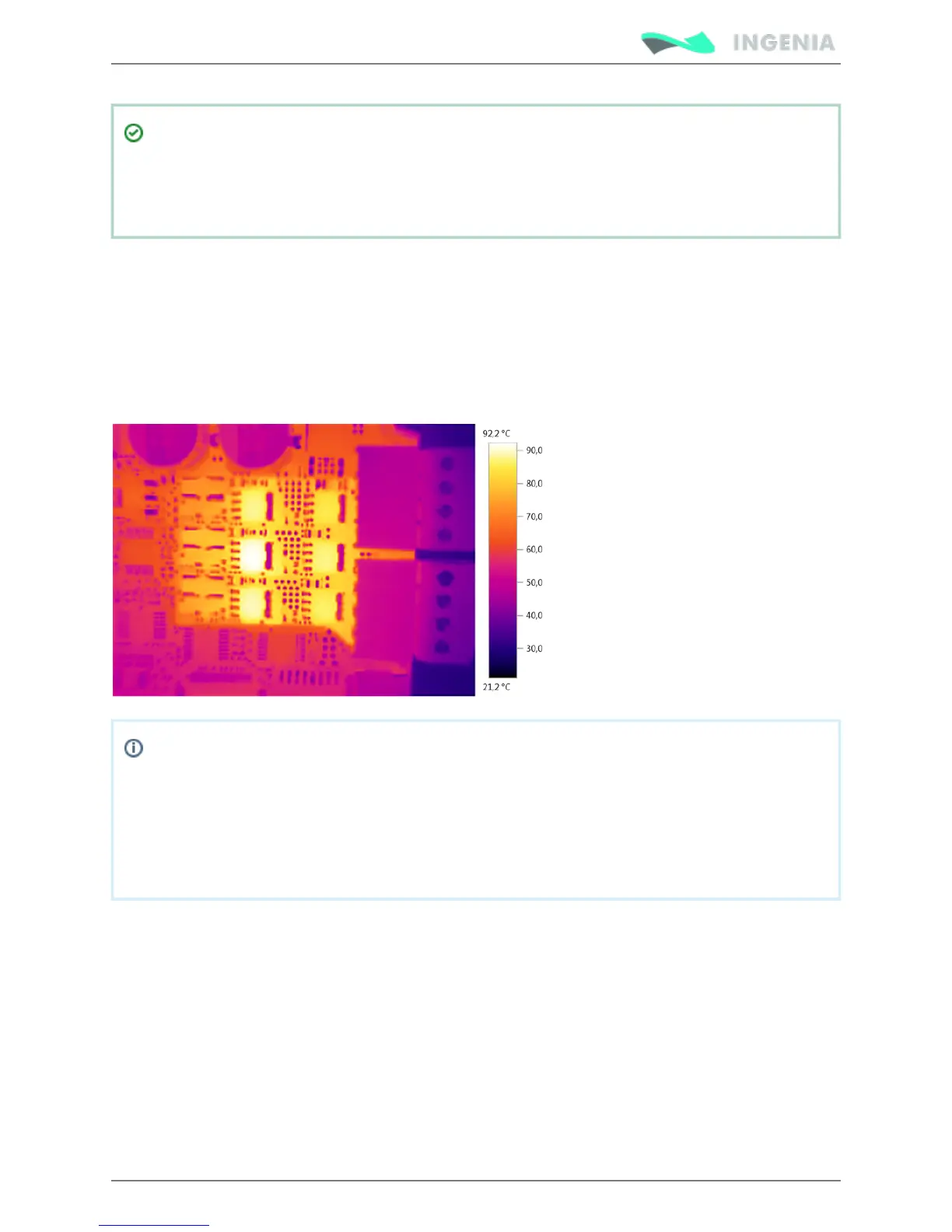
The system temperature is measured near the power stage. Between power phases. The temperature
parameter that can be accessed from USB 2.0 or CAN bus indicates the board temperature (not the air
temperature) and should not exceed 110ºC. Above 110ºC the Pluto automatically turns off the power stage
and stays in fault state avoiding any damage to the drive.
Next image shows the power stage surface at maximum load and air temperature in a 3 phase
application.
The driver is getting hot even at 0 current!
This is normal. Pluto power stage includes high power MOSFET transistors which have parasitic
capacitances. Switching them fast means charging and discharging those capacitors thousands
of times per second which results in power losses and temperature increase even at 0 current!
Recommendation: when motor is off, exit motor enable mode which will switch off the
power stage.
Dynamic application (non-constant current)
The Pluto has a big thermal inertia that allows storing heat during short current pulses (exceeding nominal
current) without causing an over temperature.
This allows achieving high peak current ratings without need of additional heatsink.
Easy approach (quadratic mean of current)
For most systems where the cycle time is shorter than 3 τ (thermal time constant) the current can be
calculated as the quadratic mean of the current during the full cycle.
The load cycle can be simplified as different constant currents during some times:



 To Next Page